
Q-Agent Fixes Blurry, Hazy, Noisy Photos 4x Faster Than Rival AI
A new image restoration agent uses chain-of-thought reasoning and no-reference quality metrics to pick the best fix order, beating all-in-one models by 1.7 dB PSNR.
 Pro
Takeaways
- Q-Agent uses a fine-tuned Qwen2-VL-7B plus chain-of-thought to detect each image degradation one at a time.
- A greedy loop guided by five no-reference quality metrics picks the best next restoration tool at each step.
- Beats ten All-in-One models on Q-Degrade, leading by 1.7 dB PSNR (22.58 vs 20.81).
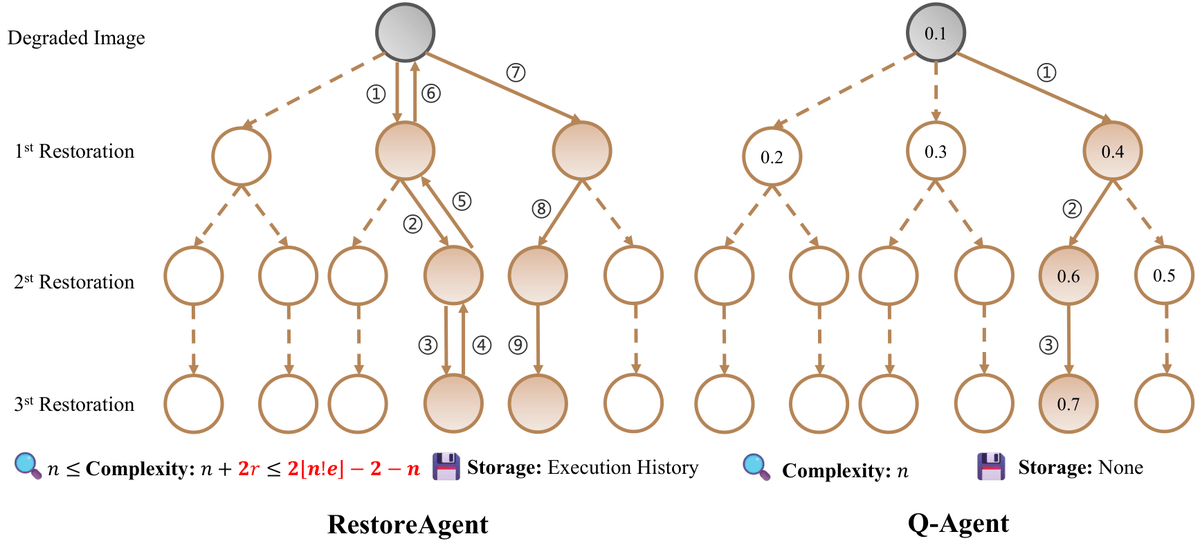
- Runs at 21 seconds per image versus 93 for RestoreAgent, with linear complexity in degradation count.
- New Q-Degrade dataset: 100,000 images with up to four ordered degradations from eight types.
- Beam search variant lifts PSNR to 23.71 but limitation remains: greedy path can hit local optima.
Real-world photos rarely suffer from a single, clean problem. A phone shot from a moving car at dusk can mix motion blur, sensor noise, low light, JPEG compression, and haze all at once. That combination has been a headache for image restoration research, because the two dominant approaches each fail in a different way. A new paper introduces Q-Agent, a multimodal-LLM-driven agent that identifies each degradation separately and then uses image quality scores to decide, greedily, which fix to apply next.
Why current fixes keep breaking
The image restoration literature has split into two camps. Task-specific models handle a single degradation well but stumble when several appear together. All-in-One models train one network to handle everything, then trade away peak quality on any individual problem and struggle when a real image contains a combination that was not in the training distribution.
Agent-based approaches try to combine both strengths by having a multimodal LLM (MLLM) look at the image, decide what is wrong, and then call specialized restoration tools. Two problems have held them back. MLLMs perceive degraded images poorly, especially when multiple defects overlap. And existing agents like RestoreAgent use a rollback search to discover the right tool sequence, which becomes expensive as the number of possible degradations grows.
Order matters more than you might expect. Denoising a hazy image and then dehazing it produces a different result than dehazing first and denoising second, because each restoration step reshapes the noise pattern the next step sees.
