
Purdue's TacVLA Teaches Robots to Feel, Boosting Blind Picking by 60%
A tactile-aware extension of Pi0.5 selectively activates touch tokens only during physical contact, boosting disassembly success by 20% and in-box picking by 60%.
 Pro
Takeaways
- TacVLA extends Pi0.5 with a compact tactile array and a gate that activates touch tokens only during contact.
- 15x8 tactile array is compressed to 36 tokens via a lightweight MLP, keeping transformer overhead minimal.
- Disassembly success climbs from 63.75% to 83.75%; in-box picking jumps from 10% to 70%.
- Under blocked front camera, average success roughly doubles from ~30% to over 60%.
- Ablation shows unconditional tactile fusion can hurt performance versus no tactile at all.
- Fine-tuned via LoRA on OpenPI pi05_base; code release promised, videos at the project page.
Vision-language-action (VLA) models are getting good at watching a scene and translating instructions into robot motion, but they still tend to fumble the moment the camera view gets obscured or a task needs finger-level force feedback. A team from Purdue and Istituto Italiano di Tecnologia is trying to close that gap with TacVLA, a fine-tuned VLA that folds a tactile sensor into the transformer policy and, crucially, only listens to it when the robot is actually touching something.
The core proposal is a contact-aware gating mechanism that selectively activates tactile tokens only when contact is detected, enabling adaptive multimodal fusion while avoiding irrelevant tactile interference. On four constraint-locked disassembly tasks and a blind in-box picking task, TacVLA reports an averaging 20% success rate improvement in disassembly, 60% in in-box picking and 2.1x improvement in scenarios with visual occlusion.
Why vision and language alone hit a wall
Modern VLAs like OpenVLA and Pi0.5 rely almost entirely on cameras and text prompts. That works for pick-and-place, but breaks down in two situations the paper zeroes in on: severe visual occlusion (the gripper or object blocking the camera, or reaching into a dark box), and contact-rich fine motor tasks where forces, friction, and slip matter more than pixels. Prior tactile-augmented policies exist, but most treat tactile readings as image-like inputs, inflating token counts and forcing the model to attend to touch even when the gripper is nowhere near the object.
TacVLA takes a different approach on two fronts: it tokenizes touch compactly, and it gates when touch is even allowed into the attention computation.

How the architecture is wired
The backbone is a fine-tuned Pi0.5 with an action expert trained under a flow-matching objective. Around it, the authors bolt on four pieces:
- Vision encoder: a SigLIP encoder processes RGB from a front-facing and a wrist-mounted camera.
- Language and proprioception: tokenized with the PaliGemma tokenizer.
- Tactile encoder: a 15x8 tactile array (120 taxels) is projected through a lightweight MLP into just 36 tactile tokens, with 2D sine-cosine positional embeddings preserving spatial structure.
- Contact-aware gating module: the piece that decides whether those tactile tokens participate in attention at all.
The gating rule is intentionally simple. A binary flag c_t is set to 1 only when the number of taxels exceeding a pressure threshold crosses a fixed count. When c_t = 0, the tactile tokens are zeroed and masked out of the attention prefix, so they cannot cross-attend with visual or language tokens. When contact fires, the tactile stream joins the party. By preserving a fixed token topology while enabling state-dependent modality routing, the proposed module allows tactile information to influence policy decisions only when physically informative.
Training uses LoRA on top of the pi05_base checkpoint from OpenPI for 10,000 gradient steps, with the tactile encoder frozen.
The tasks: disassembly and reaching into a box
Evaluation runs on a 7-DoF Franka Emika Panda with parallel grippers and a tactile array adapted from 3D-ViTac mounted on a fingertip. Four disassembly tasks require different contact strategies: pulling from a tight shaft, pressing a clip, twisting 90 degrees before pulling, and sliding then pulling. The in-box picking task is the harder one for vision: the front camera cannot see inside the box at all, and the wrist camera struggles with lighting and occlusion.

Each task got 50 human teleoperation demonstrations, with all modalities recorded at 10 Hz and temporally aligned.
The numbers
Across the four disassembly tasks, TacVLA hits an 83.75% average success rate against 63.75% for fine-tuned Pi0.5, 48.75% for image-based Diffusion Policy with tactile input, and 31.25% for 3D Diffusion Policy. The biggest jump shows up on Task 4 (slide pull), where TacVLA improves by 45 percentage points, going from 30% to 75%. The authors note that the Pi0.5 baseline frequently becomes stuck in intermediate states and attempts repeated re-grasping, indicating uncertainty in contact dynamics, while TacVLA handles contact transitions more stably.
The in-box picking result is where the tactile advantage really shows. Fine-tuned Pi0.5 lands at 10%; TacVLA reaches 70%. Diffusion policy baselines essentially fail (0% and 5%). Qualitatively, TacVLA explores inside the box, re-grasps when it slips, and only commits to lifting after physical contact is confirmed.
Gating matters more than you'd think
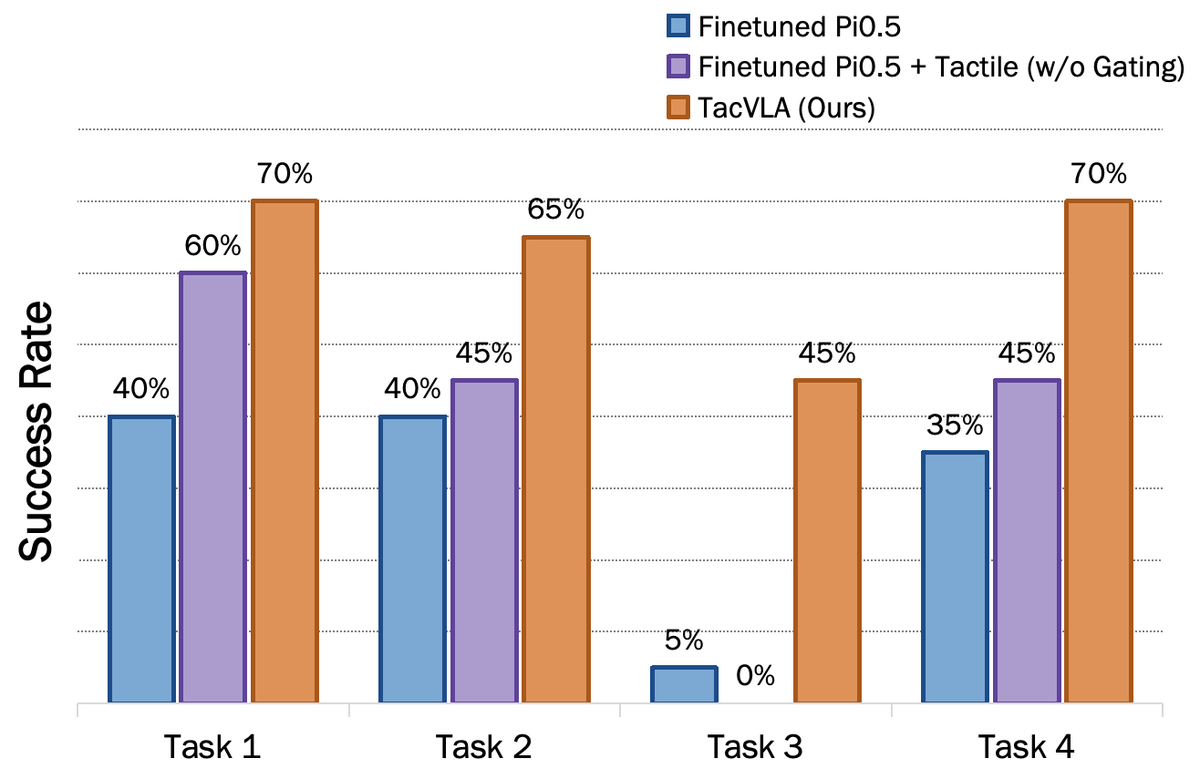
The ablation is the most interesting part. Strip out the contact-aware gate and just concatenate tactile tokens unconditionally, and average disassembly performance drops from 83.75% to 71.25%. On Task 3, the no-gating variant (60%) actually underperforms the pure-vision Pi0.5 baseline (65%). In other words, dumping tactile tokens into the attention prefix during non-contact phases can actively hurt visual localization before the gripper reaches the object.
Under a blocked front camera, TacVLA lifts the average from around 30% for pure-vision Pi0.5 to over 60%, and removing gating cuts about 25 percentage points off that gain. The gate isn't just an efficiency trick, it's what keeps tactile from polluting the representation during the reach phase.
What it's good for, and what it isn't
The practical sweet spot is short-horizon, contact-heavy work: insertion, disassembly, retrieval from cluttered or occluded spaces, and any manipulation where the robot needs to verify a grasp haptically before committing. It also improves robustness to runtime disturbances - in one test, a human operator drops the object back into the box mid-task, and TacVLA detects the change, returns, re-grasps, and continues, whereas the vision-only baseline gives up.
The limitations are honestly stated. The gate is a hand-tuned binary threshold rather than a learned soft weighting, the sensor has limited spatial resolution so fine geometric reasoning through touch alone is out of reach, and the evaluation stays within short-horizon tasks. Extending this state-dependent routing to long-horizon plans is left for future work.
The authors say code will be released, and task videos are already up on the project site. For anyone working on contact-rich policies built on Pi0.5 or similar OpenPI checkpoints, the takeaway is that adding touch is not just about wiring in a sensor - deciding when to let it speak may matter as much as the sensor itself.