
Purdue's SAATT Nav Lets an LLM Drive Wheelchairs and Explain Every Decision
A Purdue team wraps a language model around a wheelchair's local planner so it can reason about pedestrian intent and explain every move in plain text.
 Pro
Takeaways
- SAATT Nav wraps an LLM around a wheelchair's local planner to predict pedestrian intent and explain each move in text.
- Three-stage pipeline: LLM hypothesis generator, rollout scorer, rule-based motion planner, with periodic and risk-based triggers.
- LLM labels each pedestrian as yield, rush, or constant velocity, plus a natural-language rationale per waypoint.
- Beats A*, Social Force Model, and no-LLM ablation on safety and social-bubble compliance across 360 simulated trials.
- A* remains faster and smoother because it cuts through conversational groups instead of routing around them.
- Evaluated only in a 2D simulator with up to two pedestrians; no code or model weights released.
Powered wheelchairs solve the fatigue problem of manual chairs, but they trade physical strain for mental strain. Every doorway, hallway, and crowd becomes a stream of micro-decisions the user has to process, plan, and execute. A new framework from Purdue called SAATT Nav tries to hand that cognitive load to a language model, and, importantly, make the model explain itself as it drives.
The load nobody talks about
Roughly 80 million people worldwide use a wheelchair, a population growing as medical advances improve survival across age groups. Even with a joystick doing the muscle work, neuroimaging studies using fNIRS show that navigating cluttered environments increases prefrontal cortex activation, reflecting higher attentional and executive demands that contribute to fatigue and performance degradation over time.
Prior autonomous wheelchair work has pushed on either social awareness (LiDAR-based proxemics, user preference fields) or on transparency (floor projections that show where the chair is about to go). Existing transparent systems only communicate what the wheelchair will do, not why. SAATT is an attempt to close both gaps with one component: an LLM that predicts what the humans around the chair are about to do and narrates its own reasoning.
How the framework actually runs
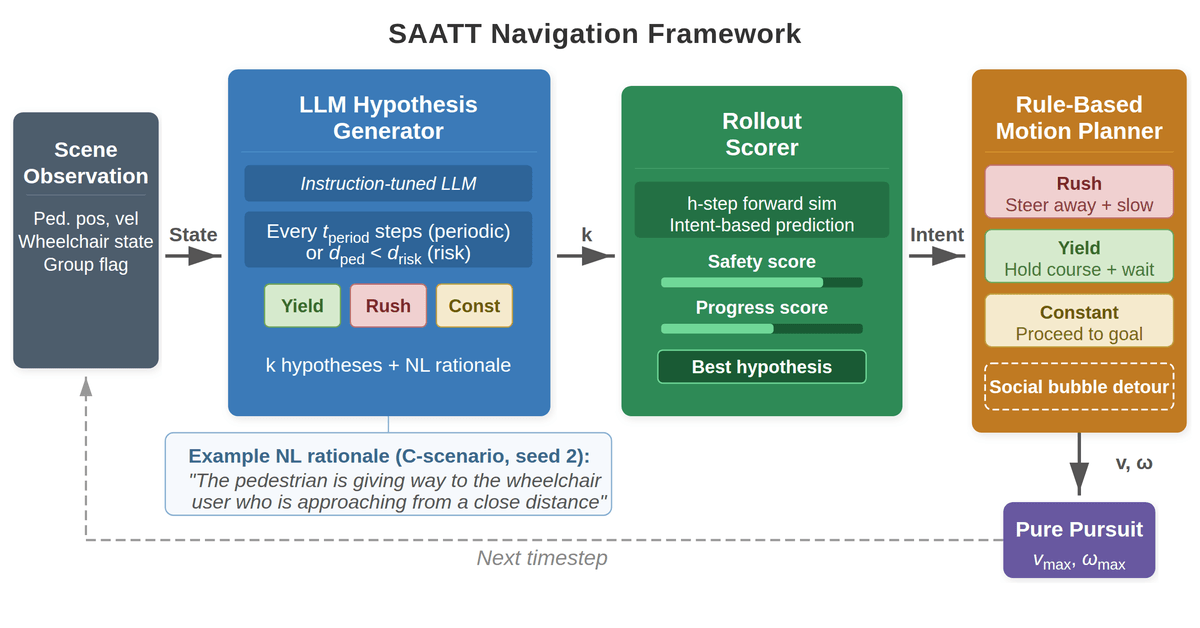
The pipeline has three stages. An LLM-based hypothesis generator produces a finite set of pedestrian intents based on wheelchair and pedestrian states, obstacles, and goal position. Each hypothesis labels every visible pedestrian with predicted behavior and pairs it with a natural language rationale. A rollout-based scorer simulates each hypothesis forward over a fixed horizon to evaluate safety and progress. The highest-scoring hypothesis is passed to a rule-based motion planner.
The LLM isn't called on every tick. It fires on a schedule or when someone gets close: a periodic trigger invokes it every t_period steps to maintain situational awareness, while a risk trigger fires when any pedestrian falls within a distance threshold to reduce reaction latency. Each call produces up to eight hypotheses that tag each pedestrian as yield, rush, or constant velocity, plus the reasoning behind the choice.
The scorer then rolls each hypothesis forward for 30 timesteps, scaling pedestrian velocities by 0.2 for yield and 1.5 for rush to make the trajectories visibly different. Safety is weighted twice as heavily as progress in the final ranking. The winning hypothesis feeds a pure pursuit controller that slows or steers around people based on the predicted intent.
The socially interesting bit is group detection. When two or more stationary pedestrians are found in close proximity, the planner computes a detour around the group's social bubble, centered at the midpoint of the two pedestrians with a radius that includes the pedestrian radius, personal space margin, and group space margin. Even when the physical gap between the two pedestrians is wide enough to pass through, the planner treats the conversational space as a unified social zone and routes around it. This is the F-formation idea from human interaction research: don't walk between two people talking.
The benchmark
Testing happened in a custom 2D Python simulator, a 10m by 10m space with a differential-drive wheelchair capped at 1.5 m/s. Three scenarios were run across four methods: SAATT, A* as a shortest-path baseline, a Social Force Model (SFM) baseline inspired by the Helbing and Molnár framework where each pedestrian exerts an exponentially decaying repulsive force, and an Ablation that uses SAATT's rule-based planner with the LLM disabled.
- Scenario A: empty corridor, sanity check.
- Scenario B: two stationary pedestrians in a face-to-face F-formation.
- Scenario C: a pedestrian crossing the path at 0.4 to 0.8 m/s.
Each scenario was run with 30 random seeds across all four methods, for 360 total trials, and evaluated on eight metrics grouped under Safety, Social Compliance, Efficiency, and Comfort.
Where SAATT wins and where it doesn't

SAATT had the fewest collisions in both Scenario B and C, and the largest minimum pedestrian distance in both scenarios as well. On social compliance, the wheelchair spent the least timesteps in the social bubble compared to the other three methods.
Efficiency is where the tradeoff shows. A* completed trajectories in the shortest time for Scenarios B and C because it ignored social situations, while SAATT took them into consideration. A* cuts straight between the two people talking; SAATT goes around them. On comfort, A* achieved the lowest Mean Jerk for all scenarios, though the absolute differences were small enough that the authors note they may be negligible in practice.
The ablation comparison is the most useful signal for whether the LLM is actually doing work. SAATT differed from the Ablation across all metrics in Scenario B and specifically in Safety for Scenario C, and since the only difference between the two is the LLM's intent prediction, that supports that intent-prediction influences the decisions.
Why the transparency piece matters
Alongside the trajectory, the LLM emits a message at each waypoint explaining its reasoning: which pedestrian it's yielding to, why it's detouring around a pair, and so on. The intellectual grounding here is that research in social sciences shows people prefer selective, cause-focused explanations over exhaustive causal chains. The paper does not include a human-subjects study of the explanations yet, so the transparency claim is qualitative for now.
The honest limits
A few caveats worth flagging before anyone gets excited:
- The evaluation is entirely in a 2D simulator with at most two pedestrians per scene. Real crowds, doorways, and elevators are not tested.
- SAATT currently treats humans as repellent forces, which does not fit cases where the user actually wants to approach someone.
- No code or model checkpoints are released with the paper. The framework is described in enough detail to reimplement, but there is no public repository.
- LLM inference latency is acknowledged as an open problem for on-device deployment.
The interesting piece for anyone building assistive or social robots is the pattern itself: use an LLM as a slow, high-level intent estimator that scores hypotheses forward-simulated by a cheap classical planner, rather than putting the LLM inside the control loop. It's a reasonable template for wrapping language models around existing motion stacks without paying inference cost on every timestep, and it gives you natural-language explanations essentially for free. Whether that's enough to earn user trust in a real hallway is the next study to run.