
Purdue's McVAMP Plans Humanoid Robot Motion 1000x Faster on a CPU
A new SIMD-accelerated planner from Purdue's CoMMA Lab drops humanoid constrained motion planning from tens of seconds to milliseconds, enabling reactive whole-body control.
 Pro
Takeaways
- Purdue's McVAMP plans manifold-constrained motions in milliseconds, 100 to 1000x faster than prior art.
- Core trick: SIMD-parallelize the projection step that maps configurations onto constraint manifolds along an edge.
- Built on VAMP's tracing compiler, adds vectorized Levenberg-Marquardt with custom branchless Cholesky solve.
- Demonstrated on a real 28-DoF Digit humanoid transporting boxes with balance, feet, and bimanual constraints.
- Reactive replanning under 40 ms lets the humanoid dodge dynamic obstacles mid-trajectory.
- Open-source code available as a branch of the VAMP library.
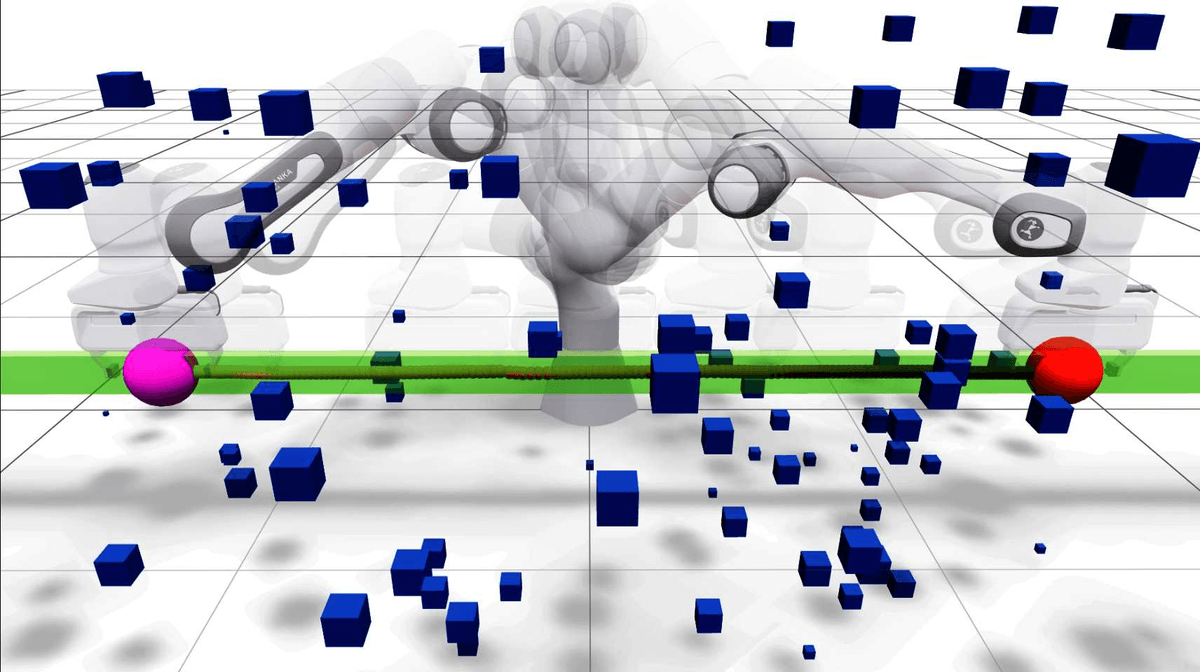
Getting a humanoid robot to walk across a room is one thing. Getting it to carry a box between three shelves while keeping its feet planted, its balance intact, both hands locked on the payload, and its knees respecting closed-loop mechanical linkages, all while dodging an obstacle that just appeared, is another problem entirely. Planning that kind of motion has typically taken tens of seconds. A new paper from Purdue's CoMMA Lab claims to do it in under 12 milliseconds.
The system, called McVAMP (Manifold-Constrained Vector Accelerated Motion Planner), takes an old idea from robotics research and rewrites it to exploit CPU SIMD instructions. The approach reports 100x to 1000x speedups over prior state-of-the-art planners, making real-time constrained motion planning feasible on commodity hardware. The code is open source as a branch of the existing VAMP library.
The projection bottleneck
Manifold-constrained motion planning is the general form of problems where a robot needs to satisfy geometric conditions across an entire trajectory, not just at the endpoints. Consider a robot carrying a mug of water: the container must stay upright at every point along the path. Mathematically, each such constraint carves a lower-dimensional surface (a submanifold) out of the robot's configuration space, and the planner has to find a collision-free path that stays glued to that surface.
The classical approach, dating back to Berenson et al.'s CBiRRT2, is projection: sample a random configuration, use the constraint's Jacobian to iteratively push it back onto the manifold, then repeat for every point along every candidate edge. Beyond collision checking, the main cost sits in the manifold-constrained extension step, which traces a geodesic between configurations on the manifold. McVAMP tackles this by fine-grained parallelization of the projections that build up that geodesic.