
Purdue's H-NTFields Beats Neural Motion Planners With 90% Success in 19-Room Homes
H-NTFields merges sparse roadmap hints with physics-based PDE losses, hitting 90.8% success on Gibson scenes where prior neural planners stall.
 Pro
Takeaways
- H-NTFields adds sparse-roadmap weak supervision to physics-informed NTFields for robot motion planning.
- Roadmap gives upper and lower travel-time bounds; PDE losses handle local obstacle geometry.
- Hits 90.8% success on 18 Gibson houses versus 27% for NTFields and 77% for TD-NTFields.
- Sample efficient: 50k pairs match what prior methods need 200k to approach.
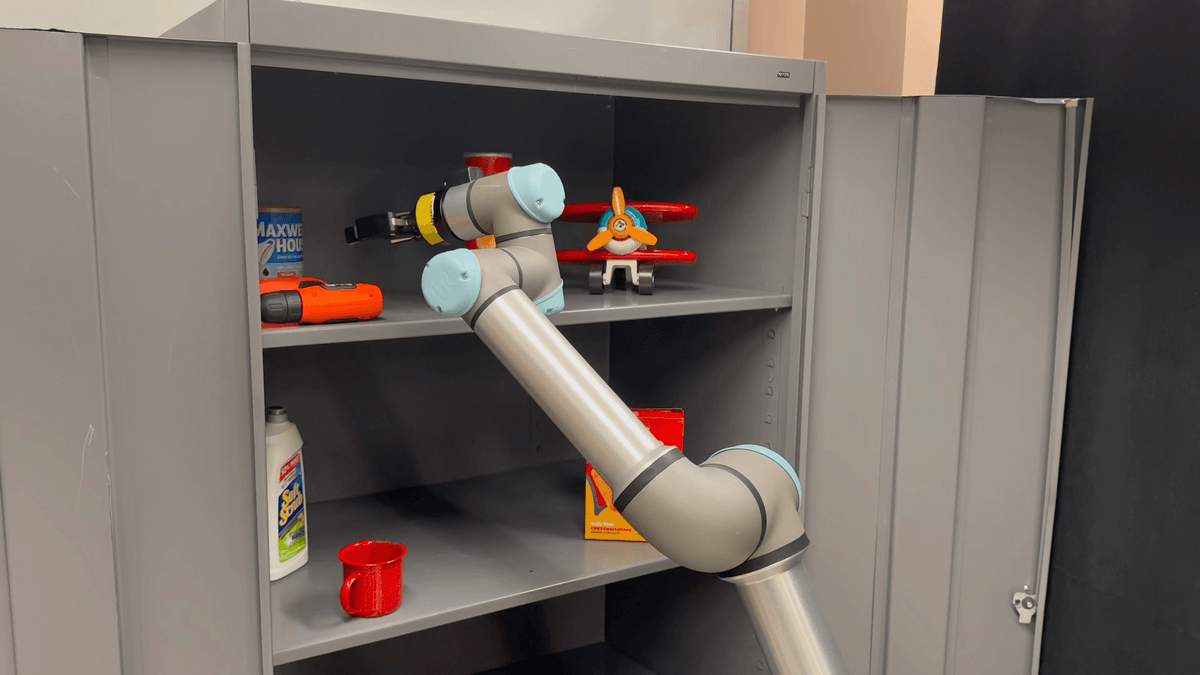
- Demonstrated on UR5e arm cabinet task and Unitree B1 quadruped kitchen pick-and-place.
- Trained per scene; cross-scene generalization remains open, no code link in paper.
Motion planning has a stubborn scaling problem. Sampling-based classics like RRT and PRM come with clean theoretical guarantees but slow down in high-dimensional or cluttered spaces. Learning-based planners promised amortized inference, but the physics-informed variants that avoid expert demonstrations keep breaking down the moment you ask them to plan across more than one room. A new paper from Purdue proposes Hierarchical Neural Time Fields (H-NTFields), a hybrid that fixes the long-horizon failure mode by mixing a sparse roadmap with PDE regularization.
Where neural planners kept falling over
The lineage starts with NTFields, which reframed motion planning as solving the Eikonal equation, a first-order non-linear PDE whose solution represents the shortest arrival time from a source to a destination under a pre-defined speed model. The trick is that the speed slows down near obstacles, so the travel-time function naturally encodes collision avoidance and acts like an optimal value function. Follow-ups like P-NTFields and TD-NTFields added viscosity terms and temporal-difference losses to sharpen the solution.
PDE regularization only gives you local geometric consistency. In a Gibson house with 19 rooms and three floors, PDE supervision alone cannot reliably propagate information over long horizons, often leading to local minima or underestimated travel times. Throwing more samples at the problem does not fix it. Supervised alternatives could inject global structure, but they need dense roadmaps or expert demonstrations that are prohibitively expensive to generate in high-dimensional spaces.