
Purdue's DiDi-Instruct Beats GPT-2 Quality in Just 8 Denoising Steps
A new distillation method squeezes diffusion language models into 8-128 denoising steps while beating GPT-2 perplexity and delivering 64x acceleration.
 Pro
Takeaways
- DiDi-Instruct distills masked diffusion LLMs into 8-128 step students that beat GPT-2 and the teacher on OpenWebText.
- Achieves perplexity from 62.2 at 8 NFEs down to 18.4 at 128 NFEs with 64x inference acceleration.
- Trained on a single H100 in about one hour, over 20x less wall-clock time than SDTT or DUO distillation.
- Uses integral KL divergence minimization with a policy-gradient formulation and an adversarial discriminator as reward.
- Adds grouped reward normalization, intermediate-state matching, and a Reward-Guided Ancestral Sampler for stability.
- Extends to protein sequence generation with DPLM, clearing pLDDT>70 in 8-32 NFEs; code available.
Diffusion language models keep threatening to unseat autoregressive giants, but the catch is always the same: they need hundreds of denoising passes to produce clean text. A team from Purdue, UT Austin, UT El Paso, NUS, Xiaohongshu, and Morgan Stanley just released DiDi-Instruct, a distillation recipe that collapses those passes into as few as eight while actually improving quality. The code is on GitHub, and the numbers are hard to ignore.
Why diffusion text models keep hitting a wall
Autoregressive LLMs generate tokens left-to-right, which caps throughput no matter how many optimizations you stack on top. Masked diffusion language models (dLLMs) reinterpret generation as iterative denoising over a fully masked sequence, letting many tokens be predicted in parallel with bidirectional attention. The problem is quality-per-step: on OpenWebText, dLLMs still need up to 256 NFEs to match the performance of a GPT2 model when generating sequences of length 1024, where NFE stands for the number of neural network forward passes.
Prior attempts to distill dLLMs into few-step generators, such as SDTT and DUO, mostly borrowed tricks from continuous diffusion. Existing distillation methods are motivated by heuristic design choices, lacking well-established theoretical justification, and empirically none of them could match GPT-2 quality within 32 NFEs.
The trick: minimize an integral KL divergence
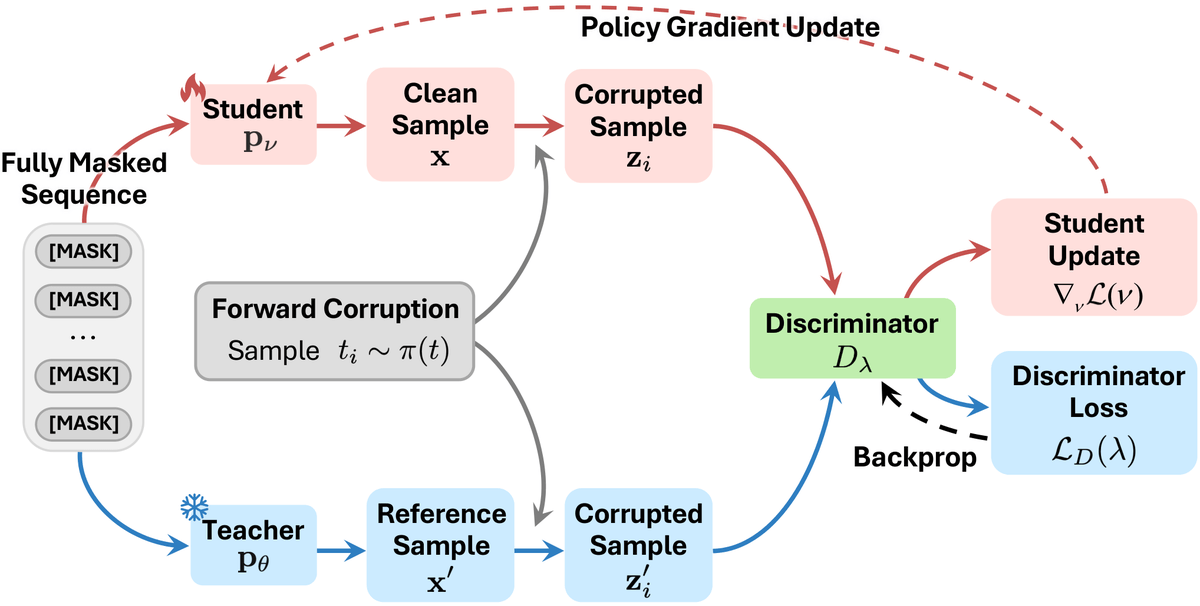
DiDi-Instruct reframes distillation as distribution matching across every noise level. The learning objective of DiDi-Instruct is to minimize the Integral Kullback-Leibler (IKL) divergence, introduced by the seminal work of Luo et al. (2023b) for the continuous diffusion model. The IKL integrates KL between the student and teacher marginals over the whole denoising time interval, so the student learns to mimic the teacher's behavior everywhere along the corruption schedule, not just at the endpoints.
Applying this idea to masked diffusion is not trivial. The forward corruption process involves discrete, non-differentiable operations, so you cannot just backpropagate through sampled tokens. The authors solve this with a policy-gradient reformulation: the IKL gradient becomes a score function weighted by a reward, where the reward is the log-density ratio between student and teacher marginals. That ratio is intractable to compute directly, so they train an adversarial discriminator to estimate it, GAN-style. With an adversarial language discriminator to estimate the log-density ratio (reward) between the teacher dLLM and the student, we introduce a practical DiDi-Instruct algorithm that trains the few-step student, accompanied by an assistant discriminator.

Three stabilizers that make it actually train
Adversarial density-ratio estimation is notoriously unstable, so DiDi-Instruct layers on several tricks. Their ablations show each one is load-bearing:
- Grouped reward normalization. Borrowed from GRPO-style RL, they standardize rewards within each mini-batch using the group mean and standard deviation, taming the high variance of score-function gradients.
- Intermediate-state matching (score decomposition). Instead of forcing the student to jump straight from a fully masked sequence to clean text, the gradient is decomposed through a randomly sampled intermediate corruption level. Without this, training collapses catastrophically, with perplexity above 30,000 in their leave-one-out ablation.
- Reward-Guided Ancestral Sampler (RGAS). At inference time, the discriminator is reused to bias sampling. Early denoising steps use gradient tilting toward high-reward regions; late steps switch to multi-candidate re-ranking. Together these cut perplexity by roughly 30 percent versus vanilla ancestral sampling.
- Warm starts. Both the student and the discriminator are initialized from the pre-trained teacher, and the discriminator gets a warm-up phase while the student stays frozen.
The numbers
The teacher is a 169M-parameter masked diffusion transformer pre-trained on OpenWebText, which hits perplexity 38.53 at 1024 NFEs. DiDi-Instruct is distilled on a single H100 in about an hour. On OpenWebText, DiDi-Instruct achieves perplexity from 62.2 (8 NFEs) to 18.4 (128 NFEs), which outperforms prior accelerated dLLMs and GPT-2 baseline. These gains come with a negligible entropy loss (around 1%) and reduce additional training wall-clock time by more than 20x compared to competing dLLM distillation methods.
A few results worth flagging:
- At 16 NFEs, the student already beats its 1024-step teacher on perplexity.
- At 1024 NFEs the distilled model hits 15.62 PPL, over 24 percent lower than the strongest baseline.
- On a standardized H100 benchmark, it generates 2,366 tokens per second, a 13.2x wall-clock speedup over an autoregressive model of the same size at matched perplexity.
- Training uses about one H100 GPU hour versus 20+ GPU hours for multi-round methods like SDTT.
Diversity holds up too. Entropy across 8 to 128 NFEs stays between 5.15 and 5.21, essentially matching the teacher's 5.22. MAUVE scores are the highest of any compared method and Self-BLEU stays low, suggesting the model is not just mode-collapsing to fluent-sounding sludge.
It generalizes past English text
The authors scale the recipe to a 424M teacher with essentially no procedural changes, and the quality-efficiency curve holds. They also apply DiDi-Instruct to the Diffusion Protein Language Model, a 150M protein sequence model pre-trained on UniRef50. The distilled student retains the teacher's ability to generate variable-length protein sequences while substantially reducing inference cost and clears the pLDDT > 70 high-confidence threshold with as few as 8 to 32 NFEs, where the teacher needs many more steps to reach the same structural quality.

When to reach for it
DiDi-Instruct is most useful if you have a pre-trained masked diffusion model and want cheap inference without sacrificing quality. The tradeoffs to be aware of:
- You need three models in memory during training: teacher, student, and discriminator. The authors flag this as the main obstacle to scaling to billions of parameters.
- The regularization terms that stabilize the 8-NFE regime actively hurt at higher NFE budgets, so you tune them per target step count.
- The current release is aimed at unconditional generation and downstream fine-tuning; chat-style instruction following is not yet demonstrated.
For anyone working on diffusion LLMs, the appeal is that this is a single-stage, principled distillation method that finally beats GPT-2 quality below 32 steps, with training that fits on one GPU for a day's work. The full training and RGAS inference code is available in the official repository, and the project page has additional visualizations of the pipeline.