
Purdue and Rice's VIZ-COAST Lets Robots Plan Smarter With Zero Geometric Failures
VIZ-COAST uses vision-language models to predict geometric constraints before planning starts, cutting task-and-motion planning failures and speeding up long-horizon robot problems.
 Pro
Takeaways
- VIZ-COAST uses VLMs to predict TAMP constraints before planning, avoiding costly refinement failures.
- Constraints are emitted as Python code targeting a Z3 SMT-based task planner, keeping PDDL descriptions clean.
- On the Blocks domain, initial constraints generalized to all 30 test problems with zero refinement failures.
- On Containers, VIZ-COAST solved every problem while COAST+FD failed on all instances.
- A feedback loop lets the VLM revise constraints across multiple failed problems, critical for the Packing domain.
- Gemini 3 Flash produced correct constraints in about 15 seconds, beating slower GPT-5.2 configurations.
Task and motion planning (TAMP) is the engine behind robots that clear cluttered tables, pack boxes, or navigate multi-step chores. It works by splitting reasoning into two layers: a symbolic task planner that decides what to do, and a motion planner that figures out how to actually move the arm. The catch is that the symbolic layer throws away geometry, so a plan that looks perfectly valid on paper can collapse the moment the motion planner tries to execute it. A new paper from Purdue and Rice, Using VLM Reasoning to Constrain TAMP, proposes to fix this by letting a vision-language model look at the scene first and warn the planner about what will not work.
The downward refinement headache
The core issue has a name: downward refinement failure. A valid task plan may not correspond to any feasible sequence of motion plans. A classic example is a plan that says pick(block1) when another block sits along the only approach vector the gripper can use. The abstraction has no way to represent that, so the planner happily commits and only discovers the problem after motion planning fails.
Prior systems handle this reactively. IDTMP formulates planning through Z3, an SMT solver, incrementally adding constraint clauses upon failure. COAST, a plan-first successor to PDDLStream, adds auxiliary predicates and entities to directly encode constraints in the PDDL description. Both approaches only learn about a constraint by tripping over it, then replanning. On long-horizon problems this loop can fire ten or more times before a plan sticks.
Letting the VLM read the room first
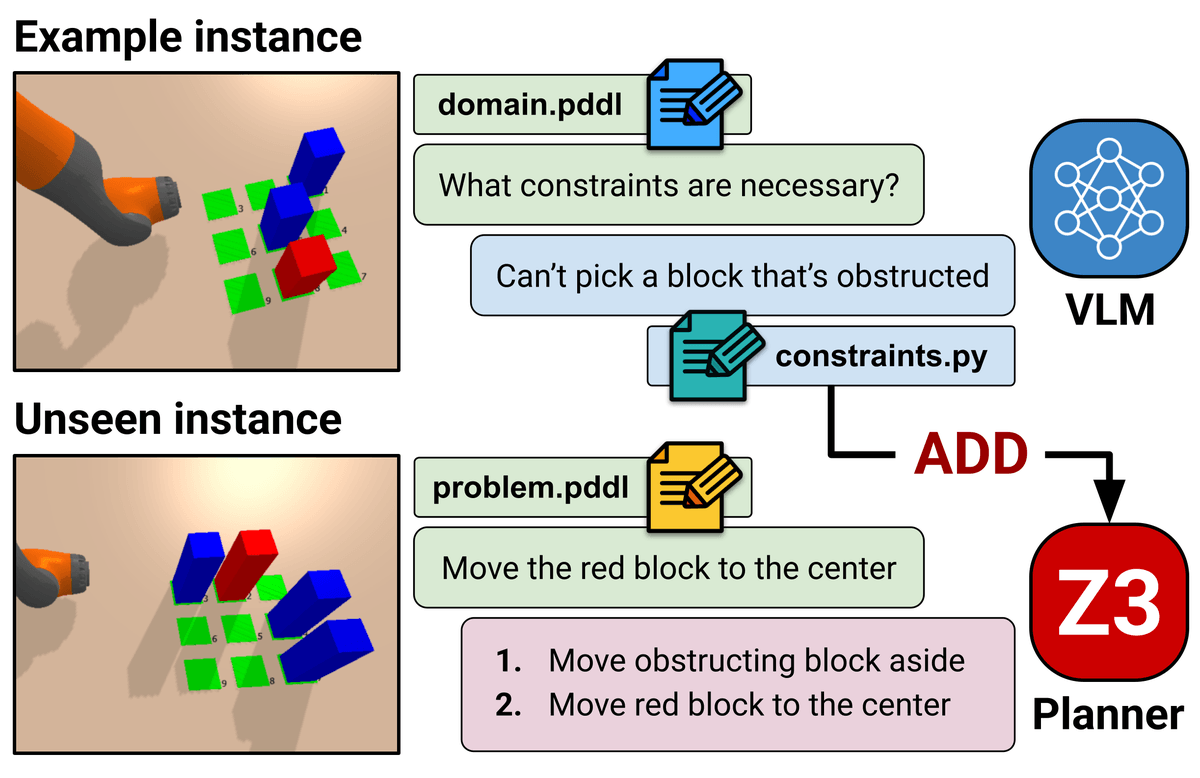
VIZ-COAST (Visual Insight for Z3-based Constraints and Streams) flips this around. Before any planning happens, a VLM inspects an image of the scene, the PDDL domain and problem description, the object geometry, and a natural-language description of how the robot grasps things. It then writes a Python file full of constraints that plug directly into a Z3-based task planner.

The pipeline has three parts:
- SMT-based task planner: Z3 with a SATPlan encoding, which lets constraints be expressed as arbitrary first-order logic through the Python API.
- Visual Reasoning Module (VRM): A two-step prompt where the VLM first identifies likely refinement issues in natural language, then translates them into Z3 constraint code.
- Stream-based grounding: Borrowed unchanged from PDDLStream and COAST for sampling continuous action parameters.
When planning still fails, the VRM enters a feedback loop. If the task planner cannot find a plan, the VLM is asked to loosen the constraints. If the constraints throw errors during application, the VLM receives the error message and debugs them. If a task plan is produced but hits downward refinement failure, the failed plan and stream sample are written to a feedback cache, a temporary state-action block is added to prevent revisiting the failed action, and planning is reattempted. After K such attempts without success, the temporary blocks are removed and the VLM analyzes the K feedback entries to revise the constraints wholesale.
Why not just replace COAST's PDDL trick?
One of the more subtle contributions is the shift away from encoding constraints inside PDDL. COAST's auxiliary constructions introduce significant search overhead, and PDDL 3.0's native constraint syntax is barely supported by mainstream planners. By encoding constraints directly in Z3, VIZ-COAST keeps the original domain description clean and lets the SMT solver do the heavy lifting.
Three domains, three failure modes
The team tested on three PyBullet manipulation domains, each engineered to expose a different geometric blind spot:

- Blocks: A 3x3 grid where a red block must reach the center, but the gripper can only approach from one direction, so any block along the approach corridor causes a collision.
- Containers: Items must go into lidded containers, but the PDDL never states that a lid must be removed first.
- Packing: Items of varied shapes must fit inside a single container so the lid still closes, which the symbolic description knows nothing about.
On Blocks, VIZ-COAST generated correct constraints on the very first call from a 2-block scene and generalized them to all 30 problems up to 7 blocks with zero refinement failures. On Containers, COAST+FD failed to find a plan for any problem instance, and COAST+Z3 only succeeded on instances with one goal predicate, while VIZ-COAST solved everything. Packing is where the feedback loop earned its keep: initial constraints were incomplete, but iterating with planner feedback pushed VIZ-COAST to 100% success on 5 and 6 item problems where COAST-based baselines timed out entirely.
Picking a VLM that pulls its weight
The paper also benchmarks nine model configurations across Gemini 3, GPT-5.2, and Qwen 3.5. Gemini models led the pack, and more reasoning budget generally meant fewer refinement failures.
| Model | Success | Prompt time (s) | Ref. failures |
|---|---|---|---|
| Gemini3-Pro-High | 100% | 94.1 | 0.00 |
| Gemini3-Flash-Low | 100% | 14.9 | 0.20 |
| GPT5.2-High | 100% | 113.7 | 0.35 |
| Qwen3.5-Flash | 85% | 56.9 | 4.59 |
Gemini-3-Flash-Low yielded fewer refinement failures on average than GPT-5.2-High despite taking roughly one-tenth of the time. Cheap fast models are viable for this task, which matters if you plan to call the VLM inside a planning loop.
What is actually new here
The headline is "VLMs help TAMP," but the deeper contribution is the division of labor. VLMs are notoriously bad at long, precise combinatorial search and quite good at looking at a scene and saying "you cannot place a block behind another block from this direction." VIZ-COAST isolates the model to that role and hands the search back to a classical SMT-based planner. The authors put it plainly: VLMs demonstrate strong geometric intuition but remain inefficient at precise search.
There are limits worth knowing. Everything runs in simulation, so real-world perceptual noise is untested. The constraints generalize within a PDDL domain but not across domains, and the pipeline currently depends on proprietary cloud VLMs. The paper does not appear to include a public code release yet, though the method is built on open components (Z3, PDDLStream, COAST) that anyone can wire together. For teams already working with plan-first TAMP frameworks, the recipe here is straightforward to adapt: swap the reactive constraint discovery for a VLM prompt over an example scene, and let the SMT solver handle the rest.