
PTB's Open-Source Neural Networks Replace Slow X-Ray Radiation Simulations
A multi-institution team releases three neural network variants, three synthetic datasets, and an open training pipeline for estimating scatter radiation fields around patients.
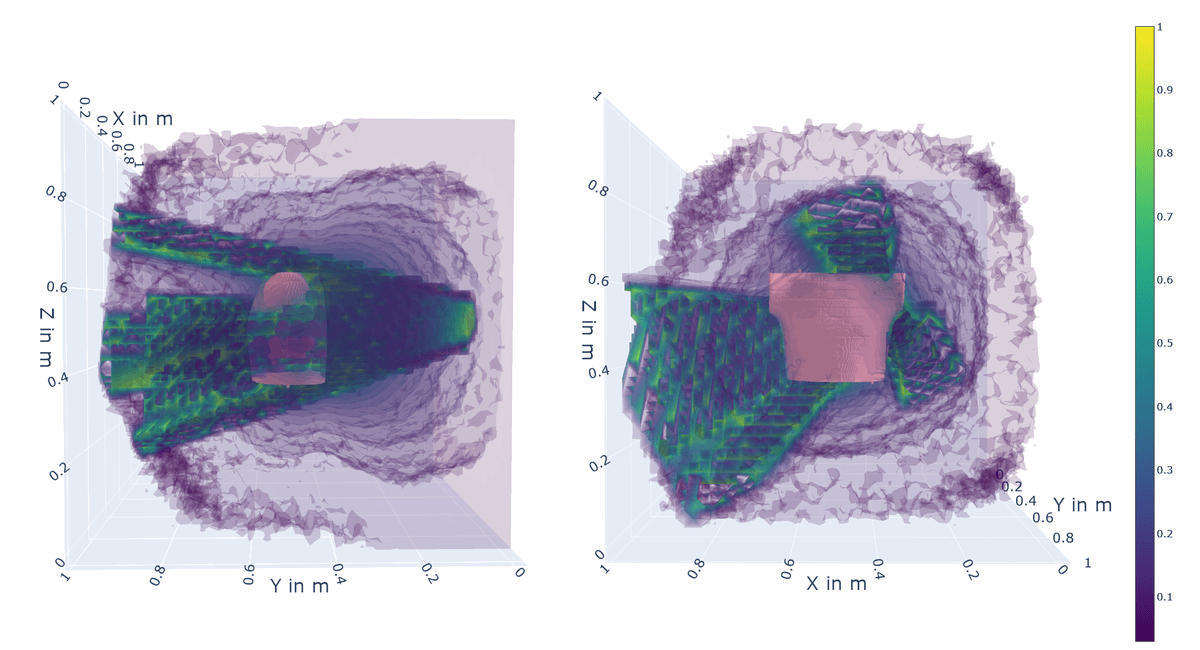
Takeaways
- Multi-institution team publishes three NeRF-inspired FCNN variants for estimating scatter radiation fields in interventional radiology
- Three open synthetic datasets generated with Monte Carlo tool RadField3D using an Alderson RANDO phantom torso
- SRBFNet, SPERFNet, and PBRFNet handle beam direction, spectrum, and tube-distance variation respectively
- Scatter-region SMAPE accuracy stays above 84% across all datasets, outperforming a 3D U-Net baseline
- Inference is around 20 ms per field on RTX 4090, interactive but not yet VR-ready without custom kernels
- Full paper plus datasets, pipeline, and code released as open source
A collaboration between Germany's national metrology institute PTB, the Belgian Nuclear Research Centre SCK CEN, TU Braunschweig, the University of New Mexico, and Leibniz University Hannover has published a paper tackling one of the more awkward corners of medical imaging: figuring out how much scattered X-ray radiation is bouncing around the room while a surgeon operates under a fluoroscope. The team presents three lightweight fully connected network variants, three synthetic training datasets of increasing complexity, and a complete training pipeline, all released as open source.
The authors propose surrogate neural networks as a replacement path for Monte Carlo radiation transport, publishing the ingredients (datasets, architectures, metrics) that the community needs to build on, and documenting which design choices actually worked.
Why Monte Carlo falls short
In interventional radiology (IR), clinicians operate close to the patient while fluoroscopy is running, and the radiation field around them is highly inhomogeneous. Personal dosemeters suffice for spatially homogeneous distributions but inherently misestimate doses in inhomogeneous fields. The workaround is computational dosimetry, which uses Monte Carlo Simulation (MCS) to track photon transport through the room.
Speed is the bottleneck. Existing MCS codes for radiation transport lack the throughput for real-time calculations, a limitation that also affects the software used for Virtual Reality (VR) or Augmented Reality (AR) training. A full-field simulation for an IR scene can take tens of seconds at best and hours in the worst case. VR training rigs that could teach medical staff radiation awareness need frame budgets on the order of 8 to 11 ms to hit 90 to 120 fps without perceptual lag, so today they render radiation using simplified deterministic approximations.