
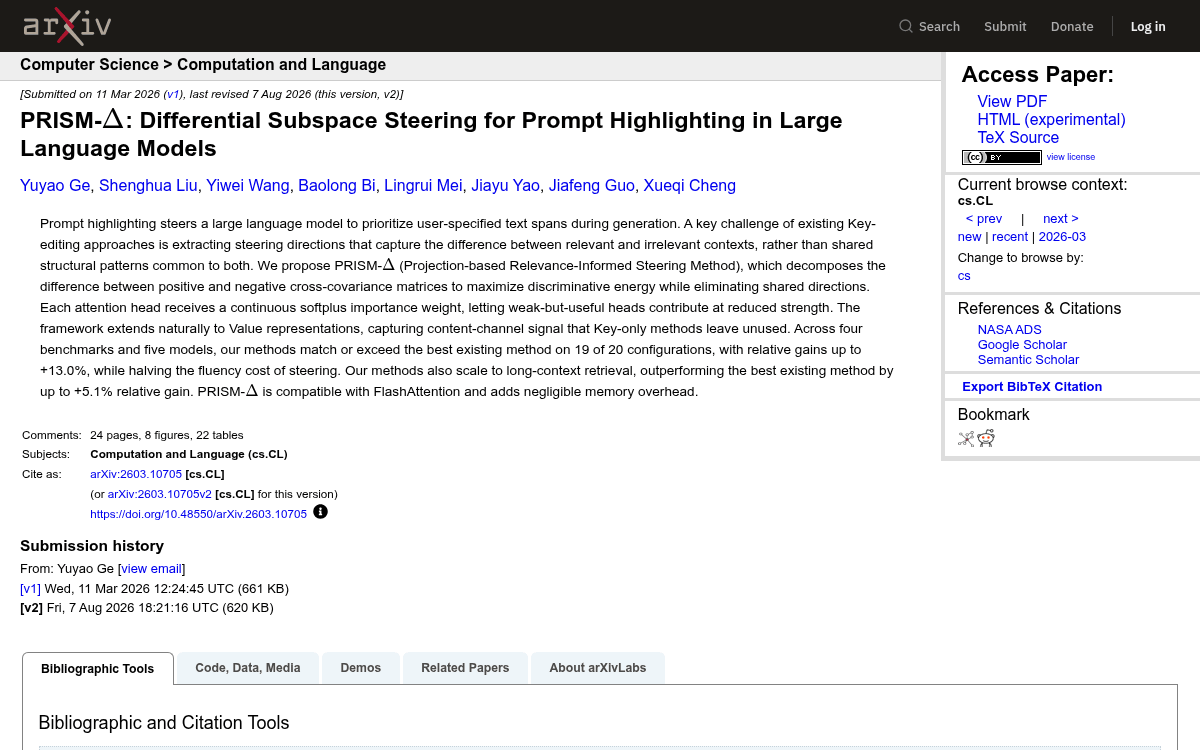
PRISM-Δ Beats Prior Attention Methods on 19 of 20 AI Benchmarks
A new attention steering method edits both Key and Value channels to boost prompt highlighting accuracy up to 10.6% while cutting fluency loss in half.
 Pro
Takeaways
- PRISM-Δ steers both Key and Value channels of attention for prompt highlighting, beating prior methods on 19 of 20 configs
- Uses differential cross-covariance SVD to isolate directions that discriminate relevant from irrelevant context
- Softplus head weighting keeps weak-but-useful heads active instead of hard on/off thresholding
- Up to +10.6% relative accuracy gain and +4.8% on Lost-in-the-Middle 30-passage retrieval
- Halves the fluency cost of steering, FlashAttention-compatible, +0.30s latency, +0.02 GB memory
- Code available at github.com/YuyaoGe/PRISM-DELTA, paper at arxiv.org/abs/2603.10705
Getting a large language model to actually focus on the part of a prompt you care about is harder than it looks. Users mark spans they want prioritized, but attention often drifts, especially in long contexts where the right passage sits buried in the middle. A new technique called PRISM-Δ takes a fresh cut at this problem by steering not just where the model looks, but what information it pulls from those tokens.
The method is gradient-free, works with FlashAttention, and the authors have released code on GitHub. Across five models and four benchmarks, it matches or beats the strongest prior method on 19 of 20 configurations.
Why routing alone leaves signal on the table
Prior prompt highlighting methods, including post-hoc attention score manipulation, logit-level anchoring, and pre-attention Key vector editing, all operate solely on the routing channel: the Key representations that control where the model looks. Transformer attention output also depends on a content channel, the Value representations that determine what information is transmitted. Even if you route attention perfectly onto highlighted tokens, the content those tokens broadcast stays untouched.
The authors probed this by extracting Key and Value representations under contrastive prompts. Value shifts turn out to be comparable in magnitude to Key across all five tested models, with roughly half of all heads showing significant Value-channel signal. There's a whole channel of usable signal that Key-only methods ignore.

Differential SVD, in plain terms
The core trick is what the authors call differential cross-covariance decomposition. To find directions in Key or Value space that separate a relevant question from an irrelevant one, you could just run SVD on the positive condition. But that spectrum is contaminated by shared structural directions that fire under both relevant and irrelevant contexts, essentially generic features that co-vary either way.
PRISM-Δ instead decomposes the difference of the two cross-covariance matrices, Ω⁺ minus Ω⁻. If a direction satisfies Ω⁺u = Ω⁻u, then the differential matrix maps it to zero: shared directions contribute nothing to the projection, regardless of their raw energy. By the Eckart-Young theorem, the top singular vectors of the difference are exactly the subspace that maximizes discriminative energy.
The second ingredient is softplus head weighting. Each head gets a continuous importance score based on how much its output shifts between positive and negative conditions, rather than a hard on/off decision. Hard thresholding shuts off 108 of 288 heads entirely, while softplus assigns them weights of around 0.69, allowing weak-but-useful heads to contribute at reduced strength.
Where the numbers land
The team evaluated on BiasBios (occupation prediction), CounterFact (knowledge conflict), Pronoun Change (rewriting instructions), and Lost-in-the-Middle (30-passage retrieval), across QWEN3-4B/8B/14B and GEMMA3-4B/12B. Highlights:
- Up to +10.6% relative gain on Pronoun Change with GEMMA3-4B against the previous best method
- +4.8% relative gain on Lost-in-the-Middle with QWEN3-8B, when steering is applied to the middle passages
- Fluency cost roughly halved versus the best prior method on BiasBios (0.504 vs 0.957)
- Latency overhead of +0.30s at batch 10 with ~4362 tokens, with only +0.02 GB extra memory
- Fully compatible with FlashAttention
Interestingly, the Key channel primarily drives accuracy while the Value channel preserves generation quality. PRISM-Δ incurs only 53% of the prior method's fluency cost. The two channels also peak at different depths: Key signal averages 0.175 in middle layers and Value averages 0.307 in late layers, with Value surpassing Key from layer 28 onward. That suggests a functional division where middle layers decide where to look and late layers enrich what gets transmitted.
When to reach for it
PRISM-Δ ships in two flavors. The Key-only variant is the recommended default. The dual-channel PRISM-ΔV variant is better when generation quality matters more than raw accuracy. There is a practical caveat: the optimal gain varies across benchmarks and models, requiring a validation sweep of typically 5 to 8 values. On GEMMA3-12B for pronoun rewriting, the gain even needs to flip sign, which reflects whether the model's default tendency already aligns with the learned contrastive direction.
The offline projection stage is cheap. For QWEN3-4B with head dimension 128, running SVD across all layers and heads takes about 5 minutes on a single GPU, and the resulting projection files are stored and reused across all inference runs. Only 100 synthetic contrastive QA pairs are needed to build the projections, and results are stable across data subsets with standard deviations of 0.05 to 0.15 percent.
For anyone building retrieval-augmented systems, agents that need to obey specific instructions in a crowded context, or applications where user-marked spans should dominate generation, the dual-channel view is worth pulling into the toolbox. It's a small addition to the standard attention path that recovers signal existing methods have been quietly discarding.