
Princeton Shows Amdahl's Law Predicts When AI Agent Teams Actually Win
A new framework borrows decades of distributed computing theory to predict when multi-agent LLM systems actually help, and when they waste tokens.
 Pro
Takeaways
- Princeton-led paper maps LLM teams onto distributed systems theory for principled design.
- Amdahl's Law bounds LLM team speedup; highly serial tasks gained essentially zero benefit from more agents.
- Preassigned teams hit median 1.36x speedup versus 0.88x for self-coordinating decentralized teams.
- Decentralized teams produced 19 median test failures versus 4 for preassigned, from concurrent writes and rewrites.
- Serial tasks burned 5.83x tokens for only 1.13x wall-clock speedup, exposing a cost trap.
- Code and coding benchmarks open-sourced at github.com/emieczkowski/distributed-llm-teams.
Multi-agent LLM setups keep getting built by intuition. Someone spins up three agents with roles like planner, engineer, and reviewer, wires them together, and hopes the whole thing outperforms a single call. A new paper from Princeton, MIT, Cambridge, and NYU argues there is a much older field that already has the answers: distributed systems. The team's core claim is that LLM teams inherit the same scaling laws, coordination costs, and failure modes that have been studied for decades in classical distributed computing, which means we can stop guessing and start predicting.
Why single-agent thinking breaks down
Single models are bounded by context windows, memory, tool use, and are prone to faults like hallucinations or missing context. Composing them into teams is the obvious workaround, but the empirical picture has been messy. Performance gains from adding agents are neither linear nor guaranteed, and multi-agent systems tend to help on parallelizable tasks while degrading on sequential or tightly coupled workflows due to communication overhead and coordination errors. Worse, LLM agents tend to be helpful and agreeable rather than honest, which suppresses productive disagreement.
The authors argue that existing design frameworks like MetaGPT, AgentVerse, and AutoGen mostly borrow structure from human organizations (planner, engineer, reviewer) rather than from any formal theory of coordination. That leaves a real question unanswered: when will a team actually beat a single agent, and by how much?
Four properties that make LLM teams look like clusters
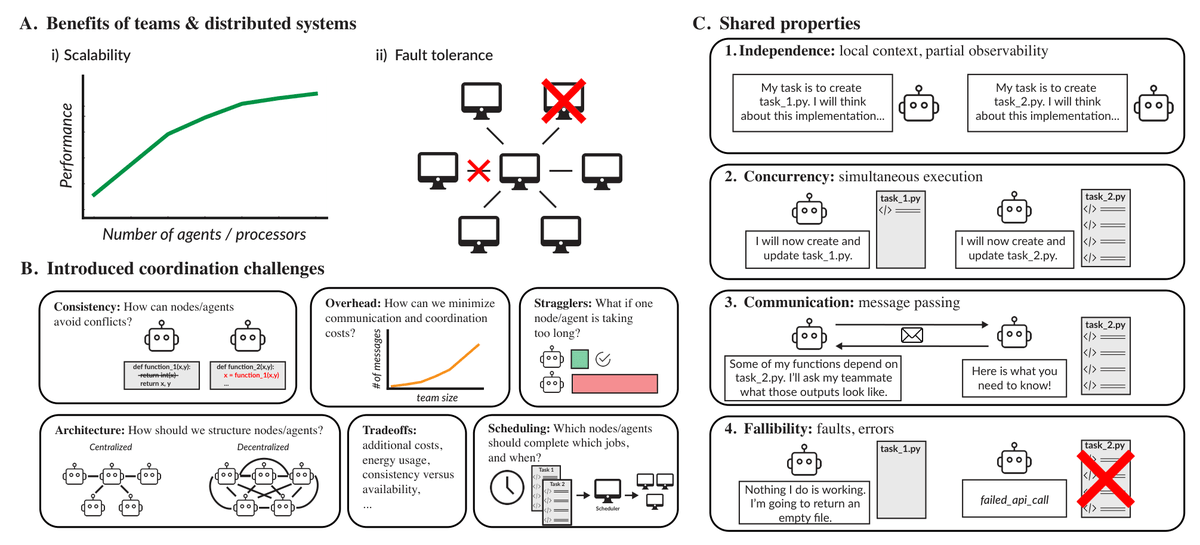
The paper's central move is to show that LLM teams and distributed systems share four structural properties:
- Independence: Each agent maintains its own local context with only partial observability of the broader task and team, just like nodes with local memory and no global clock.
- Communication: Teams coordinate by exchanging messages rather than sharing state directly, mirroring how nodes exchange packets.
- Concurrency: Multiple agents work simultaneously, which introduces stale information, conflicting outputs, and overwrites.
- Fallibility: Agents can hallucinate, stall, or produce incorrect outputs that propagate, similar to nodes that crash or return corrupted results.
Where the analogy breaks, they argue, it breaks usefully. Natural language messages are ambiguous where network protocols are formal, and LLM failures are semantic rather than clean crashes, so the gaps point at exactly where new theory is needed.
Amdahl's Law shows up in your agent swarm
To test the framework, the authors built a collaborative coding harness with three benchmarks (a math utilities library, a data analysis pipeline, and an SVG rendering library), each with 20 subtasks. They varied how much of the work could actually run in parallel: a highly parallel setup where 18 subtasks are independent, a mixed setup with a chain of 10 plus 10 independent, and a highly serial setup with 16 interdependent subtasks. Teams of 1 to 5 homogeneous agents were built from Claude Sonnet 4.6, Gemini 3-Flash, or GPT-5.2.
Amdahl's Law, from 1967, predicts speedup as S = 1 / ((1 - p) + p/s), where p is the parallelizable fraction of the workload and s is the number of processors. At 95% parallelizable, a 20x speedup is achievable; at 50%, even infinite processors cap you at 2x.
In experiment 1, tasks were preassigned to isolate task structure from coordination costs. The prediction held: highly parallel tasks benefited most from more agents, mixed tasks got less, and highly serial tasks gained essentially nothing. Even in the highly parallel condition, observed speedup stayed significantly below the Amdahl bound at a median 2.19x, with GPT-5.2 and Gemini 3-Flash driving the plateau while Claude Sonnet 4.6 did not significantly plateau below the bound.
What decentralization costs you
Experiment 2 removed the central task assigner and let agents self-claim work. The efficiency picture got noticeably worse. Preassigned teams achieved significantly higher speedup than decentralized teams, with median speedups of 1.36x versus 0.88x. In other words, letting agents figure out who does what on average made things slower than a single agent.
The decentralized teams exhibited three recognizable consistency violations:
- Concurrent writes where two agents edit the same file and silently overwrite each other.
- Rewrites where one agent completely overwrites work a teammate committed in a previous round.
- Temporal violations where an agent implements a task before its dependencies exist.
Decentralized teams produced a median of 19 test failures per run compared to 4 for preassigned teams. Communication overhead compounded the problem. Classical theory predicts n agents in a peer-to-peer setup can generate O(n^2) communication channels versus O(n) for a central coordinator, and the empirical numbers agreed. Decentralized teams exchanged substantially more messages, message counts increased with team size, and self-coordinating teams suffered more idle rounds where agents communicated but did not complete any task progress.

Some of the qualitative failure logs are worth reading. In one Gemini run, an idle agent spent multiple rounds sending cheerleading messages like standing by and cheering teammates on. In a Claude run, a blocked agent sent the same standing by message for 13 consecutive rounds. These are token-burning failure modes that no benchmark accuracy number captures.
The straggler tradeoff
Decentralization is not purely worse. Preassigned teams are vulnerable to stragglers, individual agents whose reasoning or tool latency drags the whole team behind. The straggler gap, defined as the difference between the slowest agent's completion time and the mean of the others, was significantly larger in preassigned than decentralized teams, with a median delay of 2.64 seconds versus 1.42 seconds. When agents could self-claim, faster ones could pick up work abandoned by slower ones, which is basically the same trick MapReduce uses with task replication.
Tokens outpace speedup
The most practical finding is that speedup and cost do not track each other. Preassigned teams showed a small excess of tokens over speedup driven mostly by serial tasks, where token multiplier averaged 5.83x versus a speedup of only 1.13x. Decentralized teams showed a consistently larger gap with token costs scaling strongly with team size while speedup did not. Put simply, adding agents to serial workflows can multiply your bill by 5-6x while barely moving wall-clock time.
What this is useful for
The framework offers a set of design heuristics grounded in something more rigorous than analogy to human orgs:
- Estimate
p, the parallelizable fraction of your task, before choosing a team size. Amdahl gives you an upper bound on any possible speedup. - Prefer centralized coordination when consistency matters and workloads are predictable, since it reduces messages to O(n) and prevents concurrent-write conflicts.
- Prefer decentralized coordination when agent latencies are highly variable, since dynamic reallocation absorbs stragglers.
- Treat multi-agent deployment as an efficiency-cost problem, not a pure accuracy problem. Serial tasks in particular are a trap.
The code and experimental harness are open source at github.com/emieczkowski/distributed-llm-teams. The authors also flag natural extensions: Gustafson's Law and Gunther's Universal Scalability Law for non-monotonic scaling, heterogeneous load-balancing algorithms for mixed-model teams, and fault-tolerance techniques like consensus and replication for handling hallucinations. If your production stack has more than one agent talking to another, this is the theoretical vocabulary you probably want.