
Princeton's VisRFTwin Cuts Wireless Signal Mapping Data Needs by 10x
A new digital twin framework uses vision-language models to seed differentiable ray tracers with material priors, slashing mmWave calibration data by 10x.
 Pro
Takeaways
- VisRFTwin fuses CLIP-based vision priors with Sionna differentiable ray tracing for mmWave channel modeling.
- Reduces channel measurement needs by up to 10x compared to pure data-driven baselines.
- Achieves 59% lower median delay spread error than deep learning methods like PointNet.
- GPT-4o proposes material candidates, CLIP matches them to 3D points, ITU database supplies EM parameters.
- Evaluated on conference room, lobby, and outdoor scenes with a 60.5 GHz sounder from NIST.
- Improves mmWave beam selection throughput by 30% in a SpaceBeam-style case study.
Modeling how millimeter-wave signals bounce around a room is one of the messier problems in wireless research. Beams are narrow, blockages are brutal, and every wall, sofa, or glass panel reflects RF energy differently depending on its material. Getting a digital twin accurate enough to plan beams or predict handovers has traditionally meant either sweeping the site with thousands of channel measurements or hand-coding the electromagnetic properties of every surface. A team from Princeton, Pittsburgh, Georgia, NIST, and InterDigital has proposed a different route: let a vision-language model do the material guessing, then let physics clean up the rest.
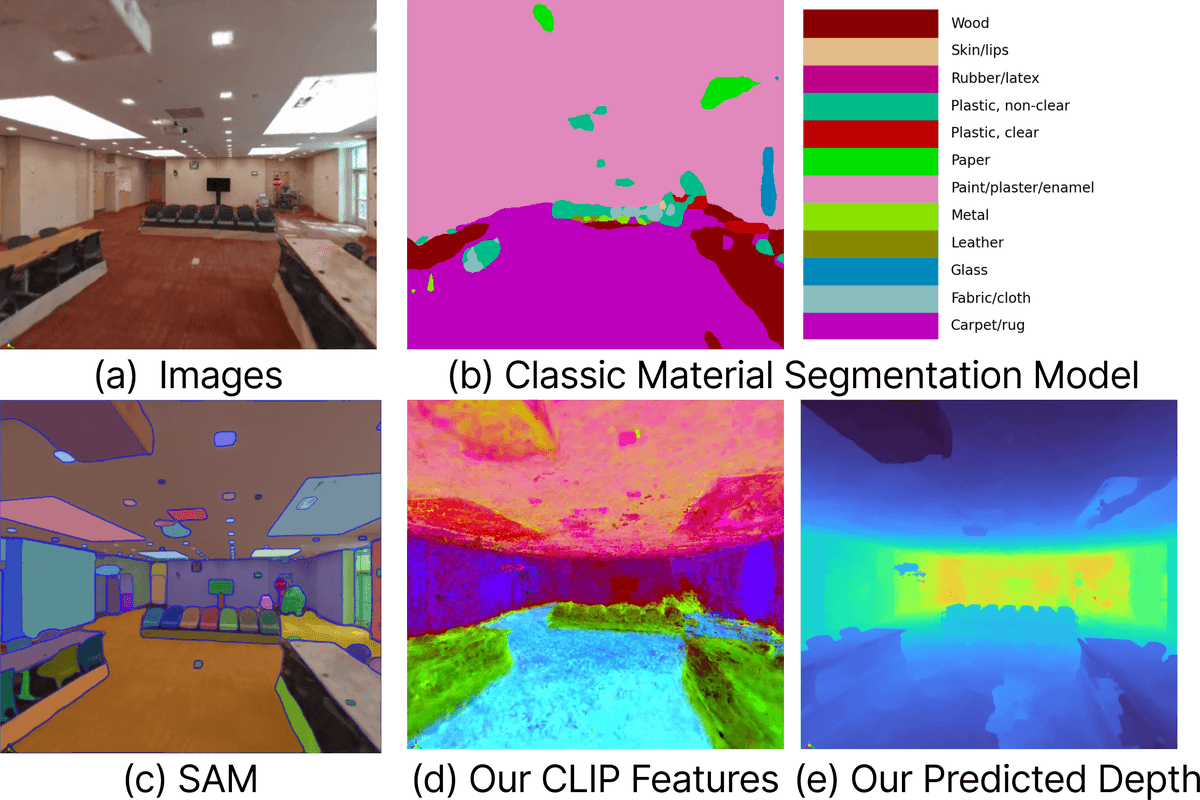
Their system, called VisRFTwin, plugs CLIP-style visual features into a Sionna differentiable ray tracer. Multi-view images from commodity cameras are processed by a frozen Vision-Language Model to extract dense semantic embeddings, which are translated into initial estimates of permittivity and conductivity for scene surfaces. These priors initialize a Sionna-based differentiable ray tracer, which rapidly calibrates material parameters via gradient descent with only a few dozen sparse channel soundings. The headline result: up to 10x fewer channel measurements needed, and a 59% lower median delay spread error than data-driven deep learning baselines.
Why mmWave modeling is stuck
There are basically two schools of thought for building an RF digital twin, and both have problems. End-to-end deep learning approaches like PointNet-based predictors or Lumos5G treat the environment as a black box, but they need enormous per-site datasets, on the order of 2000 samples for a 200 square meter room, or 30k for a single city block, and they generalize poorly the moment you move a chair. Differentiable ray tracing offers physically grounded predictions and interpretable outputs like a wall's conductivity, but it also needs hundreds of measurements to calibrate those material parameters from scratch. In preliminary tests on the NIST lobby dataset, channel estimation error exceeded 8 dB with fewer than 50 measurements and only settled around 2 dB after several hundred.
The insight behind VisRFTwin is that you rarely need to learn from scratch. The electromagnetic behavior of a surface is largely determined by what it is made of, and what it is made of is often obvious from a photo. Wood, glass, metal, plasterboard, and brick each have well-characterized permittivity and conductivity values in ITU databases. If a vision model can identify the material, the physics gives you the rest.

How the pipeline actually works
The system runs in three stages. First, VisRFTwin trains a semantic NeRF on around 100 panoramic images of the scene. Unlike a standard NeRF that only predicts color and density, this one also outputs a high-dimensional CLIP-aligned feature vector at each voxel, supervised with a cosine similarity loss against per-pixel CLIP embeddings. To handle CLIP's tendency to produce coarse, image-level features, the team borrows the multi-scale pyramid strategy from LERF, cropping each training view at multiple scales so the field learns both fine texture and broader context.
Second, those 3D semantic features are translated into EM parameters. The team prompts GPT-4o with the raw scene images to propose a shortlist of plausible materials as a JSON list. Each candidate name is encoded by CLIP's text encoder, and every 3D surface point is assigned the material with the highest cosine similarity against its learned feature vector. The chosen label is then looked up in a curated database initialized from the ITU-R material specification, yielding initial values for relative permittivity, conductivity, and a scattering coefficient. For scattering specifically, the team maps visual roughness cues to Lambertian scattering coefficients ranging from about 0.07 for smooth plasterboard to 0.5 for brick.

Third, the vision-derived priors are dropped into Sionna as the starting point for gradient descent. Each surface gets a learnable embedding that projects into sigma, epsilon_r, and S through exponential and sigmoid transforms, guaranteeing physically valid values. The calibration loss compares predicted and measured received power and RMS delay spread using a symmetric mean absolute percentage error, avoiding the brittleness of aligning raw channel impulse responses. Only a few dozen soundings are needed because the optimizer starts near a physically sensible solution rather than searching blindly.
What the numbers show
The team evaluated on three real environments captured with a 60.5 GHz sounder, a panoramic camera, and a LiDAR: a 20x10 m lecture room with 4956 samples, a 20x15 m lobby with 5100 samples including non-line-of-sight paths, and an outdoor parking-lot scene. On RMS delay spread error, the comparison stack looks like this:
| Method | Median error | Data used |
|---|---|---|
| RF-3DGS | 11.8 ns | vision only |
| PointNet (20%) | 3.8 ns | partial supervision |
| PointNet (100%) | 1.5 ns | full dataset |
| VisRFTwin zero-shot | 2.5 ns | no RF data |
| VisRFTwin few-shot | 1.8 ns | 10% of data |
Even without any RF measurements, VisRFTwin beats a PointNet baseline trained on 20% of the site data. With 10% supervision, it comes within striking distance of a fully supervised model. The optical ray-marching baseline RF-3DGS lags badly on delay-related metrics because it fits per-direction intensity but cannot track the actual sequence of reflections and path lengths.
In a downstream case study using SpaceBeam-style beam selection, accurate multipath reconstruction translated into a 30% median throughput improvement over a geometry-only tracer. End-to-end inference runs at about 0.33 seconds per link on an A6000, comparable to NeRF2, and local scene updates such as a walking human only require re-tracing the affected region.
Where it helps, and where it does not
The framework is a strong fit for scenarios where you can capture multi-view photos of a space cheaply but cannot afford exhaustive channel sounding. That includes AR and VR deployment planning, network operators calibrating fixed-wireless links, autonomous driving simulators, and dense IoT sites where retraining on every layout change is impractical. It is also robust to dynamics, since a walking person can be inserted as a proxy mesh and only the affected paths are re-traced.
The limits are real, though. Outdoor error jumps to about 12 ns median because outdoor scenes have less geometric constraint and more complex scattering. Surface color can mislead the semantic classifier, roughness is only inferred indirectly, and NeRF geometry drifts by centimeters at oblique angles like ceiling corners. The system also inherits Sionna's dependence on the shoot-and-bounce ray budget. A related approach explored in a contemporary paper on VLM-guided differentiable ray tracing reports similar findings on convergence speedups when priors are informed rather than random. Code has not yet been released with this arXiv preprint, though it is built on top of the open-source Sionna RT and Nerfstudio stacks.