
Princeton's PlayWorld Lets Robots Learn From Failures Overnight, Boosting Performance 65%
Princeton's PlayWorld lets robots train their own world models overnight via unsupervised self-play, cutting hallucinations and boosting RL policy success rates by 65%
 Pro
Takeaways
- Core idea: PlayWorld trains robot video world models using fully autonomous overnight robot self-play instead of human demonstrations.
- Data problem solved: Human demo data is success-biased; PlayWorld captures slips, collisions, deformations, and missed grasps that demos never show.
- Policy evaluation: Predicted success rates correlate 0.8766 with real-world outcomes across 18 diverse policies -- up to 40% better than human-collected baselines.
- RL fine-tuning: Policies fine-tuned entirely inside the PlayWorld simulator improve real-world success rates by up to 65% over the base policy.
- Scaling advantage: PlayWorld keeps improving with more data beyond 30 hours; human demo models saturate well before 6 hours.
- No public weights yet: Paper on arXiv; project site at robot-playworld.github.io.
Building a simulator that truly understands how a robot gripper crushes a carrot or knocks over a block has been one of the quiet hard problems in robotics. PlayWorld, from Princeton's IRoM Lab, proposes a surprisingly simple fix: stop training on polished human demonstrations and let the robot make a mess on its own, overnight, without anyone watching.

The hallucination problem nobody talks about
Despite training on large-scale robot datasets, current state-of-the-art video models still struggle to predict physically consistent robot-object interactions that are crucial in robotic manipulation. The failure mode is specific and repeatable: objects duplicate when grasped, appear or disappear on contact, or deform in ways that defy physics. The field calls these hallucinations, and they are not a model capacity problem -- they are a data problem.
While existing models typically train on human-collected demonstrations or task-specific policy rollouts, this leads to hallucinations caused by systematic biases and poor coverage of interaction dynamics. Human demonstrations are inherently success-biased: a teleoperator picks up the object cleanly, places it correctly, and moves on. The model never sees a slip, a missed grasp, or a collision -- exactly the events it needs to predict when evaluating whether a policy will actually work.
Let the robot play
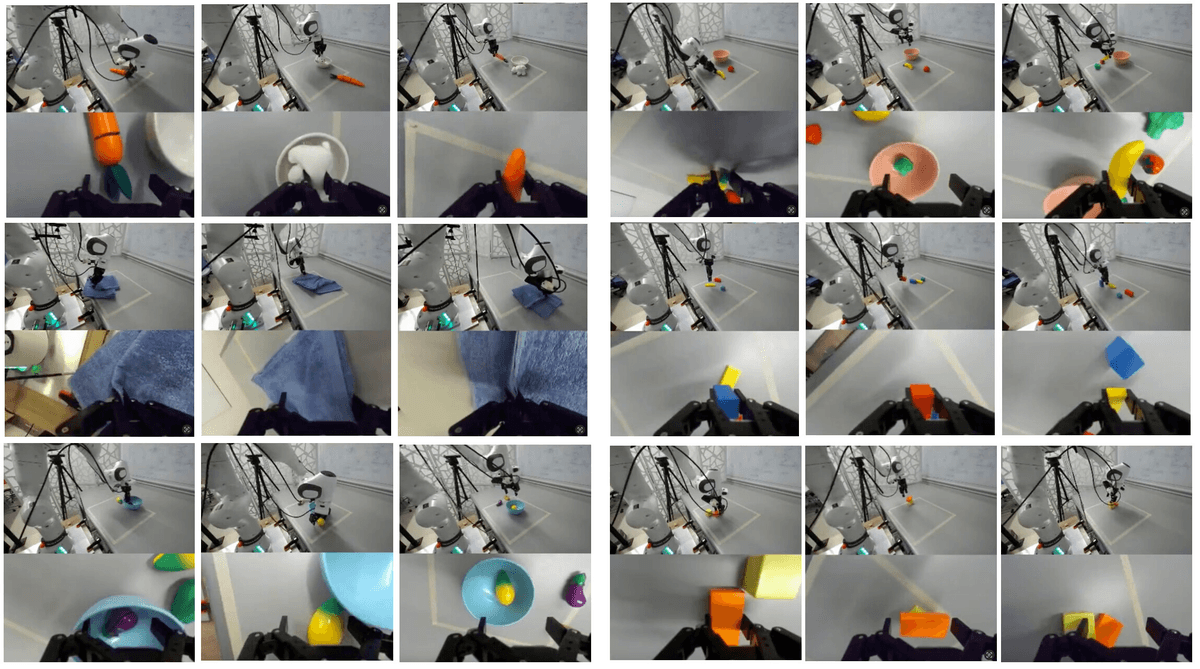
PlayWorld is a scalable framework for training high-fidelity action-conditioned robot world models using autonomous play. Instead of relying on success-biased human demonstrations, it continuously gathers diverse, contact-rich interactions and failure cases that better match downstream policy behavior. The system runs on the DROID manipulation setup with no hardware modifications and supports up to eight hours of continuous, fully unsupervised data collection -- including overnight runs.
The pipeline has two moving parts working in a loop:
- Task Proposer: A vision-language model (VLM) looks at the current camera feed and generates a natural-language instruction grounded in what it sees -- things like "push the object forward" or "stack the block." It deliberately introduces small variations in verb choice and object descriptions to probe different behavior modes.
- Task Executer: A vision-language-action (VLA) policy (specifically
π0.5-DROID) executes the instruction. Because small perturbations in language often cause large swings in robot behavior, this naturally produces a wide variety of contact outcomes -- grasps, slips, collisions, deformations -- without any scripted diversity engineering.
A lightweight safety filter enforces joint limits and prompts the VLM to reset the scene if objects drift out of reach. That is the entire human-supervision requirement. The team collected 30 hours of autonomous play data across three object sets this way.
Training a world model on chaos
Raw play data has a structural problem: it is extremely imbalanced. Free-space arm motions dominate, while the rare contact events -- slips, deformations, collisions -- are exactly what the model needs to learn. Standard training lets the model overfit to the easy majority and ignore the informative tail.
PlayWorld addresses this with curriculum learning. The key idea is to rank training samples by their visual distance from successful task executions, using CLIP embeddings as a proxy. Training starts with samples close to nominal success trajectories and progressively incorporates increasingly out-of-distribution interactions. This forces the model to eventually learn from rare contact events rather than skipping over them. The video model itself is built on a Stable Video Diffusion backbone, fine-tuned to jointly predict three camera views (left, right, and wrist) conditioned on per-frame robot actions.

What the numbers actually show
The team built an interaction-centric benchmark of 500+ clips drawn from rollouts of 20+ different robot policies, labeled into six categories: Success, Missed Grasp, Slide, Slip, Deformation, and Collision. This is a deliberately harder test than the standard "replay a good trajectory and check pixel quality" approach used in most prior work.
PlayWorld enables fine-grained failure prediction and policy evaluation, with up to 40% improvements over human-collected data. The gains are concentrated exactly where they matter: failure modes. On the LPIPS perceptual metric (lower is better), PlayWorld with curriculum learning scores 0.066 on Missed Grasp versus 0.080 for Human Demo, and 0.072 on Collision versus 0.086 for Human Demo. Success prediction quality is roughly equal across all methods -- the gap only opens up when things go wrong.
Scaling also behaves differently. PlayWorld enables scalable data collection that continues to expand interaction coverage and improve world model quality as more interaction data is gathered. Models trained on larger play datasets achieve steadily better prediction accuracy, while models trained on human demonstrations show much weaker gains when scaled up. Human demo data effectively saturates well before 6 hours; PlayWorld at 30 hours still shows measurable improvement.

Policy evaluation that actually correlates with reality
One of the most practically useful results is on policy evaluation. The team trained 18 different policies -- diffusion policies from scratch and fine-tuned π0 variants with varying amounts of demonstration data -- and ran each one in both the real world and inside each world model. PlayWorld's predicted success rates achieve a Pearson correlation of 0.8766 with real-world outcomes across this diverse policy suite. Baseline models trained on human demonstrations collapse to predicting near-uniform success because they have never seen the failure modes those policies produce.
The most common failure mode in baseline world models is what the paper calls "hallucinated success" -- the model predicts a clean grasp even when the robot clearly missed, because it was trained almost entirely on successful grasps. This makes the world model useless for ranking policies or detecting regressions.
RL inside the simulator
The most striking result is reinforcement learning entirely within the world model. PlayWorld enables reinforcement learning in the world model, improving policy performance by 65% in success rates when deployed in the real world. The setup uses DSRL (Diffusion Steering via Reinforcement Learning) -- a method that keeps the base diffusion policy frozen and instead learns a small noise-sampling policy that steers the diffusion process toward higher reward, avoiding the instability of backpropagating through multi-step denoising.
The reward signal is a simple progress estimator trained on a handful of demonstrations. Despite this minimal setup, the fine-tuned policies learn genuinely new behaviors -- including recovery moves like scooping -- and generalize to object initializations they never saw during fine-tuning. The baseline world model (trained on human demos) produces the opposite effect: policies learn to "hack" the model's hallucinated success predictions, and real-world performance actually degrades with more fine-tuning steps.
Where it falls short
The paper is candid about limitations worth knowing:
- No active data collection: The play strategy maximizes behavioral diversity but does not explicitly seek out the most informative transitions. A lot of collected data is still redundant free-space motion.
- Open-loop rollout drift: Prediction errors accumulate over long horizons. The system uses fixed action horizons, which can cause closed-loop instability on longer tasks.
- RL overfitting: Extended fine-tuning can cause the policy to exploit world model errors rather than learn real task strategies. The team recommends early stopping based on real hardware trials.
- Lab-scale only: All experiments use a single DROID setup with a limited set of objects. Scaling to diverse scenes, embodiments, and environments remains open.
- Requires a capable play policy: The system depends on
π0.5-DROIDbeing able to execute diverse instructions reliably. A weaker base policy would produce less useful play data.
What this unlocks
The practical use cases are concrete. Any team that wants to evaluate a new robot policy without running hundreds of hardware trials can now use a world model as a proxy -- but only if that world model has seen failure modes. PlayWorld provides the data pipeline to build that model. For RL fine-tuning, it offers a path to improving policies with minimal real-world interaction: collect play data once, train the world model, then iterate on policy improvement entirely in simulation.
PlayWorld learns robot world models from autonomous play and shows that reinforcement learning in the learned simulator improves downstream real-world performance. No code or pretrained model weights are publicly released yet, but the project website is live and the paper is available on arXiv. The system is built entirely on top of the existing DROID dataset infrastructure, which lowers the barrier for labs already using that setup to replicate the approach.