
Princeton's FloeNet Runs 140-Year Sea Ice Simulations on a Single GPU
A GNN sea ice emulator trained on one climate holds up under pre-industrial and warming scenarios by predicting mass budgets instead of raw state.
 Pro
Takeaways
- FloeNet is a mass-conserving graph neural network emulator of GFDL's SIS2 global sea ice model.
- Trained on present-day climate, it generalizes to pre-industrial and 1% CO2 scenarios.
- Predicts mass and area budget terms (growth, melt, transport) instead of raw state fields.
- Volume anomaly correlations exceed 0.96 in Antarctic and 0.76 in Arctic across forcings.
- 140-year rollout runs in ~4.75 hours on a single L40S GPU.
- Designed to plug into Ai2's ACE2 and Samudra for coupled emulation.
A team from Princeton, NOAA's Geophysical Fluid Dynamics Laboratory, Ai2, and NYU has released FloeNet, a machine-learning emulator that replaces the sea ice component of a full climate model. What makes it interesting is not just speed, but that it was trained on present-day data and still generalizes to colder pre-industrial and warmer high-CO2 climates, thanks to a design that bakes in mass conservation.
Why sea ice is the awkward piece of climate emulation
Climate emulators for the atmosphere and ocean are having a moment: once trained, ML emulators can accurately simulate entire Earth system components in a fraction of the time of their numerical model counterparts. But sea ice has lagged behind. Sea ice concentration alone cannot fully capture the complex exchanges of energy, mass, and salt across the atmosphere-ice-ocean interface, and polar regions are exactly where existing atmosphere-ocean emulators show their largest surface temperature biases.
The physical model being emulated is SIS2, the sea ice component of the GFDL fourth-generation global ocean-sea-ice model, OM4. Traditional climate models like this need thousands of CPU cores and still only manage 10 to 20 simulated years per day. FloeNet, once trained, does a 140-year rollout in about 4.75 hours on 1 L40S NVIDIA GPU.
The trick: emulate the budget, not the state
Most ML climate emulators predict the next state directly (concentration, thickness, velocity, etc.). FloeNet instead predicts the terms of the physical mass and area budget, then reconstructs the state from them. For sea ice mass, that means separately predicting:
- LSRCi: sources from ice growth (congelation, frazil, snow-to-ice conversion)
- LSNKi: sinks from top melt, bottom melt, evaporation, sublimation
- XPRTi: transport convergence from ice motion
At every timestep, FloeNet overwrites its own state prediction with the integral of these budget terms, guaranteeing conservation by construction. The same trick is applied to snow-on-sea-ice mass and ice area fraction. As a side effect, you can attribute any change in sea ice to thermodynamics versus dynamics, which is exactly how physical climate scientists reason about the system.
Architecture and training
FloeNet is a graph neural network built on the GraphCast model encoder-processor-decoder framework, with modifications for the poles. GNNs allow flexibly setting the degree of non-locality within the model. Specifically, they avoid global connections as there are no physically-meaningful timestep-to-timestep relationships between Arctic and Antarctic sea ice. The multi-mesh uses only icosahedral refinements 4, 5, and 6, giving a receptive field of roughly 1500 km, and mesh nodes over land are removed.
The model takes 6-hour atmospheric forcings (shortwave, longwave, sensible/latent heat, wind stress, snowfall) and 5-day ocean forcings (ocean-to-ice heat flux, sea-surface height, ice-ocean stress), and predicts ice concentration, ice mass, snow mass, skin temperature, all the budget terms, and coupling variables like ice-to-ocean salt flux and top/bottom melting energy fluxes. It has around 3 million parameters and was trained for 50 epochs in about 5 days on 4 H200 NVIDIA GPUs.

Does it hold up out of distribution?
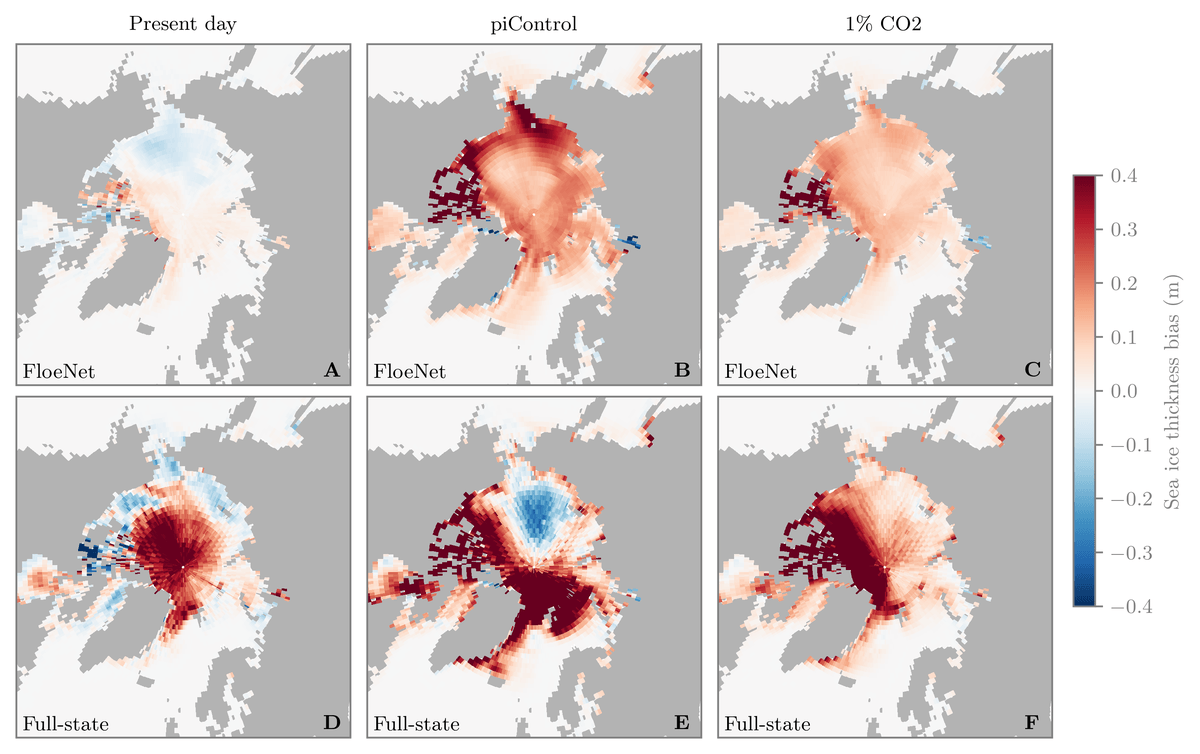
The real test is generalization. FloeNet was trained on a reanalysis-forced simulation of the present-day climate, then run under two very different climates from the GFDL CM4 coupled model: a pre-industrial control and a 1%-per-year CO2 increase scenario. It was compared against a "full-state" baseline using the same GNN architecture and inputs but predicting raw state variables instead of budgets.
Under present-day forcing, FloeNet reproduces the Arctic sea ice volume trend of -166 km3/year almost exactly (truth is -167), while the full-state model gets -132. Its year-round volume bias is +40 km3 vs. +1175 for the baseline. Under 1% CO2, both models reach ice-free summers stably, but FloeNet stays closer to CM4's spatial pattern.

For inter-annual variability, volume anomaly correlations are above 0.96 in the Antarctic and 0.76 in the Arctic across all forcings. The full-state baseline has the opposite failure mode in each regime: too little variability in present-day, too much in piControl and 1% CO2. FloeNet's budget decomposition also correctly attributes year-to-year anomalies to export vs. thermodynamic drivers.
Where it still struggles
FloeNet is not a perfect physicist. It conserves mass and area but not energy, which the authors suspect is behind a persistent positive Arctic thickness bias under piControl and 1% CO2 (up to +2645 km3 in piControl volume). They plan to add an enthalpy budget in future work. Training is also somewhat sensitive to random seed (Arctic RMSE varies from 9.81 to 10.99 cm across three seeds), and swapping the GNN for a ConvNeXt UNet at comparable parameter count degrades performance noticeably.
What is now possible
The obvious downstream use is coupling FloeNet into existing emulators. It shares a 1-degree grid and 6-hour cadence with Ai2's ACE2 atmospheric emulator and the Samudra ocean emulator, and the authors explicitly frame it as a drop-in sea ice component for the SamudrACE coupled system, whose current 5-day ice representation is shown to be much worse than a 6-hour model. FloeNet's salt flux output could also constrain ocean salinity budgets, which matter for large-scale circulation like the AMOC.
Practically, if you work on climate emulation, extreme-event ensembles, or polar processes, FloeNet gives you three things existing sea ice ML models don't: mass conservation, physical interpretability via budget attribution, and demonstrated generalization to unseen climates. Weights and initial conditions are available on Hugging Face, and the underlying training codebase is the open-source Ai2 ACE repository.