
Princeton's AggAgent Beats Every Rival by Treating AI Trajectories as Searchable Environments
Princeton researchers built AggAgent, an aggregator that treats parallel agent trajectories as an environment to explore, beating existing methods by up to 10 points on deep research.
 Pro
Takeaways
- Princeton's AggAgent treats parallel agent trajectories as an environment, exploring them via lightweight tools.
- Beats existing aggregation methods by up to 5.3 points average and 10.3 on deep research tasks.
- Uses four tools: get_solution, search_trajectory, get_segment, and finish, no external API calls.
- Only 5.7% cost overhead at K=8, versus 41% for summary-based aggregation approaches.
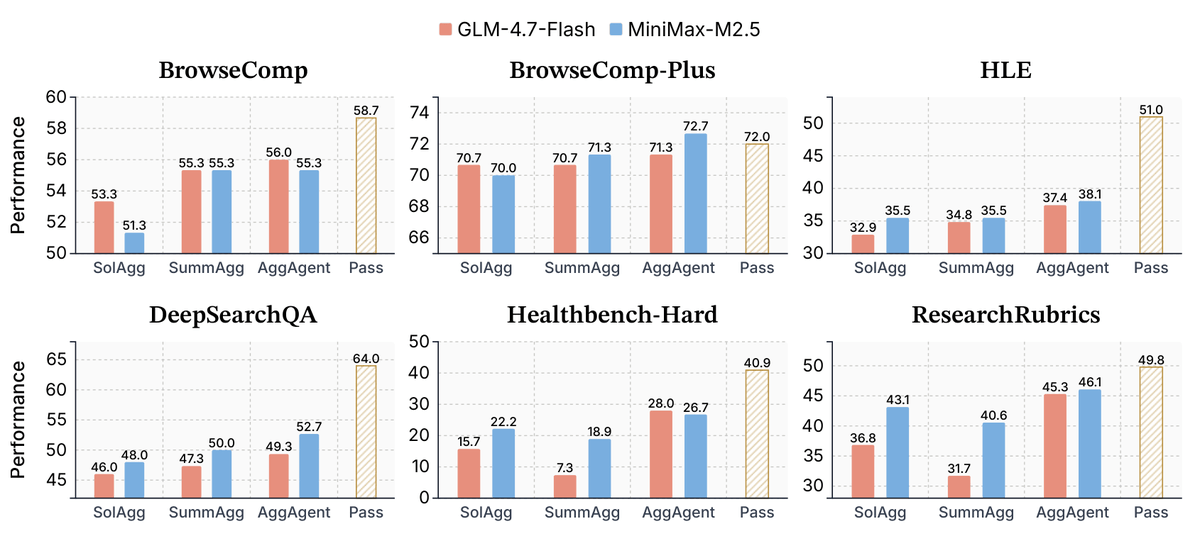
- Can surpass Pass@8 by composing correct answers from individually incorrect trajectories.
- Training-free, works with GLM-4.7, Qwen3.5, MiniMax-M2.5, code on GitHub.
Running the same agent eight times in parallel and combining the results is a proven trick for boosting accuracy on math and coding. For long-horizon agentic tasks like deep research and web browsing, the aggregation step turns out to be surprisingly hard. Princeton's Language and Intelligence group has published a paper introducing AggAgent, an approach that reframes aggregation itself as an agentic task, and it outperforms every existing method they tested against.
The setup is what you would expect: given a problem, an agent runs K times independently, producing K trajectories, and the goal is to synthesize a better final solution. The catch is that agentic traces look nothing like chain-of-thought. They span hundreds of turns with interleaved tool calls, and a single rollout can consume hundreds of thousands of tokens. Concatenating eight of them blows past any reasonable context window.
Why the obvious approaches fall short
The paper lays out the aggregation dilemma cleanly. Aggregating only final solutions discards the rich information in trajectories, summarizing trajectories is expensive and lossy, and concatenating everything into a single context is infeasible. Majority voting works for math problems where answers are short strings you can count, but it breaks down entirely for multi-answer queries or long-form research reports.
The headroom is real. GLM-4.7-Flash improves from 27% to 59% on BrowseComp and 25% to 51% on HLE when scaling from Pass@1 to Pass@8, meaning correct answers frequently exist somewhere in the parallel rollouts. The problem is extracting them.