
Princeton and Google DeepMind Turn Pokémon Into AI's Hardest Decision-Making Benchmark
A NeurIPS 2025 benchmark uses Pokémon battles and speedruns to expose reasoning gaps that standard evals miss, with 100+ teams competing.
 Pro
Takeaways
- PokéAgent Challenge launched as a NeurIPS 2025 benchmark with two tracks: competitive battling and RPG speedrunning in Pokémon Emerald
- Over 100 teams competed, generating 100K+ battles on the custom Showdown server
- Dataset includes 20M+ battle trajectories, 200K+ competitive teams, and 30 open-source RL checkpoints
- Specialist RL and search methods crushed frontier LLMs; winning speedrun used Scripted Policy Distillation combining both
- Analysis shows Pokémon battling is nearly orthogonal to standard LLM benchmarks like those in BenchPress
- Living leaderboard at pokeagent.github.io continues evaluation post-competition
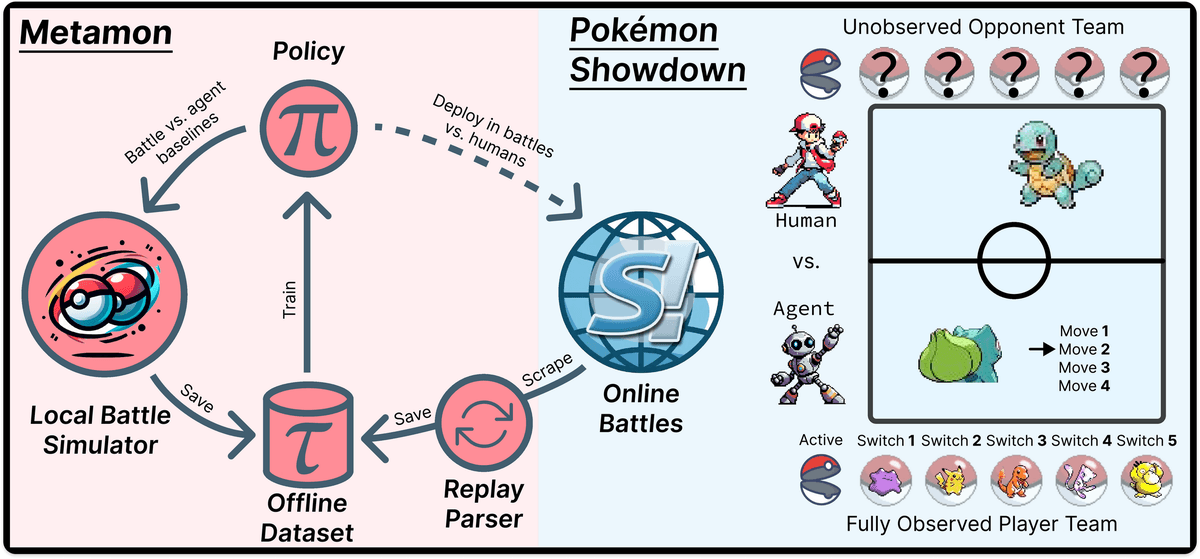
A team from Princeton, UT Austin, CMU, NYU, and Google DeepMind has turned Pokémon into what might be the most punishing decision-making benchmark yet built for AI agents. The PokéAgent Challenge, run as a NeurIPS 2025 competition, drew over 100 teams and 100,000+ battles, and its results paint an uncomfortable picture: specialist reinforcement learning agents crush frontier LLMs at competitive play, and no raw model can even start the RPG without an elaborate scaffold.
The pitch is simple. The paper argues that partial observability, game-theoretic reasoning, and long-horizon planning are core challenges in sequential decision-making, yet few existing benchmarks stress all three simultaneously under realistic conditions. Pokémon happens to combine all three at once.
Why Pokémon is harder than it sounds
The scale is absurd. The authors derive roughly 10^564 possible battle states for Gen 9 OU, dwarfing chess (~10^47) and Go (~10^170). Teams draft from 1,000+ species, each with hidden moves, items, abilities, EV spreads, and (in Gen 9) a chosen Terastallization type. On each turn, players select simultaneously from around nine actions, outcomes are stochastic, and rare events can swing the game.
The Speedrunning Track uses Pokémon Emerald and demands the opposite skill set: sustained coherence over thousands of steps. The benchmark features two complementary tracks: Competitive Battling evaluates strategic reasoning under partial observability in two-player competitive Pokémon, while the RPG Speedrunning tests long-horizon planning in completing Pokémon Emerald as quickly as possible.

What the organizers shipped
This is not just a paper. The release includes a real infrastructure stack that other researchers can plug into:
- 20M+ battle trajectories, including 4M reconstructed from human replays (with the winner's private information inferred) and 18M self-play battles
- 200K+ curated competitive teams inferred from human replays and expert forums
- 30 RL agent checkpoints spanning compact RNNs to 200M-parameter Transformers, built on the Metamon codebase
- The PokéChamp LLM harness, extended to support GPT, Claude, Gemini, Llama, Gemma, and Qwen backends with depth-limited minimax search
- The first open-source multi-agent orchestration system for RPG play, coordinating MCP tools (A* pathfinding, button inputs, knowledge retrieval) with specialized sub-agents
- A live leaderboard at pokeagentchallenge.com that continues after the competition ended
Specialists still win, decisively
The most cited finding is the capability hierarchy the competition exposed. A NeurIPS 2025 competition advancing AI decision-making through Pokémon featured competitive battling and RPG speedrunning tracks to unify research in reinforcement learning and large language models, and the outcome was lopsided. In Gen 9 OU, the winning agent was FoulPlay, a Rust-based bot using root-parallelized Monte Carlo Tree Search with damage-roll grouping and probabilistic opponent-set inference. In Gen 1 OU, PA-Agent won by fine-tuning the Metamon offline RL baseline with iterative self-play and dynamic data weighting.
Pure LLM harnesses lagged badly. When compared against 49 standard benchmarks in the BenchPress matrix, Pokémon battling turned out to be nearly orthogonal to everything else: Pokémon battling is nearly orthogonal to standard LLM benchmarks, measuring capabilities not captured by existing evaluation suites and positioning Pokémon as an unsolved benchmark that can drive RL and LLM research forward. Models that score at frontier level on standard evals sometimes collapse in battles, and vice versa.
The speedrunning winner combined both worlds
The Speedrunning Track produced the most interesting methodological result. The winner, Team Heatz, developed Scripted Policy Distillation (SPD), a three-stage pipeline that treats LLMs as priors and RL as refinement:
- Subgoal generation: An LLM decomposes the long-horizon task into subgoals, each with an executable success_cond(state) function
- Scripted policy generation: The LLM writes Python-like policies for each subgoal, optionally calling a vision-language model (Qwen3-VL-8B) for visual cues, and iterates based on execution traces
- Script-guided RL: Successful scripted policies are distilled into a DQN via imitation learning, then refined with expert action guidance (epsilon annealed from 0.1 to 0) so the neural policy can execute faster and discover shortcuts
Heatz finished the route to the first gym in 40:13, more than twice as fast as the top pure-LLM harness submission. Notably, after distillation the neural policy invented tricks not in the original scripts, including shorter routes, skipping unnecessary trainer battles, and faster menu interactions.

The harness is not optional
One of the sharper findings buried in the results: without any scaffolding, raw frontier VLMs achieve effectively 0% completion in Emerald. They wander, repeat failed actions, and get stuck in dialogue loops. Even more striking, generic CLI-agent harnesses (Claude Code, Codex CLI, Gemini CLI) fail to maintain coherence over thousands of sequential decisions, despite using the exact same underlying models that succeed with the PokéAgent domain-specific harness.
This suggests long-context embodied tasks demand qualitatively different architectures than coding workflows, particularly around long-term memory abstractions and consistently iterated plans. Different model families also fail in characteristic ways: Claude showed "memory corruption cascades," Gemini oscillated between goals, GPT over-committed to bad plans, and Qwen fell into "computational paralysis" recursively verifying basic type matchups while the battle clock ran out.
What's still open
The best agent (Heatz at 40:13) is still 2.2x slower than human speedrunners, and no open-source model has completed a full Pokémon RPG. The authors call out four concrete open problems: VLM spatial grounding (essentially SLAM through a language-vision interface), closing the LLM-RL gap in battling, full-game completion with open-source models, and approaching human speedrun times. The Battling leaderboard remains live, and the Speedrunning Track ships as a self-contained local evaluation so anyone with a GBA emulator and API credits can benchmark against the field.