
PreSafe Cuts DeepSeek-R1 Jailbreak Rates to Near Zero Without Hurting Reasoning
A new alignment method called PreSafe locks in a refusal decision before chain-of-thought starts, cutting jailbreak success rates to near zero without hurting reasoning.
 Pro
Takeaways
- Safety failures in reasoning models happen only when chain-of-thought is enabled, not when disabled.
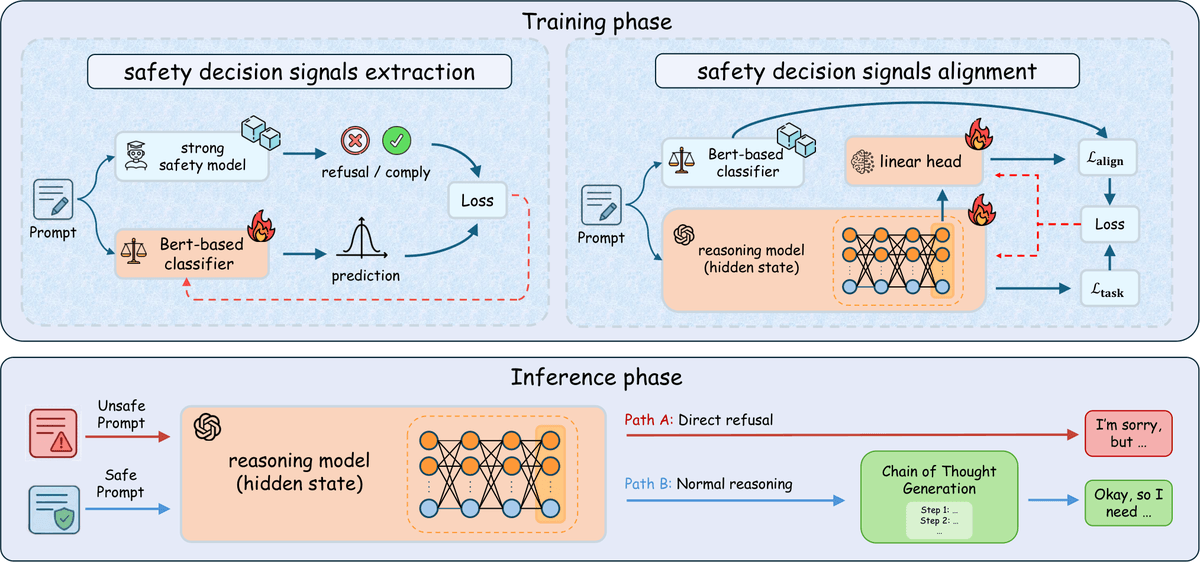
- PreSafe trains a BERT classifier on a CoT-OFF teacher, then aligns the LRM's pre-CoT hidden states to match.
- Attack success on PAIR drops from 44-69% to under 4% across DeepSeek-R1, Qwen3, and Skywork backbones.
- StrongReject ASR falls from up to 67% down to 2.9-7.1%, beating SafeChain, R2D, and SafePath.
- Reasoning benchmarks (AIME2024, MATH-500, GPQA-Diamond) remain intact, unlike competing R2D method.
- Weight updates concentrate in deeper-layer
gate_projandup_projMLPs; no inference-time overhead added. Paper.
Turning on chain-of-thought reasoning makes large language models smarter, but it also makes them dramatically easier to jailbreak. A new paper from researchers at Southeast University, University of Queensland, and Nanyang Technological University pinpoints why, and proposes a fix that pushes attack success rates on models like DeepSeek-R1 and Qwen3 down to near zero while keeping their math and science performance intact.
The core observation is simple but striking. The authors report that safety degradation in large reasoning models appears only after CoT is enabled, and vanishes when CoT is disabled. The same weights that behave safely with reasoning off suddenly comply with harmful requests once you let them think out loud. That finding motivates a method called PreSafe, which forces the model to commit to a safety decision before the first reasoning token is generated.
The chain-of-thought safety tax
Existing defenses fall into two camps. Post-hoc input filters like SmoothLLM or Perplexity Filter try to detect adversarial strings, while process-oriented alignment methods like SafeChain and R2D fine-tune on safe reasoning traces. Both approaches struggle: supervised fine-tuning on manually constructed reasoning data hurts general capability yet delivers only limited safety gains.
The paper frames this as a structural issue. When a reasoning model unrolls a long CoT for a jailbreak prompt, the intermediate steps can rationalize their way into compliance, or hide harmful objectives inside seemingly benign sub-goals. If the refusal decision has to survive that entire reasoning process, it often doesn't.