
Premier Beats Every Rival by Learning Your Visual Taste Without Words
A CVPR 2026 Highlight paper replaces text-based preference descriptions with learnable per-user embeddings that steer diffusion generation at the token level.
 Pro
Takeaways
- Premier learns a per-user embedding directly through diffusion loss instead of using MLLM-generated text descriptions.
- Code released as a CVPR 2026 Highlight, built on FLUX.1-dev with MM-DiT modulation.
- A dispersion loss based on InfoNCE separates user embeddings and prevents outputs from collapsing to a shared style.
- Cold-start for new users represents them as linear combinations of existing training-set user embeddings.
- Beats ViPer, InstantStyle, Bagel, Qwen-Image-Edit, and DrUM on ViPer Score, CLIP alignment, and LPIPS.
- Each user embedding is 61 KB versus 10.7 MB for a LoRA, with 1-second inference overhead.
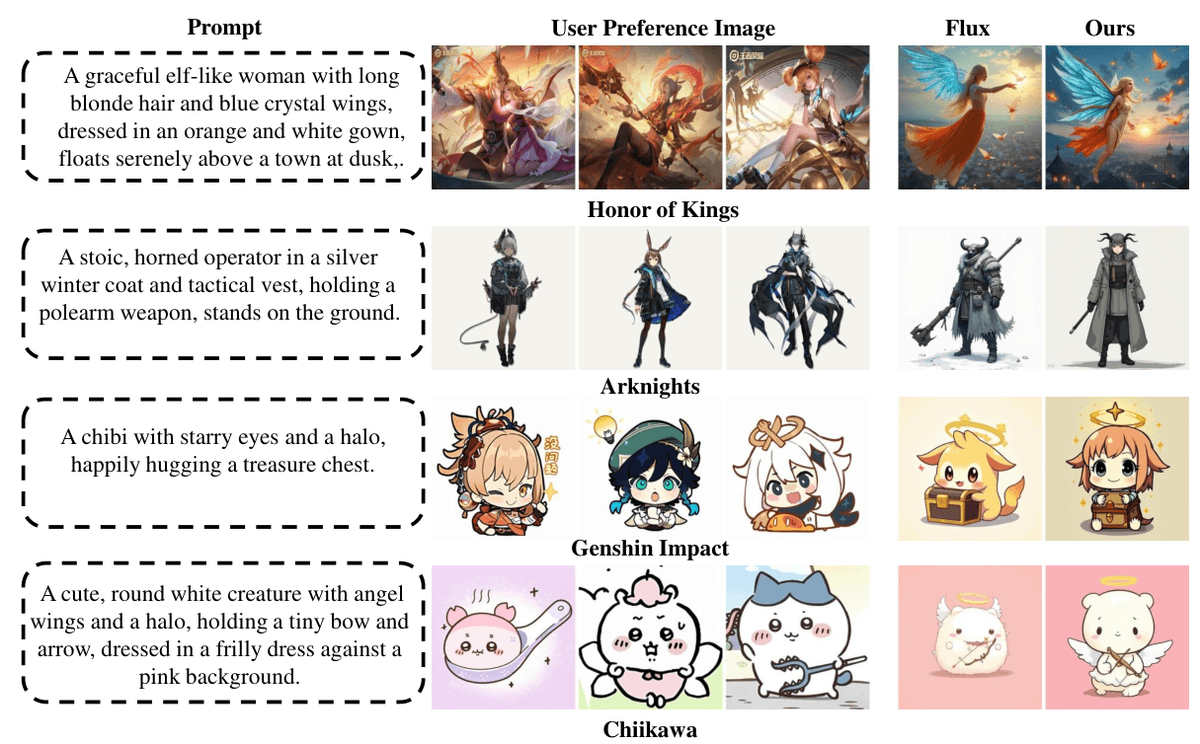
Personalizing text-to-image models has been a messy business. Most approaches lean on a multimodal LLM to look at a user's favorite images, describe what it sees, and hand that description back to the diffusion model as a fancier prompt. Text descriptions leak information, diffusion models struggle to follow long stylistic instructions, and the connector modules between MLLMs and image generators become their own bottleneck. A new CVPR 2026 Highlight paper called Premier proposes a cleaner path: skip the natural language middleman and learn a user embedding directly through the diffusion loss.
Each user gets a learnable vector (shape 30 x 1024) trained on their preferred images. A small adapter fuses that vector with the text prompt and produces a per-token modulation direction that nudges generation toward the user's taste, without ever verbalizing what that taste is. Code is available, the base model is FLUX.1-dev, and the whole thing takes about 30 minutes per user on an A800.
Why prompt-based personalization keeps falling short
The authors identify two failure modes in current work. When a multimodal model dumps its hidden states into a connector for the diffusion backbone, the connector becomes a lossy translator because the representation spaces don't match. And when the MLLM writes out natural language preferences, the image model often can't follow complex or nuanced style descriptions; as a user's history grows longer, the MLLM starts glossing over fine-grained details across samples.