
PPO-Based Framework Slashes Autonomous Vehicle Network Latency by 50%
A new two-tier PPO and Linear Programming framework cuts autonomous vehicle communication latency by up to 50% using intelligent signal reflection and semantic compression.
 Pro
Takeaways
- A new framework combining Reconfigurable Intelligent Surfaces (RIS), semantic communication, and vehicular edge computing cuts end-to-end latency by 40-50% vs. GA and QPSO baselines.
- Tasks are split three ways simultaneously: local compute on the vehicle, offload to a roadside RSU via V2I, and offload to a nearby service vehicle via V2V.
- A two-tier solver uses PPO (reinforcement learning) for discrete RIS phase shifts and semantic compression depth, and Linear Programming for continuous offload ratios.
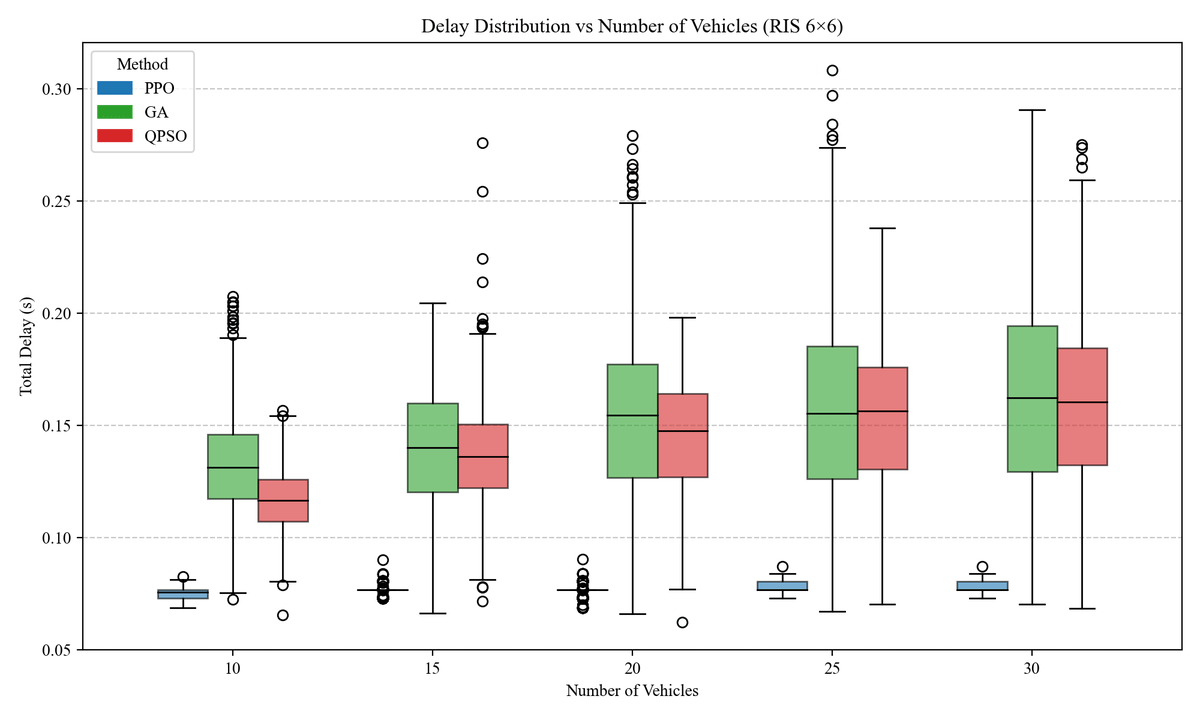
- The system scales to 30 vehicles in congested urban scenarios while maintaining low latency; heuristic baselines (GA, QPSO) degrade rapidly under the same conditions.
- The number of semantic symbols is treated as a first-class optimization variable alongside physical-layer RIS phase shifts -- a cross-layer coupling rarely done in prior work.
- Code and data are open-sourced on GitHub; the paper is published in Electronics (MDPI).
Autonomous vehicles and connected transportation systems are generating enormous volumes of sensor data that need to be processed in near real-time. The problem is that urban environments are hostile to wireless signals: buildings block line-of-sight links, multipath fading degrades channel quality, and dozens of vehicles competing for the same spectrum create interference that traditional optimization methods simply cannot handle fast enough. A new paper published in Electronics proposes a framework that tackles all three of these problems simultaneously, cutting average end-to-end latency by 40% to 50% compared to leading heuristic baselines.
Three problems, one framework
The Internet of Vehicles (IoV) is driving the intelligent transformation of transportation systems by enabling real-time connectivity between vehicles, infrastructure, and pedestrians to support autonomous driving. But the data volumes involved are staggering, and cloud-based processing is too slow. Vehicular Edge Computing (VEC) allows vehicles to offload tasks to edge servers at roadside units (RSUs), which significantly reduces latency and energy consumption by shortening communication distances.
Even with edge servers nearby, two obstacles remain. Urban obstacles and multipath fading often degrade vehicle-RSU links, potentially violating Quality of Service standards. Reconfigurable Intelligent Surfaces (RISs) offer a solution by dynamically adjusting electromagnetic signal properties to reroute signals, boost strength, and suppress interference. A RIS is essentially a large panel of passive, programmable antenna elements mounted on a building surface. Each element can independently shift the phase of an incoming radio wave, effectively steering reflected signals around obstacles to create a virtual line-of-sight path.
The third ingredient is semantic communication -- a paradigm that moves beyond transmitting raw bits. Instead of sending every byte of sensor data, a semantic encoder extracts only the task-relevant meaning and transmits a compressed representation. The receiver reconstructs the intent, not the exact bits. This paper uses the pre-trained DeepSC model as its semantic backbone, which maps text-based vehicle tasks into a controllable number of semantic symbols. The key insight is that fewer symbols mean lower transmission latency, and the system can trade off compression depth against channel quality in real time.

The three-path offloading model
The proposed RIS-aided semantic-aware VEC system comprises vehicle users and edge nodes. Each vehicle user adaptively partitions its task into three parts: local execution, V2I semantic offloading to the RSU, and V2V semantic offloading to a service vehicle (SV). These three paths run in parallel, and the total task delay is determined by whichever path takes longest -- so the optimizer's job is to balance the load so all three finish at roughly the same time.
This three-path design is a key architectural innovation. Prior work on RIS-assisted VEC typically only considered vehicle-to-infrastructure (V2I) links. By also routing work to nearby service vehicles via V2V links, the system can exploit idle compute capacity in other cars, distributing the load more flexibly. The RIS can dynamically choose which link -- V2I or V2V -- to boost based on real-time channel quality and semantic similarity scores.
Why this is a hard optimization problem
Jointly optimizing all the knobs at once is computationally brutal. The variables include:
- Offloading ratios: what fraction of each task goes local, to the RSU, or to a service vehicle (continuous)
- Semantic symbol count: how aggressively to compress the data for each link (discrete integers)
- RIS phase shifts: which phase angle each of the N reflecting elements adopts (discrete, from a finite set)
Considering the problem's high dimensionality and non-convexity, the authors propose a two-tier hybrid scheme that employs Proximal Policy Optimization (PPO) for discrete decision-making and Linear Programming (LP) for offloading optimization. Trying to solve everything with a single deep reinforcement learning agent would create an action space so large that training becomes unstable and slow.
The two-tier solver
The key architectural decision is to decouple the problem by variable type. PPO -- a policy-gradient reinforcement learning algorithm that prevents catastrophically large policy updates by clipping the ratio between old and new action probabilities -- handles the discrete choices. LP handles the continuous ones.
Here is how the two layers interact at each time step:
- The PPO agent (upper layer) observes the current state: vehicle positions, RIS angles of arrival, current phase shifts, and per-link SINR values. It outputs discrete actions: which phase configuration to apply to each RIS element, and how many semantic symbols to use on each link.
- With those discrete choices fixed, the channel gains and semantic transmission rates become known constants. The LP solver (lower layer) then solves a standard linear program to find the optimal continuous offloading ratios that minimize total delay across all vehicles.
- The LP's minimum-delay result is fed back to the PPO agent as a reward signal (negative total latency), guiding the next policy update.
A subtle but important trick: because the RIS phase shifts and symbol counts are technically discrete, the PPO actor network outputs continuous values in [-1, 1] using a Gaussian policy, then maps them to the nearest valid discrete option via rounding. This continuous relaxation strategy lets the network use smooth gradient updates during training while still satisfying hardware constraints at execution time.

Simulation setup and results
Simulations were implemented in Python 3.8 with PyTorch 1.12.1, modeling an urban intersection with one RSU, one RIS panel (default 6x6 = 36 elements), and up to 30 vehicles moving at 20 m/s. The semantic similarity threshold was set to 0.9, meaning the decoded meaning must be at least 90% faithful to the original. The system was benchmarked against two well-known heuristic optimizers:
- Genetic Algorithm (GA): simulates natural selection through crossover and mutation to search for global optima
- Quantum-behaved Particle Swarm Optimization (QPSO): uses quantum mechanics-inspired wave functions instead of velocity vectors, giving it stronger global search capability than standard PSO
The results across all experimental conditions were decisive:
- Transmit power sweep (0.1W to 0.3W, 15 vehicles): PPO achieved 40-50% lower average total delay than GA and QPSO across the full power range, with a smoother and more monotonically decreasing curve -- GA and QPSO showed fluctuations consistent with getting trapped in local optima.
- V2V link specifically: PPO stabilized V2V communication delay at around 0.030 s, providing over 45% performance gain versus baselines.
- Scalability (10 to 30 vehicles): Even in a congested scenario with 30 vehicles, PPO maintains a low delay with a minimal growth rate, whereas GA and QPSO exhibit rapid performance degradation.
- RIS size scaling (4x4 to 10x10): As the number of reflecting elements grew, all methods improved, but GA and QPSO struggled with the "curse of dimensionality" in the larger phase-shift search space. PPO's advantage widened as the RIS grew larger.

What makes this genuinely new
Prior work has combined RIS with VEC, or semantic communication with VEC, but rarely all three together -- and almost never with joint optimization of the semantic compression depth as a decision variable alongside physical-layer parameters. This is among the first works to jointly consider offloading allocation, RIS phase shift optimization, and the number of semantic symbols in an RIS-aided semantic-aware VEC system.
The cross-layer coupling is the real innovation here. Traditional approaches optimize the physical layer (beamforming, power) separately from the application layer (compression, task scheduling). By making the semantic symbol count a first-class optimization variable alongside RIS phase shifts, the system can compensate for poor channel conditions with more aggressive semantic compression, and vice versa. The LP solver then instantly re-balances the workload split whenever a vehicle moves into a shadow or a burst of tasks arrives.
Limitations and what's next
The framework has real constraints worth noting. The semantic knowledge base -- the shared vocabulary that encoder and decoder use to map meaning to symbols -- is assumed static. In practice, vehicles encounter diverse and evolving tasks, and keeping that knowledge base synchronized across a fleet is an unsolved problem the authors flag as future work. The system also assumes vehicle speed is constant within each time slot, a simplification that may not hold in stop-and-go urban traffic.
The code and simulation data are available on GitHub, making it straightforward to reproduce results or extend the framework. Future directions the authors identify include dynamic knowledge base updates and multi-RIS cooperative coverage for wider deployment areas -- both of which would be necessary steps before this approach could move from simulation toward real vehicular networks.
For teams working on V2X communication stacks, autonomous driving infrastructure, or 6G network design, this framework offers a concrete blueprint for combining three technologies -- RIS, semantic compression, and edge offloading -- that are each individually well-studied but rarely optimized together. The 40-50% latency reduction over strong baselines, maintained even at 30 vehicles, suggests the approach is robust enough to be worth serious consideration as these systems move toward deployment.