
PPGuide Boosts Robot Success Rates 12% Without Retraining Diffusion Policies
PPGuide uses attention-based multiple instance learning to steer diffusion policies away from failure at inference time using only success or failure labels.
 Pro
Takeaways
- PPGuide steers pre-trained diffusion policies at inference using only binary success or failure labels, no world model needed.
- Attention-based Multiple Instance Learning automatically localizes which observation-action chunks caused success or failure.
- A lightweight classifier then provides success and failure gradients that modify the diffusion sampler's noise estimate.
- On Robomimic and MimicGen, gains reach +12% on Coffee D2 and +10% on Square insertion over base Diffusion Policy.
- Alternating guidance schedule matches constant guidance quality while cutting classifier forward passes in half.
- Transfers across checkpoints: one PPGuide trained on early rollouts guides much later policies, avoiding overfitting to weights.
Diffusion policies have become one of the most reliable ways to teach robots complex manipulation skills from demonstrations, but they share an annoying weakness with every other imitation learner: small errors in the generated action sequence pile up over time, and once the robot drifts off the demonstrated distribution, the whole rollout can collapse. A new method called PPGuide (Performance Predictive Guidance) tackles this without touching the base policy's weights, without collecting more demos, and without training a world model.
The idea is a lightweight classifier that nudges the denoising process at inference time toward action chunks that look like they'll succeed and away from chunks that look like they'll fail. The tricky part is training that classifier when the only supervision available is a single success or failure signal at the end of a long trajectory.
Turning one label into thousands of useful ones
To solve the credit assignment problem, the authors borrow a trick from computational pathology called attention-based Multiple Instance Learning (MIL). In that setting a whole slide image gets a single cancer or no-cancer label, and attention weights learn which tiny patches within the slide actually justify the label. PPGuide treats a complete trajectory as a bag, each observation-action chunk as an instance inside the bag, and the terminal outcome as the bag-level label.
The pipeline runs in three stages:
- Collect diverse rollouts. The authors roll out checkpoints of the diffusion policy from various stages of training so the dataset contains everything from clumsy early behavior to near-proficient runs.
- Train an attention MIL model on trajectory-level success/failure labels. A success bag must contain at least one success-relevant instance, an observation-action chunk that decisively contributes to reaching the goal; a failure bag contains at least one failure-relevant instance that leads to a terminal error. The learned attention weights localize which chunks matter.
- Train a lightweight guidance classifier on the resulting pseudo-labels, then use its gradient with respect to the action to steer the diffusion sampler.

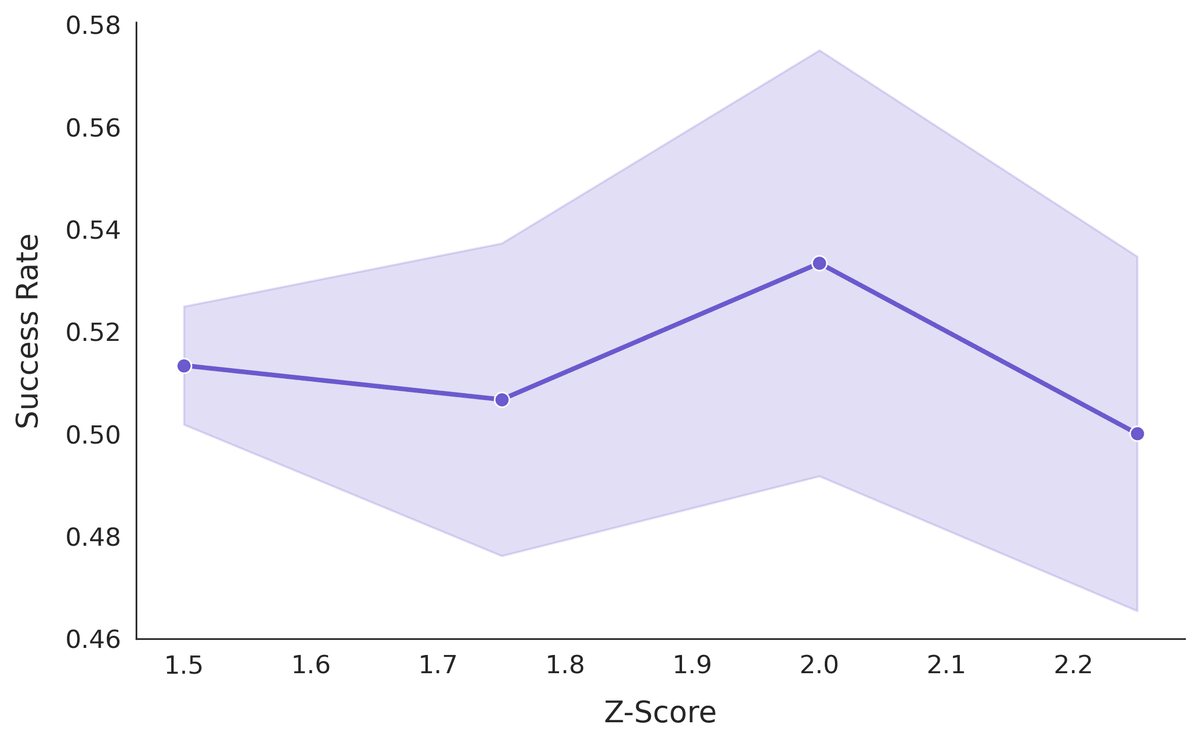
Chunks whose attention weight exceeds a z-score threshold get labeled Success-Relevant or Failure-Relevant depending on the trajectory outcome, and everything else is Irrelevant. The authors observed that chunks classified as irrelevant outnumbered success or failure ones by more than tenfold, which they read as evidence that the MIL model is actually pinpointing the few critical moments inside a long trajectory.
How the guidance actually pushes the sampler
At inference time the classifier produces two gradients: one toward success-relevant actions and one away from failure-relevant actions. These are added to the noise prediction inside the reverse diffusion loop with separate scalar weights. A useful detail: the success weight is kept much lower than the failure weight because failure modes are diverse and can occur at many points, so a strong general repulsion works well, while success-relevant actions are sparse and context-specific and a strong constant attraction can destabilize the policy.
To keep the runtime cost reasonable, the classifier is not called on every denoising step. Instead PPGuide uses an alternating guidance schedule, applying the correction on only every other denoising step, which the authors report achieves almost the same performance as constant guidance while cutting significant forward-pass compute.
Numbers on Robomimic and MimicGen
Experiments cover eight manipulation tasks including Stack, Coffee, Kitchen, Mug Cleanup, Square insertion, and Transport, drawn from Robomimic and MimicGen. To probe sample efficiency, base policies were trained on only 10 percent of the original expert demonstrations, and PPGuide was trained on rollouts from checkpoints at epochs 250 through 450, then applied to guide separate epoch-500 and epoch-550 checkpoints.

Selected success-rate gains over the base diffusion policy:
| Task | Base DP | PPGuide |
|---|---|---|
| Stack Three D1 | 28% | 34% (+6) |
| Coffee D2 | 46% | 58% (+12) |
| Coffee Prep D1 | 18% | 22% (+4) |
| Mug Cleanup D1 | 26% | 36% (+10) |
| Square | 62% | 72% (+10) |
| Transport | 68% | 76% (+8) |
A more interesting result is the heterogeneous setting, where the classifier is trained on rollouts from early checkpoints and then applied to guide much more heavily trained policies. A single PPGuide instance trained on rollouts from epoch-250 to 450 policies was used to guide separate deployment policies trained for 1300 to 1600 epochs, and the improvement on the 1300-epoch checkpoint was among the highest in the paper, suggesting the guidance model transfers rather than overfitting to a specific set of weights.
Where it helps and where it breaks
PPGuide slots in front of any pre-trained diffusion policy, which makes it attractive if you already have a policy that mostly works but occasionally derails on precision-sensitive or long-horizon steps like insertion, coffee preparation, or transport. It requires only binary success signals, no dense rewards, and no dynamics model, so it fits well into simulation pipelines and any setting where task success is cheap to check but reward shaping is not.
The honest limitations are worth flagging:
- The method depends on the quality of the initial rollouts, so a policy that rarely succeeds creates a cold start problem for the self-labeling process.
- Self-labeling can latch onto spurious correlations, where an irrelevant but recurring feature gets misread as relevant and produces flawed guidance.
- The z-score threshold and guidance strength need careful, task-specific tuning.
- Stochastic-sampling variants underperformed the deterministic alternating schedule in these tasks.
The paper does not mention a public code release. The arXiv preprint is the primary reference, with authors from Purdue and Mitsubishi Electric Research Laboratories. For teams already running diffusion policies on Robomimic-style benchmarks, PPGuide is a small enough addition that reimplementing it, an attention MIL head plus a three-way MLP classifier, is a plausible weekend exercise.