
POSTECH Study Shows Drone Vertical Climbs Silently Destroy Batteries Faster
A new framework connects quadrotor flight maneuvers directly to internal battery aging, showing that identical energy budgets can produce very different degradation.
 Pro
Takeaways
- New framework links quadrotor flight motions to specific battery degradation modes via a calibrated electrochemical model.
- Custom ±100 A sensing module logs real flight currents at 10 Hz for offline replay in a P2D cell model. Paper
- Same average energy can produce very different degradation depending on current waveform structure.
- Vertical maneuvers uniquely trigger nonlinear loss of active material through particle cracking and thermal stress.
- Hover and horizontal motions mostly accelerate lithium inventory loss via SEI growth on micro-cracks.
- No code released; framework runs offline and is validated on two quadrotor platforms with one battery pack.
Drone endurance planning almost always treats the battery as a fuel tank: subtract watt-hours, land when empty. A new study from Pohang University of Science and Technology argues that this abstraction hides a big problem. Two flight profiles that burn the same average energy can wear the battery out along completely different physical pathways, and one of them is much worse than the other.
The team behind Motion-Specific Battery Health Assessment for Quadrotors built an end-to-end pipeline that ties real flight current traces to the electrochemistry inside a lithium-ion cell. The result is a mechanistic picture of how hovering, climbing, and horizontal translation each chew through the cell in their own way.
Why treating the battery as a bucket falls apart
Energy-aware quadrotor planning has been around for a while, but prior approaches typically treated the battery as a simple energy reservoir rather than as an electrochemical system. That works if you only care about how many minutes are left. It fails once you ask why the pack that flew aggressive vertical maneuvers is dying faster than the one that cruised horizontally for the same total joules.
The reason is transient load structure. Quadrotor flight motions generate time-varying current profiles, and even at identical average energy, transient features such as peak amplitude, ripple, and duty cycle can affect batteries in different ways. Previous work either stopped at power estimation or used black-box predictors that never revealed which waveform features triggered which failure mode.
The pipeline in four stages

The framework has four moving parts, and each is doing real work:
- Reference performance tests: A battery-in-the-loop rig discharges the pack at 0.1 C and 2 C to capture both equilibrium and dynamic behavior.
- Model calibration: A pseudo-two-dimensional (P2D) electrochemical model, which resolves lithium concentration gradients inside the electrodes rather than treating the cell as a lumped circuit, is fit to that data.
- Flight data acquisition: A custom sensing module on the drone logs current at 10 Hz during real flights.
- Virtual experiments: The measured current traces are replayed inside the calibrated model to read out degradation pathways.
Calibration is done with strategically switching metaheuristics, a gradient-free optimizer that shifts its search strategy based on the loss landscape. The calibrated model closely reproduces the measured voltage trajectories across low-rate, high-rate, and dynamic pulse conditions, landing at a total RMSE of roughly 60 mV against the real pack.
On the sensing side, the module is built around a wide-range current sensor because quadrotor currents are not gentle. To accurately capture the high-magnitude current profiles typical of quadrotor flight, ranging between 10 and 100 A, the sensing module employs a ±100 A wide-range sensor, wired to an STM32 Nucleo board with an SD card for onboard logging.
What the flight data actually reveals
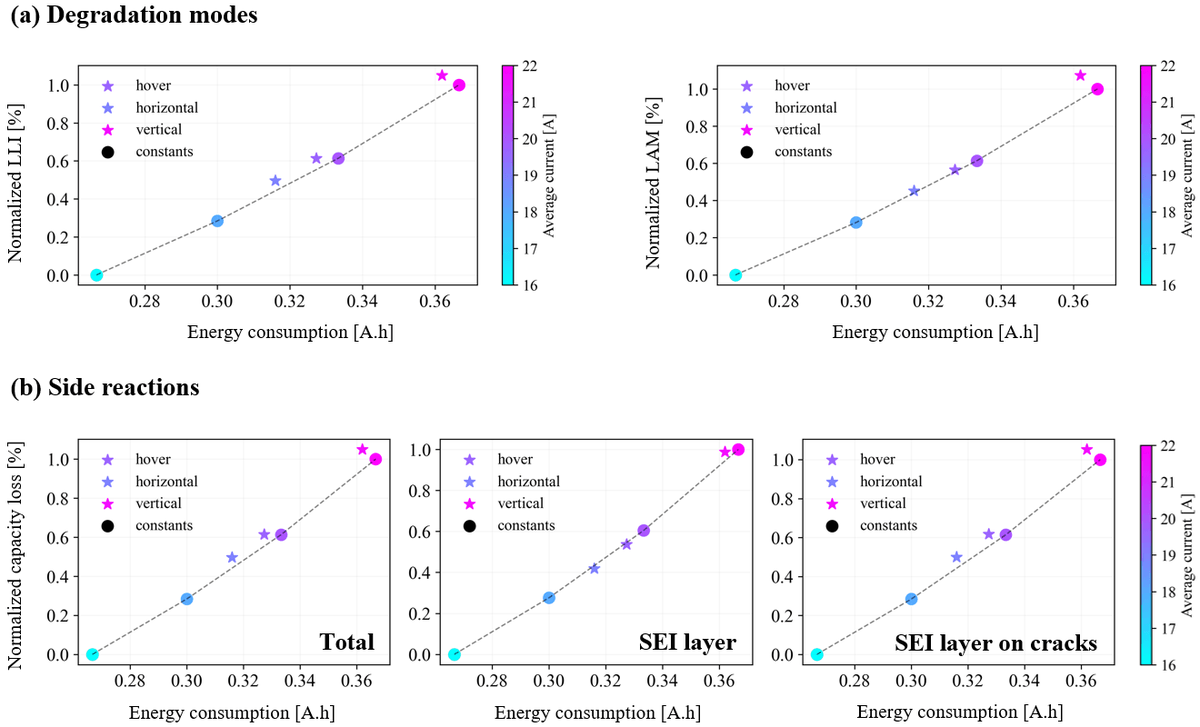
Three motion classes were isolated from mixed flights: hovering, vertical maneuvering, and horizontal translation. Each segment was reconstructed into a periodic waveform and replayed against constant-current baselines at 16 A and 22 A, which bracket the average currents seen in the real flights.

Degradation was decomposed two ways. At the mode level, the model tracks loss of lithium inventory (LLI, the cyclable lithium that gets consumed by side reactions) and loss of active material (LAM, electrode regions that become electrochemically dead). At the reaction level, it separates SEI layer growth, lithium plating, and particle cracking, including SEI that forms on freshly opened cracks.
The constant-current baselines behave the way textbooks predict, scaling roughly linearly with energy. The flight profiles do not. LLI increases more steeply than the baselines for all motions, showing that dynamic current profiles consistently accelerate lithium consumption. And LAM exhibits a pronounced nonlinear rise only under the vertical profile, while hover and horizontal motions remain close to the linear baseline trend.
The authors frame this as a two-stage aging story. All motions produce enough small ripples to seed micro-cracks, which then expose fresh surface for SEI to grow on, quietly draining lithium. Vertical motion adds something extra: large peaks and rapid transients that generate enough thermal and mechanical stress to propagate those cracks, isolate chunks of electrode, and drive LAM sharply upward.
Why this matters for anyone building drone autonomy
The practical implication is uncomfortable for anyone doing energy-optimal trajectory planning. An aggressive climb might minimize joules-per-meter on paper while quietly shortening pack life more than a slower cruise that uses the same energy. A planner that ignores current waveform shape can be efficient and abusive at the same time.
The work is useful as a template for a few concrete things:
- Building degradation-aware cost functions for trajectory optimization, where vertical accelerations get penalized above what pure energy accounting would suggest.
- Designing accelerated life tests that use flight-representative current traces rather than constant-current or synthetic pulse profiles.
- Informing battery management systems that need to derate or reroute based on cumulative mechanical stress, not just state of charge.
Limitations are worth flagging. The pipeline runs offline, not on the flight controller. The P2D model with degradation coupling is not something you drop into a real-time loop. Validation covered two quadrotor platforms and one battery chemistry, so generalization across cell formats and pack sizes is still open. The paper also does not appear to release code or the calibrated model parameters, so reproducing the pipeline means rebuilding both the sensing hardware and the calibration stack from the referenced components, including the strategically switching metaheuristics work and the degradation-coupled P2D model from earlier literature.
The bigger contribution is conceptual: a physical bridge from the shape of a current waveform to specific failure mechanisms inside the cell. Once that bridge exists, motion planning stops being a scalar energy problem and becomes a question of which internal aging pathway you are willing to pay for.