
Porsche and Delft Crack Silicon Battery's Hardest Problem With Probabilistic AI
A Porsche-backed research team builds a probabilistic ML pipeline that predicts battery hysteresis factors from real EV fleet data, enabling accurate SoC estimation for next-gen silicon-graphite anodes.
 Pro
Takeaways
- Researchers from Delft University of Technology and Porsche Engineering built a probabilistic ML pipeline to predict the hysteresis factor in silicon-graphite EV batteries.
- Silicon-graphite anodes cause voltage hysteresis -- the same voltage can map to different SoC values depending on charge direction -- breaking standard BMS lookup tables.
- A four-stage data harmonization framework standardizes heterogeneous real-world fleet data across vehicle models, temperatures (-18.3°C to 48.9°C), and sampling rates.
- A Quantile GRU (QGRU) achieved the best accuracy (AQL 2.15×10⁻²); Quantile XGBoost offers a strong accuracy-memory trade-off for constrained hardware.
- Zero-shot transfer to a new vehicle model degraded performance by 415.9%; fine-tuning or joint training is strongly recommended instead.
- Dataset and labeling algorithm remain confidential; the project page will be updated if data is released. Paper accepted to IEEE Transactions on Transportation Electrification.
Silicon-graphite anodes are the battery industry's next big bet. They promise longer range and faster charging than conventional graphite cells, and graphite-silicon composite anodes are projected to rise from 5% of battery capacity in 2022 to 17.5% by 2035. Porsche, Mercedes, and GM are already committed to the technology. But there is a catch that does not make the headlines: silicon breaks the fundamental assumption that every battery management system relies on.
Researchers from Delft University of Technology and Porsche Engineering Group have published a paper tackling this exact problem. Their work, accepted to IEEE Transactions on Transportation Electrification, introduces a probabilistic machine learning pipeline that predicts a battery's hysteresis factor directly from real-world driving data, without expensive lab tests and with enough efficiency to run inside a vehicle's constrained hardware.
The Problem Silicon Creates
Every battery management system (BMS) estimates state-of-charge (SoC) -- how full the battery is -- using a lookup table that maps open-circuit voltage (OCV) to SoC. This works cleanly when one voltage corresponds to one SoC. Silicon breaks that assumption. The high ability for lithiation comes along with massive volume changes and a problematic voltage hysteresis, causing reduced efficiency, detrimental heat generation, and a complicated state-of-charge estimation.
Voltage hysteresis means the OCV curve during charging sits above the curve during discharging. At a given voltage, say 3.5V, the battery could be at 10% or 20% SoC depending on whether it was just charging or discharging. In the case of a lithium-ion battery with a negative electrode containing silicon-based material and graphite, the open-circuit voltage after charging differs from that after discharging at the same SoC, and a unique correspondence between voltage and SoC is not established.

The standard fix is a hysteresis factor: a scalar value between -1 and +1 that blends the charging and discharging OCV curves to give a corrected SoC estimate. Predict it accurately, and you recover reliable SoC. Predict it poorly, and the BMS either wastes usable range by being overly conservative or risks damaging the battery by operating outside safe limits. A more precise SoC estimation reduces the required SoC buffer, which is typically set to account for estimation uncertainties and protect the battery from aging, enabling a greater depth of discharge and increasing the usable capacity.
Why Existing Approaches Fall Short
Prior work has three main blind spots that this paper directly addresses:
- Wrong chemistry: Existing approaches to modeling hysteresis rely on exhaustive high-fidelity tests or focus on conventional graphite-based lithium-ion batteries, without considering uncertainty quantification or computational constraints.
- No uncertainty: Prior ML models produce point estimates with no confidence bounds, which is dangerous in a safety-critical system operating under non-stationary real-world conditions.
- Ignoring hardware limits: BMS units have severely constrained RAM and ROM. A model that works on a GPU cluster is useless if it cannot fit on an embedded controller.
There is also a data problem. Real-world fleet data from different vehicle models has different sampling rates, different feature sets, different sequence lengths, and wildly different operating conditions -- temperatures ranging from -18.3°C to 48.9°C in this dataset. No prior work had proposed a systematic way to harmonize all of this before feeding it into a model.
The Pipeline, Step by Step
The team built a four-stage data harmonization framework to turn messy fleet data into clean model inputs:
- Filtering: Only battery current, cell voltage, and cell temperature are kept as inputs. SoC and capacity are deliberately excluded to avoid leaking the target variable into the features.
- Segmentation: Driving cycles are split into valid segments -- a segment starts after a relaxation period (when the battery rests and voltage stabilizes) followed by a SoC correction, and ends at the next correction. Segments shorter than 10 seconds or with zero current throughout are discarded.
- Resampling: All data is resampled to 10 Hz to eliminate inconsistencies from different logging equipment across vehicle models.
- Scaling: Features are min-max normalized to [0,1], with separate scalers for statistical and deep learning model branches.
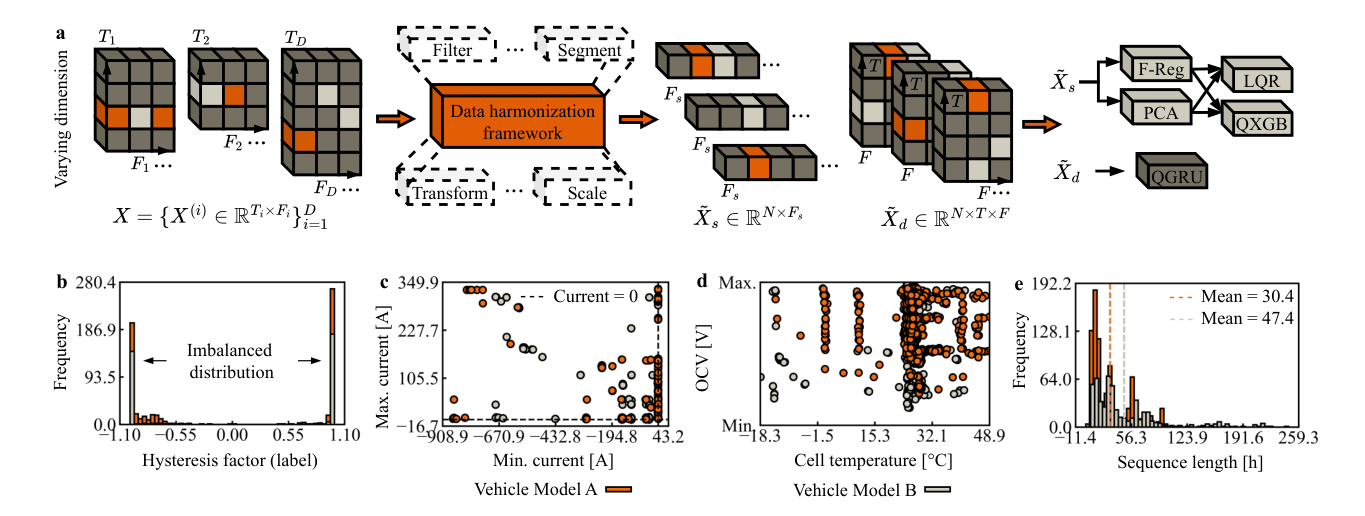
The harmonized data then feeds into three model families, all trained to output quantile predictions (5th, 50th, and 95th percentiles) rather than point estimates -- giving a calibrated uncertainty band around every prediction:
- Linear Quantile Regression (LQR): A fast, interpretable baseline. Compresses features via PCA or F-regression first, then fits a linear model per quantile. Minimal RAM and ROM, but limited accuracy.
- Quantile XGBoost (QXGB): Gradient-boosted decision trees trained with quantile loss. Captures non-linear patterns and offers a strong accuracy-vs-memory trade-off.
- Quantile GRU (QGRU): A recurrent neural network that processes the raw time-series tensor directly. GRU (Gated Recurrent Unit) was chosen over LSTM because it achieves comparable accuracy with fewer parameters -- critical for deployment on constrained hardware.
Results: Who Wins and When
The team evaluated all models on Average Quantile Loss (AQL) -- lower is better -- alongside RAM and ROM footprint. The QGRU came out on top in accuracy, achieving an AQL of 2.15 × 10⁻², while QXGB with F-regression reached 2.67 × 10⁻² with a fraction of the memory cost. LQR lagged significantly at 7.67 × 10⁻².

The practical recommendation from the paper:
- Use QGRU when prediction accuracy is the priority and hardware allows it.
- Use QXGB + F-Reg for a strong accuracy-efficiency trade-off in moderately constrained environments.
- Use LQR only in extremely resource-limited deployments where any prediction beats none.
Transferring to a New Vehicle Model
A key question in any real deployment: what happens when you have a new car model with a different cell chemistry and less data? The team tested four strategies using two vehicle models (A and B) with different chemistries and electrical specs:
- Zero-shot (A/B): Train on vehicle A, test directly on vehicle B. This performed worst, with 415.9% higher loss than training solely on dataset B. Not recommended when chemistries differ.
- Fine-tuning (A→B/B): Pre-train on A, fine-tune on B. This recovered nearly all performance, achieving an AQL close to the fully retrained baseline.
- Joint training (A+B/B): Train on both datasets combined. Achieved the best AQL of
7.60 × 10⁻³, slightly outperforming retraining on B alone. - Retraining (B/B): Train fresh on B only. Strong baseline, but wastes the knowledge from vehicle A's larger dataset.
An interesting nuance: using the scaler fitted on the larger vehicle A dataset often outperformed refitting a new scaler on B, because A's statistics were more representative. When the model is fine-tuned but the scaler is replaced, the input distribution shifts away from what the model learned, degrading performance.
What This Unlocks
The real breakthrough here is not just accuracy -- it is the combination of probabilistic outputs, hardware awareness, and cross-vehicle generalization in a single framework built on real fleet data. Fast-charging capabilities with charging speeds potentially under 10 minutes could eliminate charge anxiety, transforming the EV market by enabling smaller, cheaper batteries and dramatically accelerating EV adoption -- but only if the BMS can actually track SoC reliably through the hysteresis region.
The authors note that the dataset and Porsche's labeling algorithm remain commercially confidential for now. Code dependencies are listed (PyTorch 2.3.1, XGBoost 2.0.3, scikit-learn 1.4.2), and the project summary page will be updated if the data is released. No public model weights or training code are available at this time.
For teams building BMS software for next-generation silicon-graphite cells, this paper offers a concrete, hardware-aware blueprint: harmonize your heterogeneous fleet data, predict the hysteresis factor probabilistically, and use fine-tuning rather than zero-shot transfer when you deploy to a new vehicle platform.