
Polytechnique Montréal's ARC Teaches YOLO11 New Tricks Without Forgetting Old Ones
Polytechnique Montréal researchers propose an architecture that adds new detection classes to YOLO11 without wiping out its original knowledge, cutting forgetting from 100 percent to just over 1.
 Pro
Takeaways
- Polytechnique Montréal researchers propose Adaptive Residual Context, an architecture that adds new detector classes without catastrophic forgetting.
- Applied to YOLO11, it pairs a frozen context branch with trainable task-specific heads linked by an attention-based Context-Guided Bridge.
- Fine-tuning YOLO11 on a shuttle dataset drops COCO mAP from 63.7 percent to zero after 100 epochs.
- ARC hits 47.3 percent shuttle mAP while keeping 62.6 percent on COCO, losing only 1.1 points versus 100 for fine-tuning.
- It beats EWC and LwF on both the new task and knowledge retention without needing the original training data.
- Custom dataset of 3,120 annotated images from YouTube footage and Montreal intersections; built on the Ultralytics stack.
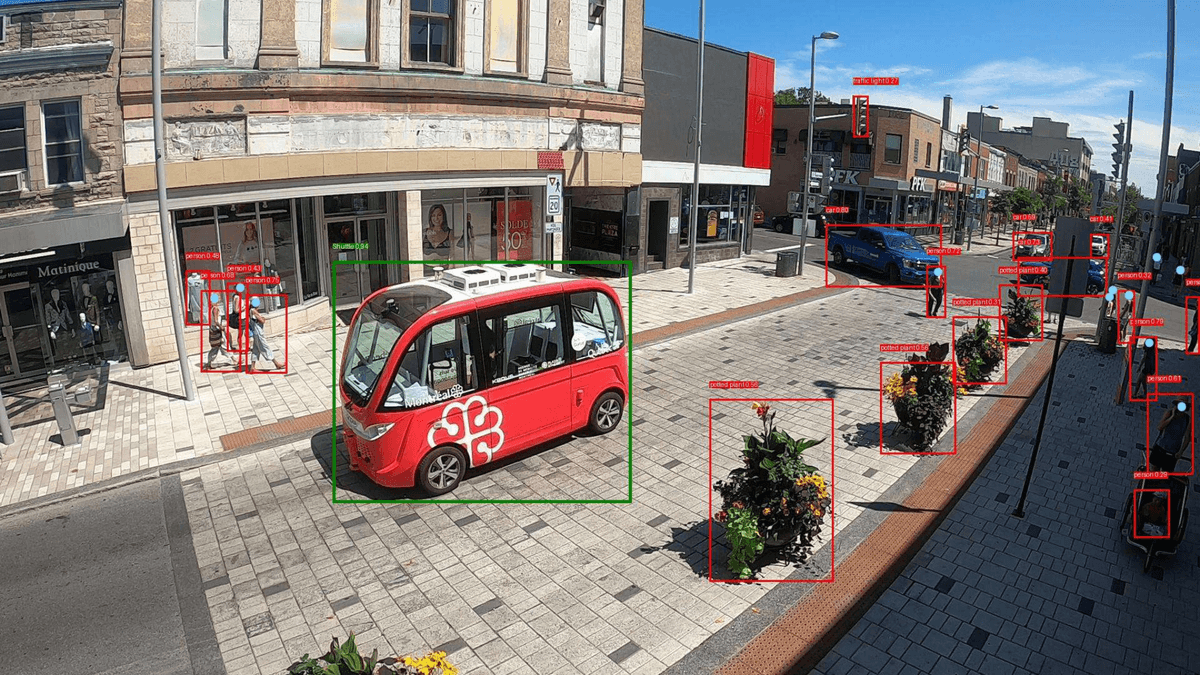
Adding a single new object class to a production object detector sounds trivial. In practice it can nuke everything the model already knew. A new paper from Polytechnique Montréal proposes a structural fix for this problem in the context of urban traffic monitoring, specifically for detecting the small but growing category of autonomous shuttles.
The work, Detection of Autonomous Shuttles in Urban Traffic Images Using Adaptive Residual Context, introduces an architecture called Adaptive Residual Context (ARC) that grafts new detection heads onto a frozen YOLO backbone. The authors apply it to YOLO11 as a case study, but the design is meant to generalize to any scenario where you need to extend a pretrained detector with new classes and cannot afford to lose the old ones.
The catastrophic forgetting tax on fine-tuning
The motivation is concrete. Cities want to monitor how automated shuttles interact with other road users using fixed traffic cameras, but off-the-shelf detectors have never seen them. The usual answer, fine-tuning, causes catastrophic forgetting, a phenomenon where the model degrades on its original scene understanding as it learns the new target. For safety applications that need to keep tracking pedestrians, cars, and cyclists while also flagging a shuttle, that trade-off is unacceptable.
The paper quantifies the damage cleanly. After 100 epochs of fine-tuning YOLO11 on a shuttle dataset, the model reaches 47.4 percent mAP on the new class but drops to 0 percent mAP on COCO. Every previous class is effectively gone. Existing continual-learning workarounds like Elastic Weight Consolidation and Learning without Forgetting reduce the damage but either sacrifice new-task accuracy, add storage overhead, or require keeping the original training data around.
How ARC is built

ARC keeps the pretrained YOLO11 backbone and replaces the single detection head with two parallel streams:
- A frozen context branch: a direct copy of the pretrained detection head with all weights locked. It keeps outputting the original COCO classes and acts as a stable reference.
- One or more trainable task-specific branches: new heads that learn only the new classes, such as autonomous shuttles.
The interesting piece sits between them. A Context-Guided Bridge uses attention to transfer spatial features from the frozen branch to the trainable branch while preserving the pretrained representations. Inside the bridge, features from the frozen head pass through channel attention (which channels matter), then spatial gating (where in the image to look), and are injected back into the new head through a residual connection controlled by a learnable scalar alpha. In effect, the frozen head whispers hints about which regions and channels are semantically meaningful without ever being updated itself.
At inference time the authors add a veto rule: if the frozen branch fires a high-confidence detection (IoU > 0.5) that conflicts with a task-specific prediction in the same region, the new branch is suppressed. This keeps the model from hallucinating shuttles on top of clearly identified cars or trucks.
The numbers
The team built a custom dataset of 3,120 manually annotated images pulled from public YouTube footage and recordings at Montreal intersections, then benchmarked ARC against pretrained YOLO, straight fine-tuning, joint training, EWC, and LwF. Detection is measured with standard COCO mAP, and forgetting is tracked as the absolute drop in mAP on the original classes after training on the shuttle data.
| Method | Shuttle mAP | COCO mAP | Forgetting |
|---|---|---|---|
| Pretrained YOLO11 | 0.0% | 63.7% | N/A |
| Fine-tuning | 47.4% | 0.0% | -100% |
| Joint Training | 47.6% | 60.2% | N/A |
| EWC | 40.3% | 51.8% | -11.9% |
| LwF | 46.8% | 59.0% | -3.7% |
| ARC | 47.3% | 62.6% | -1.1% |
ARC lands within 0.1 point of the fine-tuned baseline on the new class while giving up only 1.1 points on COCO, versus 100 for fine-tuning and 11.9 for EWC. Joint training is competitive on quality but, as the authors note, requires holding on to the entire original training set, which is often infeasible when the base weights come from someone else's large-scale pretraining.

Why this matters beyond shuttles
The real contribution is not a shuttle detector. It is a recipe for extending a frozen backbone with new specialist heads that still get to consume the backbone's semantic understanding of the scene, mediated by attention. That pattern fits any deployment where you have a solid general-purpose detector and want to add a niche category, whether that is construction equipment, delivery robots, e-scooters, or specific vehicle liveries, without retraining from scratch or maintaining rehearsal buffers.
There are caveats worth naming. The dataset is small (3,120 images) and single-class, so the study only demonstrates one new head at a time. The paper does not report inference latency for the dual-branch setup, which matters if you plan to run this on edge cameras. And the veto logic is a hand-tuned inference-time heuristic that assumes the frozen branch's detections are trustworthy, which they may not be for classes visually close to the new one. The authors flag a temporal extension of the Context-Guided Bridge as future work, aiming at tracking in dynamic scenes.
The paper is available on arXiv; the implementation is built on the Ultralytics YOLO library in PyTorch, though a public code release for ARC itself is not mentioned in the paper.