
Politecnico di Torino's LLM Agent Rewires Honeypot Traps Mid-Attack in Real Time
An LLM agent reads intrusion alerts, infers where attackers are in the kill chain, and reshuffles honeypots on the fly under strict budget limits.
 Pro
Takeaways
- Politecnico di Torino team proposes LLM agent that dynamically reconfigures honeypots based on live IDS alerts.
- Agent infers attacker stage using MITRE ATT&CK chain: discovery, initial access, exfiltration, privilege escalation.
- Four-layer design: Perception, Inference, Exposure, Enforcement, exposing at most K services per turn.
- Evaluated across 81 runs with CVEs in GitLab, Apache Struts, Docker API, Xdebug and three LLM backends.
- All models hit 100% engagement when everything is exposed; budget-constrained setting is where gains appear.
- Code, containers and benchmark released on GitHub under SmartData-Polito.
Honeypots have always faced a resource problem. You want to leave enticing services exposed to observe attackers, but you cannot afford to run every possible decoy at once, and static configurations quickly get stale against adversaries who shift tactics mid-campaign. A team from Politecnico di Torino and Università di Torino is proposing to hand that configuration decision to an LLM-driven agent that watches an attack unfold and rewires the deception surface in real time.
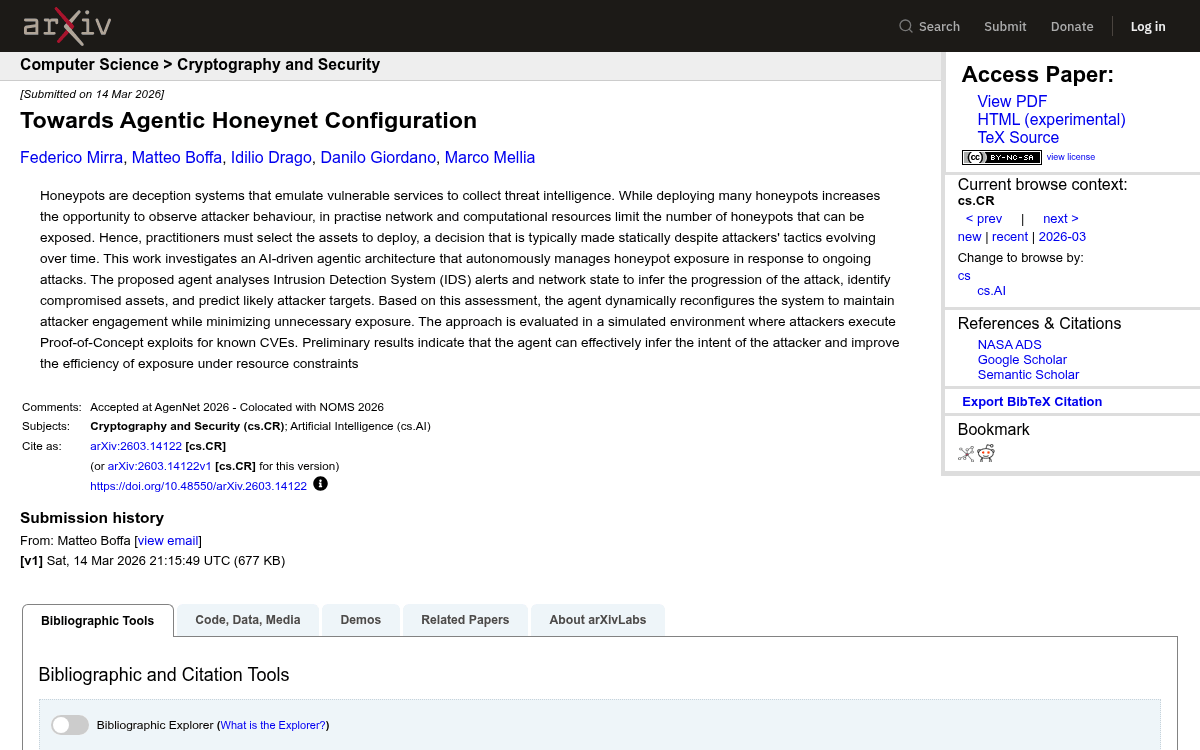
The paper, Towards Agentic Honeynet Configuration, was accepted at AgenNet 2026 (co-located with NOMS 2026). The authors also released the full implementation as adaptive-honeynet-agent, including the containerized attacker lab and the multi-agent reasoning code.
Why static honeynets keep losing
Defenders face a persistent asymmetry: attackers continuously adapt their tactics, discover new vulnerabilities, and exploit weaknesses faster than static defences can evolve, while honeypots collect threat intelligence and enable systematic study of adversarial behaviour. The catch is budget. Network and computational resources limit the number of honeypots that can be exposed, so practitioners must select the assets to deploy, a decision that is typically made statically despite attackers' tactics evolving over time.
That mismatch is the gap this work targets. Instead of picking a fixed decoy loadout at deployment time, the agent treats exposure as a live decision that changes turn by turn as evidence about the attacker accumulates.

How the agent thinks
The agent continuously analyzes IDS alerts, infers where attackers are in a multi-stage exploitation chain aligned with MITRE ATT&CK, and reconfigures the honeynet to expose the services most likely to sustain engagement, all under a strict deployment budget. The core idea is to treat adaptive honeypot management as a sequential decision problem under partial observability, where an LLM reasons over noisy security telemetry to track attacker intent and allocate deception resources accordingly.
Partial observability matters here. The agent never sees the attacker directly. It only sees IDS alerts, which are noisy, delayed, and easy to misread. The LLM's job is to turn that stream into a hypothesis about which MITRE ATT&CK stage the intruder is in, then bet its limited exposure budget on the services most likely to keep the intruder engaged in the next step.
The architecture is split across four layers that mirror a classic sense-decide-act loop with an added enforcement stage:
- Perception: ingests IDS alerts and current network state.
- Inference: reasons about compromised assets and the attacker's likely next objective.
- Exposure: chooses which honeypots to bring up or tear down, respecting the budget K.
- Enforcement: pushes the new configuration to the honeynet.

The simulated cat and mouse
The simulation instantiates attackers executing proof-of-concept exploits for known CVEs, progressing through a multi-stage exploitation chain aligned with MITRE ATT&CK: discovery, initial access, user-level data exfiltration, privilege escalation, and root-level data exfiltration. The defending agent and attackers act in alternating turns, with the agent exposing at most K services per step. An attacker advances only when the agent exposes a service aligned with its current objective.
Scripted attackers execute proof-of-concept exploits against real CVEs in GitLab, Apache Struts, Docker API, and Xdebug, with multiple attacker persistence models and several LLM backends. The authors evaluate the agent across 81 configurations varying the number of attackers, the pool of vulnerable services, and the LLM backend, focusing on the agent's ability to sustain engagement until the attacker completes its chain and to accurately track attack progression.
What the numbers show
Two headline findings emerge from the runs. First, when everything is exposed and there is no ambiguity to reason about, LLMs behave as expected: in the fully vulnerable setting, all models achieve a 100% success rate, confirming that in the absence of attack-surface ambiguity the agent trivially wins the engagement metric. That is the sanity check, not the interesting result.
The interesting result is what happens once the exposure budget bites. Preliminary results indicate that the agent can effectively infer the intent of the attacker and improve the efficiency of exposure under resource constraints. In other words, a dynamically reconfigured honeynet keeps attackers engaged with fewer decoys running than a fixed layout would need, which matters both for cost and for reducing the risk that a real service gets caught in the deception net.
Where it fits, and where it does not
This is explicitly a preliminary, workshop-scale study. A few limits are worth calling out for anyone considering building on it:
- The evaluation runs in a discrete-time simulator with scripted attackers, not against live adversaries or red teams.
- Only four CVE families are used as exploit paths, which keeps the inference problem tractable but bounded.
- LLM latency and cost are not the focus, which will matter the moment anyone tries to run this against real IDS alert volumes.
- The agent relies on API keys for external LLM providers such as OpenAI, meaning security telemetry may leave the perimeter unless a local model is swapped in.
Still, the framing is what makes this worth watching. Adaptive deception has usually been posed as a reinforcement learning problem with hand-crafted state spaces. Reframing it as LLM-driven inference over IDS text, with MITRE ATT&CK stages as the latent variable, sidesteps a lot of feature engineering and slots naturally into existing SOC tooling. The repository ships the multi-agent reasoning engine, the Dockerized attacker and firewall containers, and the benchmark harness, so anyone with an OpenAI key and a spare afternoon can reproduce the setup and swap in their own alert sources.