
Politecnico di Torino's Geometric Method Picks GPS Anchors 4x Better Before Measuring
A new geometry-based framework picks the best anchors for range-based localization before measurements and certifies uncertainty after, hitting near-oracle accuracy.
 Pro
Takeaways
- New paper derives E- and D-type geometry scores for offline anchor selection in range-based localization.
- Scores use only anchor coordinates via the centered scatter matrix S(A), no measurements needed.
- D-score subset averages just 4% above oracle box area; E-score 6% above, in Monte Carlo tests.
- New H-aware online certificates stay tight when the polyhedral bound blows up near collinearity.
- Hybrid bound tracks realized uncertainty with 0.984 log-log correlation across 4,200 subsets.
- Builds on prior set-membership localization work; no public code released yet.
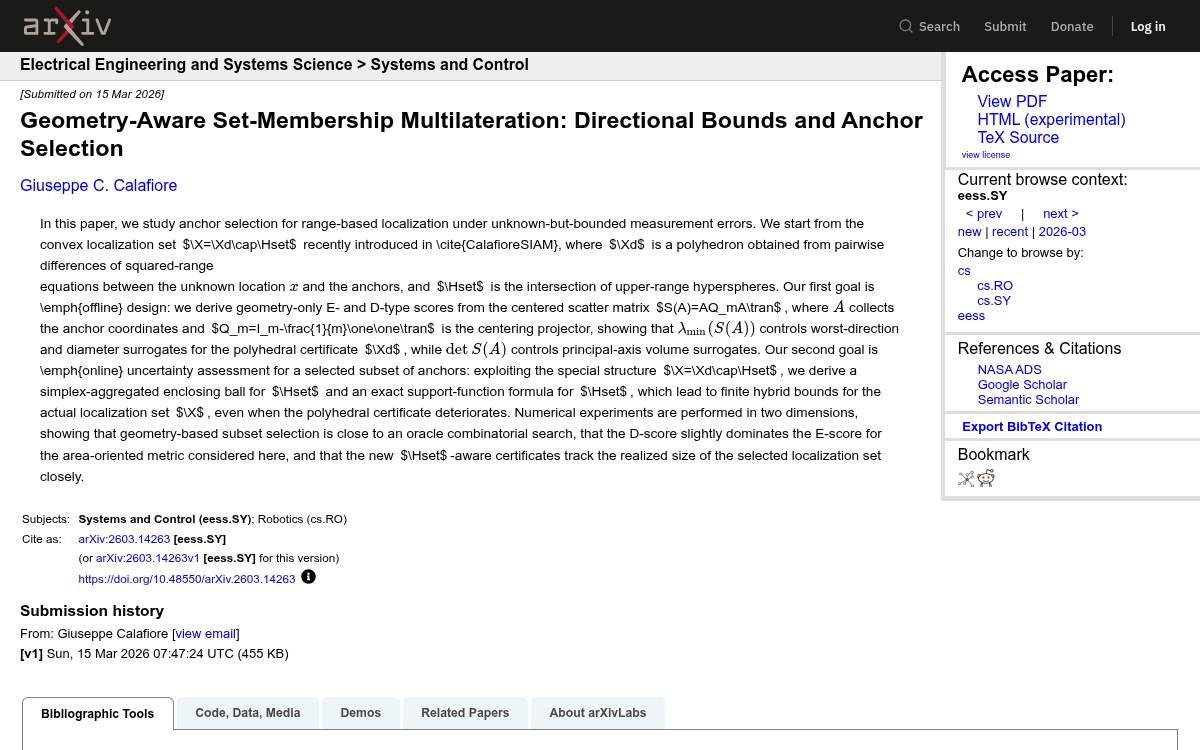
Anyone who has debugged a GPS receiver, a drone swarm, or an indoor UWB tracker knows the pain of anchor placement. You have a handful of beacons, noisy distance measurements, and a target whose position you need to pin down. Choose the wrong subset and your uncertainty region blows up. A new paper from Giuseppe Calafiore at Politecnico di Torino tackles this problem with a clean geometric recipe that decides which anchors to activate before you measure, then certifies how tight your localization actually is after.
Bounded error, unbounded headache
Most localization work assumes measurement noise is Gaussian and produces a single point estimate with a covariance. That works when you trust your noise model, but it says nothing about worst-case guarantees. Set-membership and interval methods instead seek guaranteed uncertainty sets under unknown-but-bounded errors, which is what safety-critical navigation actually needs.
The catch is that the true feasible region, the intersection of spherical annuli around each anchor, is nonconvex and ugly. A recent construction takes pairwise differences of the squared-range equations to eliminate the quadratic term, yielding a convex polyhedron that contains the true feasible set. Intersecting that polyhedron with the outer balls gives a refined convex localization set that is much easier to reason about. Two questions were left open: which anchors should you pick from a candidate pool, and how do you certify the resulting uncertainty when the polyhedron gets loose?
Two scores you can compute without measuring anything
The core insight is that the size of the polyhedral certificate is governed almost entirely by one matrix: the centered scatter S(A) = A Q_m A^T, where A stacks the anchor coordinates and Q_m centers them around the anchor centroid. From this, two scores fall out naturally:
- E-score:
λ_min(S(A))controls the worst-direction width and the diameter of the polyhedral bound. Maximize it when you care about the worst direction of ambiguity. - D-score:
det S(A)controls the principal-axis volume. Maximize it when you care about overall area or volume of uncertainty.
These act as deterministic E- and D-optimality criteria, bounding guaranteed-set surrogates rather than local covariance matrices, echoing classical experimental design but without any statistical assumptions. Best of all, they depend only on anchor positions, so you can score subsets before collecting a single range measurement.
Certifying the actual set after the fact
The polyhedral bound alone gets ugly when anchors approach collinearity, because S(A) becomes ill-conditioned. The paper's second contribution exploits the intersection with the upper-range balls H to derive two online certificates: a simplex-aggregated enclosing ball with radius ρ*, and an exact support-function formula for H obtained via SOCP duality. Together they give hybrid directional bounds that stay finite and informative even when the polyhedral part deteriorates.
The numbers
Monte Carlo experiments in 2D with 8 candidate anchors and subsets of size 4 (70 combinations enumerated exhaustively) show how close the geometry-only scores get to an oracle that picks the true best subset:
| Method | Mean box area of X | Relative to oracle |
|---|---|---|
| Oracle subset | 1.42e-3 | 1.00 |
| D-score (max det S) | 1.47e-3 | 1.04 |
| E-score (max λ_min S) | 1.50e-3 | 1.06 |
| Average subset | 5.85e-3 | 4.13 |
In 25 of the 60 trials the D-score recovers the oracle selection exactly; the E-score does so in 24. The hybrid H-aware bound also tracks the realized uncertainty tightly, with a log-log correlation of 0.984 against the exact box area and a mean bound-to-truth ratio of 1.69.
The near-collinear stress test is where the H-aware machinery earns its keep. As one anchor is pulled toward the line joining two others, the exact vertical width grows from 0.073 to 0.686, while the pure polyhedral bound blows up from 0.083 to 1.25. The H-support version stays much closer to the truth, and the hybrid minimum automatically switches to whichever term is tighter.
Where it fits, and where it does not
The workflow slots naturally into any system with an activation budget: GPS satellite selection, UWB anchor scheduling, UAV ranging under power constraints, underwater acoustic beacons. In standard applications like GPS or drone localization, the total number of available anchors is typically small, in the range 4 to 12, making exhaustive search computationally viable. For larger pools the scores plug into greedy or branch-and-bound schemes.
Limitations worth flagging: experiments are 2D only (though the theory scales to any dimension), the model assumes anchor positions are known exactly, and the framework is static rather than tracking a moving target over time. Extending these geometry-aware certificates to dynamic localization with bounded-error kinematic models, and incorporating unknown-but-bounded uncertainty on the anchor positions themselves, are flagged as open directions.
The takeaway
The real advance is separating two questions that the literature usually mashes together. Anchor geometry is an offline design problem that can be handled with cheap linear-algebra scores. Realized uncertainty is an online problem where the intersection with the outer balls does most of the work, especially when the polyhedron gets loose. The paper builds on a precursor construction of the localization set and turns it into an actionable workflow. No code repo has been released, but the required primitives, a small SOCP per support query plus eigenvalue and determinant evaluations, are one-liners in any convex optimization library.