
Politecnico di Milano's MAcPNN Teaches Edge Devices to Learn Without Constant Network Chatter
MAcPNN lets IoT edge devices share knowledge on-demand during concept drifts, cutting inter-device communication by 99.7% versus federated learning baselines
 Pro
Takeaways
- MAcPNN is a new learning paradigm for IoT edge devices that share model knowledge on-demand during concept drifts, without a central server.
- Devices communicate only when a drift is detected, reducing network traffic to 0.3-0.4% of what federated learning requires.
- Each device runs a Quantized cPNN (INT8, ~25-30% the size of the original), making model transfer and ensembling feasible on constrained hardware.
- MAcPNN is statistically the best model at adaptation speed across all tested datasets (synthetic SineRW, Weather, AirQuality), beating ARF, cLSTM, and cPNN.
- Key limitation: experiments assume a perfect drift detector and only test abrupt drifts; gradual drifts and large networks remain open problems.
- Full code is available at github.com/federicogiannini13/macpnn.
Deploying machine learning on IoT edge devices sounds straightforward until the real world intervenes. Sensors don't produce static data. Weather changes, machinery degrades, air quality shifts. The statistical patterns a model learned last month may be completely wrong today. This phenomenon, called concept drift, is one of the central unsolved problems in edge AI, and existing solutions force an uncomfortable tradeoff: either retrain from scratch and forget everything, or communicate constantly with other devices and drown in network overhead.
A new paper from Politecnico di Milano proposes a different path. MAcPNN: Mutual Assisted Learning on Data Streams with Temporal Dependence introduces a learning paradigm where edge devices behave more like students than servers. They learn independently, ask for help only when they get stuck, and decide for themselves whether that help is actually useful.
Three problems, one very hard knot
Within IoT applications, sensors consistently gather data, generating unbounded data flows known as data streams. Training ML models on these streams is hard for three compounding reasons:
- Concept drift: Data can change its distribution and generate the problem known as concept drift. ML algorithms should exhibit resilience to these changes, ensuring that performance remains consistent during and after the drift.
- Temporal dependence: Consecutive sensor readings are correlated. Predicting whether NO2 levels are rising right now depends on what they were doing five minutes ago. Most streaming ML methods ignore this.
- Catastrophic forgetting: While learning new knowledge, a model must achieve a trade-off between the ability to learn new information and the capacity to remember the past one. Old concepts may re-occur in the future. Additionally, new concepts can be similar to previous ones, or past knowledge can be useful in solving the current concept.
Existing approaches handle these in isolation. Streaming ML libraries like Adaptive Random Forests handle drift but ignore temporal structure. Continual learning methods handle forgetting but assume large batches of data are available at once. Time-series models handle temporal dependence but don't adapt to drift. Streaming Continual Learning (SCL) is an emerging paradigm specifically aimed at tackling these issues, combining elements of Streaming Machine Learning, Continual Learning, and Time Series Analysis.
The authors' prior work, cPNN (Continuous Progressive Neural Networks), was the first architecture to tackle all three simultaneously. cPNN tames concept drifts, handles temporal dependencies, and bypasses catastrophic forgetting. It is a continuous version of Progressive Neural Networks, a methodology for remembering old concepts and transferring past knowledge to fit the new concepts quickly. When a drift is detected, cPNN adds a new LSTM module (called a "column") to its architecture. The previous columns are frozen, preserving past knowledge, while the new column learns the current concept by also reading the frozen columns' outputs, enabling transfer.
But cPNN was a single-device solution. MAcPNN extends it to a network of devices that can share knowledge with each other.
Learning from Vygotsky
The authors formulate a novel learning paradigm called Mutual Assisted Learning (MAL). MAL is inspired by Vygotsky's popular Sociocultural Theory of Cognitive Development, highlighting the importance of social interaction during learning. The theory centers on the Zone of Proximal Development (ZPD) -- the gap between what someone can do alone and what they can do with guidance. In MAcPNN, edge devices are the learners. When a device hits a concept drift, it may be in its ZPD, and it can ask peers for their models.
The key insight is that communication is triggered by need, not by a schedule. Whenever a device degrades its performance due to a concept drift, it asks for assistance from others and decides whether their knowledge is useful for solving the new problem. This way, the number of connections is drastically reduced compared to classical Federated Learning approaches, where the devices communicate at each training round.
How it works, step by step
Each device runs a Quantized cPNN (QcPNN) -- a memory-compressed version of cPNN that uses INT8 quantization on frozen columns, reducing their size to roughly 25-30% of the original floating-point footprint. This makes it practical to transfer models over a network and run ensembles on constrained hardware.
The training loop for each device works as follows:
- The device streams data and makes predictions one point at a time using a new "anytime" loss function (a change from the original cPNN, which required a full mini-batch before it could predict).
- A concept drift detector fires. The device requests copies of all peer models.
- It adds a new column to every received model and its own, forming an ensemble.
- For a configurable window (default: 50 mini-batches), all models in the ensemble make predictions. Performance is tracked per model.
- The best-performing model is selected and becomes the device's new local model. The rest are discarded.
- If the device's own model wins, it learned the new concept alone. If a peer's model wins, it adopted that peer's knowledge.
This on-demand mechanism has a dramatic effect on communication volume. The number of communications in the naive approach (communicating at every training round) is reduced by a factor of 1/N_B, where N_B is the number of mini-batches per concept. In the paper's experiments with three devices and four drifts each, the total number of communications is 0.3% to 0.4% of the naive approach's count.

What the benchmarks show
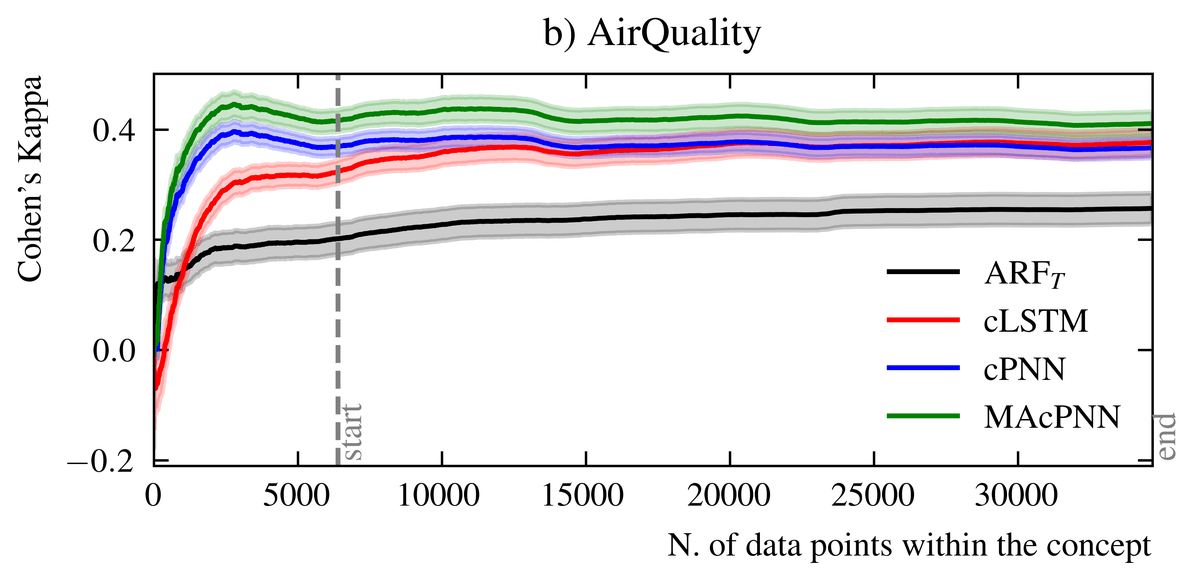
The team tested on three datasets: a synthetic generator (SineRW) with controlled temporal dependence, real hourly weather data from two mountain stations (96,432 points each), and air quality readings from 25 Seoul stations. Each experiment simulates a three-device network where devices observe different concepts at different times, with some concepts shared across devices but occurring asynchronously.
Evaluation uses Cohen's Kappa (a classification quality metric that accounts for class imbalance) measured at two moments per concept: start (the first 50 mini-batches after a drift, measuring adaptation speed) and end (the full concept score, measuring final quality). Results across 10 synthetic and 50 real-data configurations:
- Adaptation speed (start): MAcPNN is statistically the best model in every dataset and every drift. On SRW, it reaches a Kappa of 0.81 vs. 0.69-0.74 for all baselines.
- Final concept quality (end): MAcPNN leads on SRW (0.86 Kappa) and AirQuality (0.41 Kappa). On Weather, cLSTM can approach MAcPNN by the end of a concept -- but only because Weather concepts are long enough for cLSTM to eventually catch up.
- SML models (ARF, HAT): The SML models cannot learn concepts incorporating elaborated temporal dependence and achieve low scores. They simply don't have the architecture to handle correlated sequences.
The Nemenyi post-hoc statistical test across all 100 real-data configurations confirms MAcPNN as statistically the best model at concept start in every case, and at concept end in all but the final drift (where it still ranks first, just without a statistically significant margin).
Where it falls short
The paper is transparent about its limitations. The experiments assume a perfect concept drift detector -- one that fires exactly when a drift occurs with no false positives or missed detections. Real detectors like ADWIN are noisier, and integrating one into the cPNN architecture is listed as future work. The current experiments also only test abrupt drifts, not gradual or incremental ones, which are common in practice. Finally, the network is small: three devices. The current solution is for a network with few devices. The authors intend to test MAcPNN in larger networks and connect each device only with its neighbors to avoid the quadratic growth of communications.
When to reach for this
MAcPNN is a strong fit when you have:
- A network of edge devices each seeing a different slice of reality (different sensors, locations, or machines)
- Data that is temporally correlated (readings depend on recent history)
- Concepts that shift over time and may recur or be shared across devices at different times
- Bandwidth or latency constraints that rule out round-trip communication at every training step
It is less suited to scenarios where all devices observe the same distribution (standard federated learning is simpler there), where drift is gradual rather than abrupt, or where you need a very large device network without neighborhood-based routing.
All the code and data used in this work are available for reproducibility at github.com/federicogiannini13/macpnn. The repository implements the full MAcPNN pipeline including the anytime cLSTM loss, INT8 quantization for QcPNN, and the ensemble-based drift adaptation loop -- making it a practical starting point for anyone building continual learning systems on IoT edge hardware.