
Politecnico di Milano Fixes a Broken Policy Gradient Proof With a Log-Barrier
A log-barrier penalty removes an unrealistic assumption in stochastic gradient bandit theory and links the fix to natural policy gradient's geometric intuition.
 Pro
Takeaways
- Log-Barrier Stochastic Gradient Bandit (LB-SGB) adds a log-barrier penalty to softmax policy gradient, structurally enforcing exploration.
- Removes the unrealistic assumption that optimal-action probability stays bounded away from zero in prior SGB convergence proofs.
- Matches SGB's O(1/epsilon) sample complexity while adding assumption-free convergence at a slower rate.
- Draws an explicit link between log-barrier regularization and Natural Policy Gradient via Fisher information control.
- Prevents softmax policies from collapsing to the simplex boundary, where gradients vanish and cause premature convergence.
- Theory-focused work with numerical validation from Politecnico di Milano; no code release accompanies the paper.
Policy gradient methods are everywhere in modern reinforcement learning, from REINFORCE to PPO, yet their theoretical foundations still have awkward gaps. A new paper from Politecnico di Milano tightens one of them by showing that a simple log-barrier penalty can rescue the convergence proof of the classic stochastic gradient bandit algorithm, and that this trick is quietly doing the same geometric work as natural policy gradient.
The crack in the SGB story
The Stochastic Gradient Bandit (SGB) algorithm is basically REINFORCE applied to a one-step bandit problem with a softmax policy. It has been a proving ground for policy gradient theory because, as the authors note, in this setting REINFORCE takes a very simple form that is amenable to detailed analysis.
Recent work made a striking claim about it: the stochastic gradient bandit algorithm converges to a globally optimal policy at an O(1/t) rate, even with a constant step size. A follow-up went further, showing this holds for any constant learning rate. Together these results suggested that vanilla policy gradient somehow balances exploration and exploitation for free, with no decaying step size, no regularizer, and no variance reduction needed.
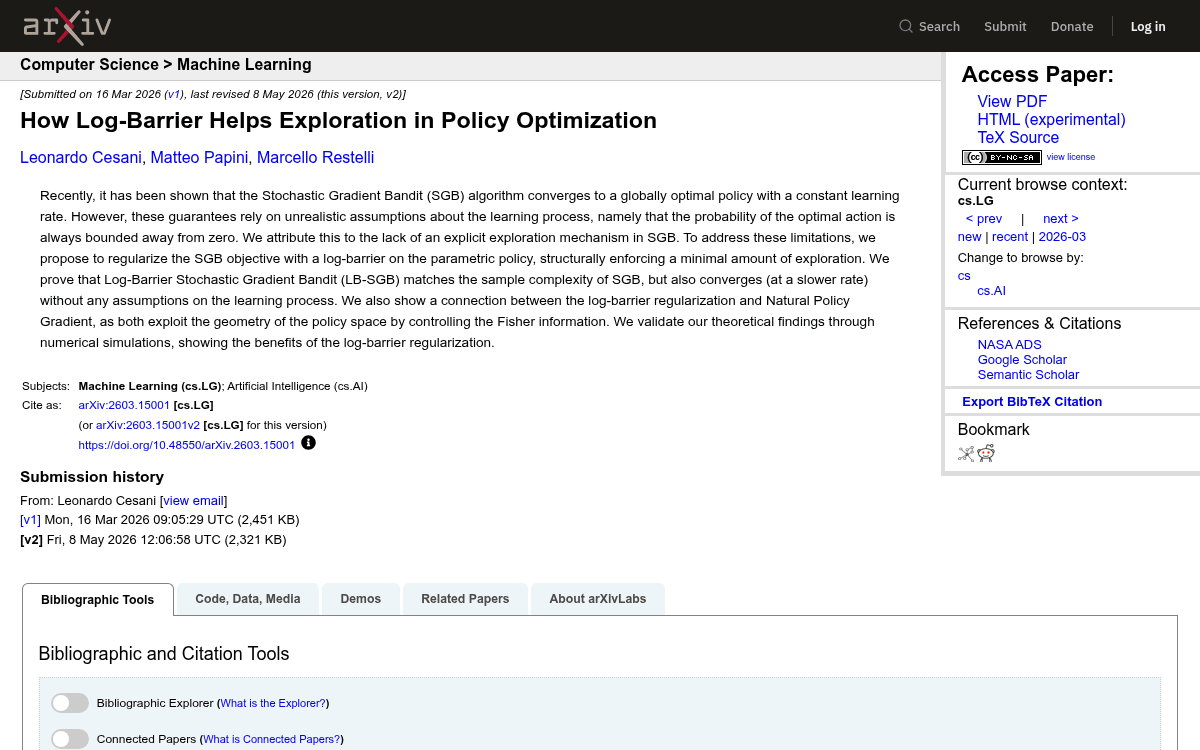
The catch is in the fine print. These guarantees rely on unrealistic assumptions about the learning process, namely that the probability of playing the optimal action is always bounded away from zero. The authors attribute this to the lack of an explicit exploration mechanism in SGB. In other words, the proof works only if the algorithm keeps sampling the best arm often enough, which is exactly what you would want the algorithm to prove for you.
The reason this matters in practice is a well-known failure mode of softmax policy gradient: as the gradient updates drive the policy toward the boundary of the probability simplex, the gradient itself vanishes, possibly leading to premature convergence to sub-optimal policies. Entropy regularization is the usual workaround, but the paper argues it does not give strong enough exploration guarantees to fix the theory.
Log-barrier as a wall against the simplex boundary
The proposed algorithm, Log-Barrier Stochastic Gradient Bandit (LB-SGB), adds a penalty of the form negative log of each action probability to the SGB objective. As those probabilities approach zero, the penalty blows up, so the optimizer is structurally prevented from committing to a single action too early. This is the same log-barrier idea used in interior-point methods for constrained optimization.
The advantage over entropy regularization is that log-barrier tends to allocate more exploration probabilities to all arms, keeping every action alive for long enough that the theoretical machinery goes through without assuming anything about the sampling process.
What the theory delivers
The main results are twofold:
- LB-SGB matches the sample complexity of SGB, but also converges (at a slower rate) without any assumptions on the learning process. Concretely, SGB is known to achieve O(1/epsilon) sample complexity, and LB-SGB retains this while dropping the boundedness assumption.
- There is an explicit connection between the log-barrier regularization and Natural Policy Gradient, as both exploit the geometry of the policy space by controlling the Fisher information. That reframes NPG's second-order preconditioning as another way to prevent the softmax from collapsing to the simplex boundary.
The trade-off is the usual one for a barrier: guaranteed exploration comes at the price of a slower convergence rate in the unrestricted regime. When the standard boundedness assumption happens to hold, LB-SGB is no worse than SGB; when it does not, LB-SGB still converges while SGB's guarantee simply does not apply.
Why it matters beyond bandits
Gradient bandits are the theoretical stress-test for modern policy gradient. Techniques that stabilize them tend to reappear in RL algorithms trained on much larger problems, whether that is PPO's clipping, SAC's entropy bonus, or GRPO's group-relative baselines. Two takeaways from this work travel well:
- Softmax policies need structural protection from the simplex boundary. Entropy regularization is a soft nudge; a log-barrier is a hard wall, and the hard wall is what the proofs actually need.
- Natural policy gradient and log-barrier regularization are two views of the same underlying idea: control the Fisher information so the policy geometry does not degenerate. That gives a cleaner rationale for why NPG-style methods, and by extension trust-region approaches, tend to be more robust than vanilla policy gradient.
This is a theory paper backed by numerical simulations rather than a released library, so there is no code drop to grab. But if you work on policy gradient stability, whether in classical RL or in the LLM fine-tuning stack, the log-barrier construction is a small addition to the loss that comes with unusually clean theoretical backing.