
Plume Beats GPT-5.4 at Wi-Fi Diagnostics With 600x Fewer Parameters
A 140M parameter model trained on structured Wi-Fi packet dissections matches frontier LLMs on protocol prediction while running on one GPU.
 Pro
Takeaways
- Researchers introduced Plume, a 140M parameter foundation model built natively for 802.11 wireless packet traces.
- A protocol-aware tokenizer over Wireshark PDML exports produces sequences 6.2x shorter than BPE with 7.61 bits per token.
- Plume hits 74 to 97% next-packet token accuracy across five real-world Wi-Fi failure categories.
- Zero-shot anomaly detection reaches AUROC of 0.99 or higher using per-token cross-entropy loss as the signal.
- Matches Claude Opus 4.6 and GPT-5.4 on the same task with over 600x fewer parameters, fitting on one GPU.
- Follow-up work with deeper and Mamba variants pushes accuracy to 98.2% using the same tokenizer.
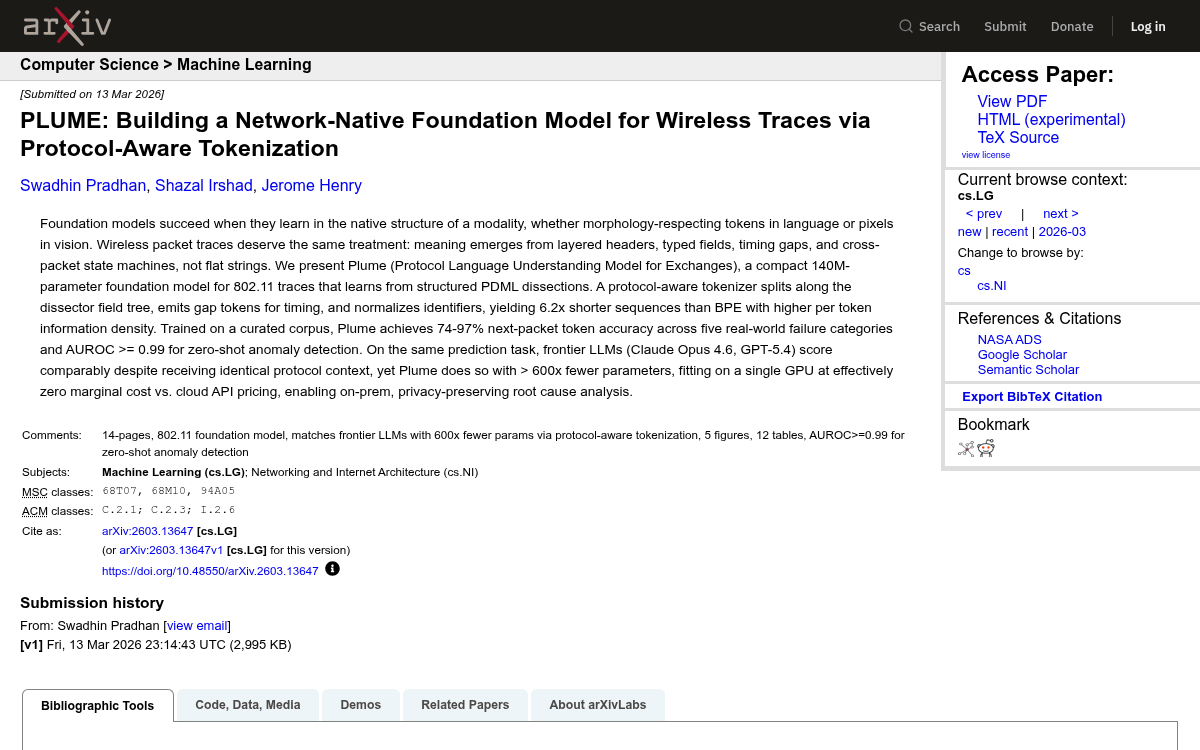
A three-author team of Swadhin Pradhan, Shazal Irshad, and Jerome Henry has published a paper introducing Plume, a compact foundation model built specifically for 802.11 wireless packet traces. The pitch is straightforward: instead of throwing raw packet captures at a general-purpose LLM, treat wireless traffic as its own modality with its own tokenizer, and a 140M parameter model can go head-to-head with frontier systems that are 600 times larger.
Why packet captures break generic tokenizers
Wi-Fi packet exchanges are not free-form text. 802.11 packet exchanges have meaning that emerges from layered headers, Information Elements carrying negotiated options, timing gaps, and cross-packet state-machine transitions. When you shove a PCAP file into byte-pair encoding, the tokenizer chops across field boundaries, ignores the microsecond-scale timing that distinguishes a retry from a fresh transmission, and treats a MAC address as an arbitrary hex string.
The other headache is data skew. In 802.11 networks, access points transmit beacons every roughly 102 ms across multiple SSIDs and bands, so a 10-minute capture can contain over 100K quasi-identical beacons dominating any naive training set. Failure-mode captures are reactive, triggered after the fact, so pre-failure context like initial handshakes and setup packets is often missing. A model that just learns to predict the next beacon has learned almost nothing useful for debugging.
The protocol-aware trick
Plume sidesteps both problems by starting from a different input format. It learns from structured dissections, specifically Wireshark and tshark Packet Description Markup Language (PDML) exports. PDML is what you get when Wireshark decodes a packet into its full field tree: every layer, every typed field, every value already parsed out. The tokenizer walks that tree.
Three design choices carry the model:
- Field-boundary splits. A protocol-aware tokenizer respects field boundaries and protocol hierarchy, yielding 6.2 times shorter sequences than BPE.
- Gap tokens for timing. Silences between packets get their own tokens, so the model can reason about retries and timeouts directly.
- Curated corpus. An HDBSCAN clustering plus MMR sampling pipeline reduces beacon bias from over 50% to 4.7% while preserving rare events.
The information-density payoff is measurable. Plume achieves the highest per-token entropy at 7.61 bits, meaning each token carries maximal information. BPE and NetGPT-style tokenizers, despite larger 100K vocabularies, achieve only 6.70 bits. With a 2,048-token context, Plume can process about 6 complete packets per forward pass, compared to roughly 1 for BPE and under 0.4 for byte-level, directly impacting the model's ability to learn cross-packet patterns.

What the numbers say
The evaluation covers five real-world failure categories: Bad Password, EAPOL Timeout, Invalid PMKID, Unable to Handle New STA, and Rejected Temporarily, with 50 PCAPs each. These correspond to the authentication, association, and key-exchange stages of the Wi-Fi connection lifecycle.
Plume delivers 74.1 to 97.3% token accuracy across those categories, zero-shot AUROC of at least 0.99 for anomaly detection, and 73.2% five-class root cause accuracy from unsupervised features. The mechanism for anomaly detection is elegant: at inference, per-token cross-entropy loss scores each packet, normal packets produce low loss while anomalous packets spike because unexpected field values deviate from learned patterns. Thresholding per-packet average loss enables zero-shot anomaly detection, and each high-loss token directly identifies the anomalous protocol field. This loss-based approach requires no labeled anomaly data and generalizes to unseen failure modes.

Beating giants with 600x fewer parameters
The comparison the authors are proudest of is against frontier LLMs. Given identical protocol context, Claude Opus 4.6 and GPT-5.4 score comparably to Plume on next-packet prediction, but Plume gets there with over 600x fewer parameters and fits on a single GPU. The economic argument writes itself: streaming a busy enterprise Wi-Fi deployment through a cloud API for continuous monitoring is prohibitive, while a local 140M model has effectively zero marginal cost per packet.
A statistical sanity check underlines this. A simple packet-length baseline achieves AUROC 0.95 for Bad Password, where failure PCAPs are substantially longer. For categories with packet lengths closer to healthy traffic, such as Invalid PMKID (0.68) and EAPOL Timeout (0.78), the statistical baseline degrades sharply, while Plume holds up. In other words, the model is not just riding on packet-count differences.
Where it fits, and where it does not
Plume is best understood as a representation layer, not a diagnostic chatbot. It operates at a lower abstraction level, learning representations of packet sequences that can be fine-tuned for downstream tasks like anomaly detection and traffic classification, while other systems operate on textualized PCAP representations and focus on diagnostic reasoning and reliability assessment. If you want a natural-language explanation of what went wrong, you still need to pipe Plume's outputs into an LLM planner. The authors frame this as a feature: the representation is compact and network-native, and a separate reasoning layer can consume it.
Limitations are also worth flagging. The training corpus is enterprise 802.11 with a fixed tshark version, so behavior on unusual vendor extensions or non-Wi-Fi protocols is out of scope. And follow-up work by the same team has already shown that a deeper 24-layer GPT variant reaches 98.2% top-1 accuracy, gaining 32 points over the original 12-layer design, while a Mamba-2 state-space variant achieves 96.1% with 1.7x higher throughput and 2x longer context, with tokenizer choice swinging accuracy by 32 points versus only 2 for the architecture. That suggests the 140M base model is a first data point on a curve the authors are still climbing.
Why this matters
The broader claim is a template. Foundation models tend to work when the tokenizer respects the structure of the modality: subwords for language, patches for images, waveforms for audio. Network traces have their own structure that has largely been ignored, and Plume is a demonstration that respecting it lets a small model punch far above its weight. For anyone running on-prem monitoring where sending packet captures to a cloud LLM is a privacy or cost non-starter, that changes the calculus.