
Pix2Pix Beats Nine Rivals Converting MRI Scans to CT Without Radiation
A five-fold cross-validation study across ten GAN architectures reveals which models actually work for turning MRI scans into synthetic CT images.
 Pro
Takeaways
- Systematic benchmark of 10 GAN architectures for MRI-to-CT synthesis on the SynthRAD2025 dataset covering 513 patients.
- Paired supervised models beat all unpaired approaches on every metric across every anatomical district tested.
- Pix2Pix wins overall with Mean Rank 2.00, topping PSNR, VIF, SSIM, and LPIPS globally.
- DualGAN and StarGAN consistently fail to produce anatomically reliable CT reconstructions across all configurations tested.
- Multi-district training improves structural robustness, while single-district training maximizes voxel-wise HU fidelity.
- Full code, configs, and results released at github.com/arco-group/MRI_TO_CT under a reproducible protocol.
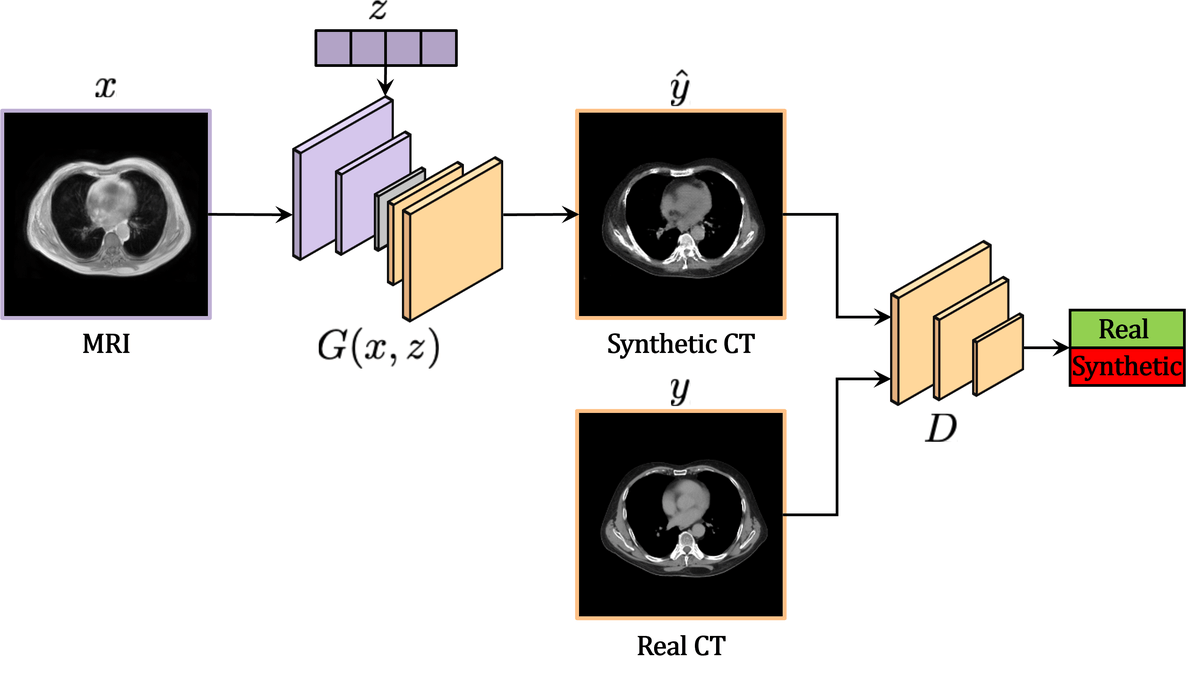
Turning an MRI scan into a synthetic CT is one of the more useful tricks generative models have picked up in medical imaging. It lets radiotherapy teams plan treatments without dragging patients through a separate CT session and its ionizing radiation. The catch: the literature is full of GAN variants claiming to do it well, but almost nobody trains them on the same data, with the same preprocessing, and compares them head to head. A new benchmark from researchers at Università Campus Bio-Medico di Roma and Umeå University finally does exactly that.
The team put ten GAN architectures through an identical training and evaluation pipeline on the SynthRAD2025 dataset, then measured both image quality and computational cost. The verdict is refreshingly boring: the oldest, simplest supervised model wins.
Why MRI-only workflows need this
MRI offers superior soft-tissue contrast without exposure to ionizing radiation, making it particularly suitable for target delineation and longitudinal follow-up, while CT provides quantitative information on tissue electron density that is indispensable for accurate radiation dose calculation. Radiotherapy planning needs both, which is why patients often get scanned twice. Synthetic CT generated from MRI can eliminate that second scan, but only if the model is faithful enough to the real Hounsfield Unit values that dose calculations depend on.
The problem is that Pix2Pix and CycleGAN have emerged as the most widely adopted architectures, commonly serving as supervised and unsupervised reference models, and most new papers only compare against one or two baselines under their own custom setup. A fair, apples-to-apples comparison across architectural families was missing.
The setup
The benchmark uses the SynthRAD2025 dataset, which includes 513 patients with paired MRI and CT 3D scans, organized into three anatomical regions: abdomen (175 patients), thorax (182 patients), and head-and-neck (156 patients). Every model gets the same preprocessing pipeline: slice filtering to drop background-heavy images, district-specific CT windowing, normalization to [0,1], and resizing to 256×256.
The ten architectures were grouped into five families based on how they learn:
- Paired supervised: Pix2Pix and BicycleGAN, which train on aligned MRI-CT pairs with voxel-wise loss.
- Cycle-based unpaired: CycleGAN, DualGAN, DiscoGAN, using cycle-consistency to avoid needing paired data.
- Shared latent space: CoGAN, UNIT, MUNIT, which embed both modalities into a common representation.
- Multi-domain: StarGAN, a single conditional generator across domains.
- Domain adaptation: PixelDA, learning a pixel-level source-to-target transformation.
All ten architectures were trained using five-fold cross-validation at the patient level to prevent data leakage. Each model was also run under seven training-testing configurations, mixing single-district training with combined multi-district training, to test cross-anatomical generalization.
What the numbers say
Performance was scored across six complementary metrics: MSE and PSNR for voxel-level accuracy, SSIM and VIF for structural fidelity, LPIPS for perceptual similarity, and FID for distributional realism. The authors then computed a Mean Rank across all six.
Paired models consistently achieve superior performance across all considered scenarios, both single-district and multi-district. Paired models outperform Unpaired ones on every evaluated metric, resulting in a Mean Rank equal to 1 in each district. That is a clean sweep for supervision: voxel-wise loss matters more than any architectural cleverness on the unpaired side.
Within the paired camp, Pix2Pix takes the crown. Pix2Pix emerges as the overall best-performing model with a Mean Rank equal to 2.00, achieving the best results in PSNR, VIF, SSIM, and LPIPS. UNIT is the runner-up and actually wins on single-district abdomen and thorax runs, but Pix2Pix dominates as soon as you train across multiple regions.

Train wide, test narrow
One of the more actionable findings concerns how you slice the training data. Training on heterogeneous anatomical data may act as a regularization mechanism, improving robustness and perceptual stability during district-specific evaluation. But there is a trade-off: the AB + HN + TH configuration achieves higher voxel-wise accuracy (MSE and PSNR), but a lower overall ranking. A structural trade-off therefore emerges: intra-district training maximizes local intensity fidelity, whereas multi-district training enhances generalization and perceptual consistency.
In practice: if you care most about exact HU values in one anatomical region, train narrowly on that region. If you want a model that generalizes and produces perceptually stable images, mix regions.
Compute cost and where models fail
The complexity story matches the quality story. Paired models, and especially Pix2Pix, also demonstrate a favorable balance from a computational perspective. Their relatively streamlined architecture enables a more controlled trade-off between synthesis quality and computational efficiency, particularly during inference, where resource demands remain comparatively moderate. Multi-generator systems like the cycle-based and shared-latent families burn far more GMACs during training because several subnetworks have to be jointly optimized.
Qualitatively, not every model actually produces usable images. DualGAN and StarGAN consistently fail to produce anatomically reliable reconstructions across all evaluated configurations, while MUNIT and DiscoGAN show contrast attenuation and localized artifacts. CycleGAN and CoGAN produce plausible structures but with visible smoothing.

What is actually useful here
The full pipeline, all model configurations, and result tables are open source at the arco-group MRI_TO_CT repository. For anyone building an MRI-only radiotherapy pipeline, the practical takeaway is short: start from Pix2Pix, train on all districts you have available, and only reach for exotic architectures if you have a specific reason. The unpaired approaches remain useful when paired data genuinely does not exist, but this benchmark shows the quality gap is real and consistent.
The authors flag diffusion-based and transformer-based generators as the natural next comparison, along with a radiologist Turing test to check whether these outputs are clinically usable rather than just numerically close. Until then, this is the reference point.