
PiVOT Uses CLIP's Zero-Shot Power to Crush Object Tracking Distractors
PiVOT uses CLIP's zero-shot recognition to auto-generate visual prompts at inference time, helping trackers ignore lookalike distractors without extra training cost
 Pro
Takeaways
- PiVOT is a new visual prompting system for object tracking that uses CLIP to auto-generate and refine heatmaps that suppress lookalike distractors at inference time.
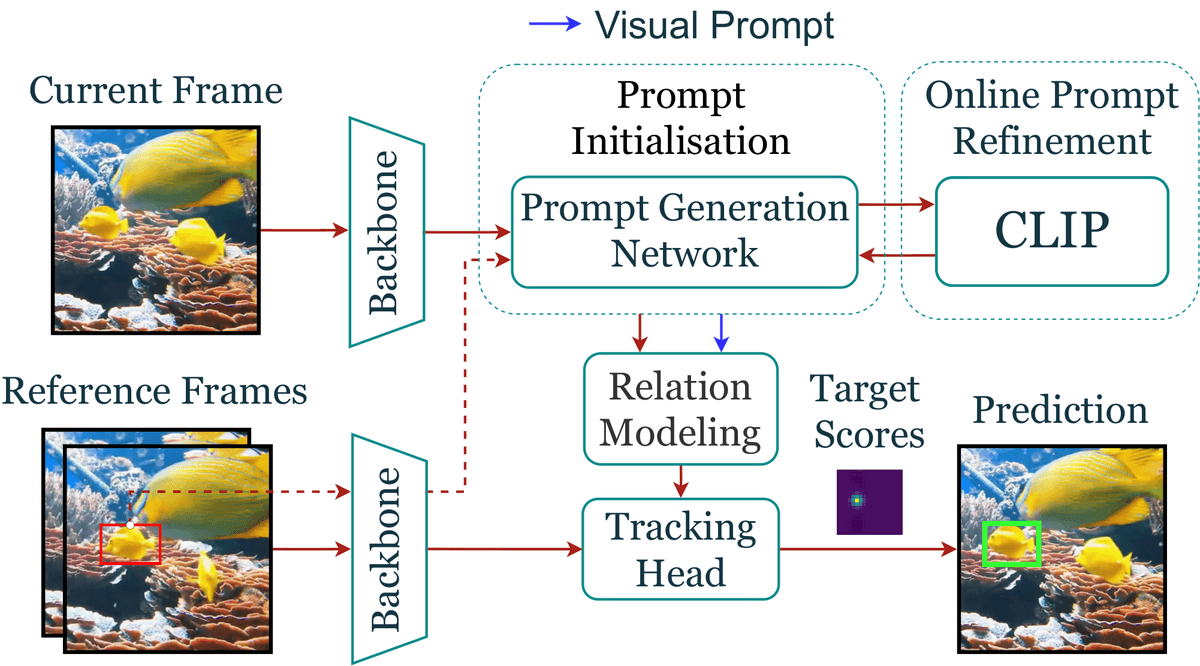
- Three new modules -- Prompt Generation Network, Test-time Prompt Refinement (CLIP-powered), and Relation Modeling -- are added on top of an existing tracker without changing training.
- CLIP is only used at inference time, keeping training complexity identical to the base tracker while adding zero-shot generalization to unseen object categories.
- PiVOT-L-27 sets new records on LaSOT (73.4 Suc AUC), AVisT (62.2 Suc AUC), and GOT-10k (76.9 AO) benchmarks.
- The model uses only 29M trainable parameters vs. 309M for SeqTrack-L, but runs at ~4 FPS due to dual foundation model inference (DINOv2 + CLIP).
- Code is publicly available on GitHub in the PyTracking framework; paper published in IEEE Transactions on Multimedia.
Object tracking sounds deceptively simple: pick a target in the first frame, then follow it. But in the real world, a tracker faces a crowd of imposters -- other objects with similar shapes, colors, or motion patterns that can hijack attention away from the true target. A new paper published in IEEE Transactions on Multimedia introduces PiVOT (Prompting mechanism for generic Visual Object Tracking), a system that borrows CLIP's zero-shot recognition power to dynamically generate visual prompts that tell the tracker exactly where to focus, frame by frame.
The distractor problem no one has fully solved
Learning a discriminative model that distinguishes the specified target from surrounding distractors across frames is essential for generic object tracking, and dynamic adaptation of target representation against distractors remains challenging because prevailing trackers exhibit limited discriminative capability. The core issue is a mismatch of knowledge types: CLIP offers broad category-level knowledge, while the tracker, trained on instance-specific data, excels at recognizing unique object instances. Neither alone is enough. A tracker that only knows "this is a dog" will lose the specific dog it was following the moment another dog walks by.
Most modern trackers handle this by fine-tuning large Vision Transformer (ViT) backbones on tracking datasets -- an expensive process that can also cause overfitting. Unlike previous works that fine-tune the ViT-L backbone on tracking datasets, PiVOT's method leverages the attributes of foundation models, combining a frozen ViT-L backbone with a lightweight adapter requiring less than 1% of trainable parameters for feature-extractor adaptation.
How PiVOT actually works
PiVOT adds three new modules on top of an existing tracker (built on ToMP, a transformer-based discriminative tracker). Each module plays a distinct role in the prompt pipeline:
- Prompt Generation Network (PGN): A lightweight CNN that correlates template features with the current frame to produce a score map -- a heatmap highlighting where candidate targets might be. This is the "initial visual prompt."
- Test-time Prompt Refinement (TPR): Active only during inference, this module crops candidate regions from the current frame and runs them through CLIP's image encoder. PiVOT leverages CLIP to refine the visual prompt based on the similarities between candidate objects and the reference templates across potential targets. Candidates with high cosine similarity to the reference template get their scores boosted; irrelevant ones are suppressed.
- Relation Modeling (RM): Takes the refined score map and channel-concatenates it with the current frame's feature map. The tracker can then generate instance-aware feature maps guided by the visual prompts, which are incrementally and automatically updated during tracking, thereby effectively suppressing distractors.
A key design choice: the proposed method does not involve CLIP during training, thereby keeping the same training complexity and preserving the generalization capability of the pretrained foundation model. CLIP is only called at inference time, which means the training pipeline stays cheap while still benefiting from CLIP's massive pretraining on 400 million image-text pairs.

Step-by-step at inference time
- The backbone (frozen DINOv2 ViT-L) extracts features from the current frame and reference frames.
- PGN correlates template features with the current frame to produce an initial heatmap of candidate locations.
- TPR crops N candidate regions at local maxima of that heatmap (above a confidence threshold).
- CLIP encodes each candidate and both reference templates; cosine similarity scores are computed pairwise.
- Candidates whose normalized similarity score exceeds a threshold have their heatmap values set to 1; others are zeroed out. This is the refined visual prompt.
- RM fuses the refined prompt with the frame features, suppressing distractor regions.
- The Tracking Head predicts the final bounding box from the prompted features.
The second reference template is also updated dynamically: if a new frame's CLIP similarity to the initial template is higher than the existing second template, it replaces it. This keeps the reference fresh without drifting to wrong targets.
Benchmark results that hold up across conditions
The authors conduct extensive experiments across various datasets, including OTB-100, UAV123, LaSOT, and others, showcasing that the proposed PiVOT framework outperforms state-of-the-art trackers in both precision and success rates. The gains are especially pronounced on out-of-distribution datasets -- sequences with object categories the model never saw during training.

Some headline numbers from the paper:
- On LaSOT (280 long-term sequences), PiVOT-L-27 scores 73.4 Success AUC and 84.7 Normalized Precision -- both new state-of-the-art among reported methods.
- On AVisT (adverse visibility benchmark), PiVOT-L-27 reaches 62.2 Success AUC, compared to 57.8 for the previous best (UVLTrack-L).
- On GOT-10k (non-overlapping object classes), PiVOT-L-27 achieves 76.9 Average Overlap, ahead of SeqTrack-L at 74.8.
- On VOT2022, PiVOT achieves the highest robustness score (0.873) among all compared methods.
The ablation study is particularly telling. Adding the initial prompt alone (without CLIP refinement) actually hurts performance on out-of-distribution datasets like NfS and OTB-100. It is only when CLIP refinement is applied that performance jumps across the board -- confirming that the raw heatmap without semantic grounding can mislead the tracker on unseen objects.
The efficiency story
PiVOT-L has 29M trainable parameters during training, compared to 309M for SeqTrack-L. Training uses 4 x 24GB GPUs versus SeqTrack's 8 x 80GB GPUs. The tradeoff is inference speed: running two large foundation models (DINOv2 and CLIP ViT-L/14@336px) at test time costs about 240ms per frame (~4 FPS). The backbone alone accounts for 50% of that, and the CLIP-based TPR module adds another 34%.
Where it still struggles
The paper is candid about failure modes. Three scenarios consistently trip up PiVOT:
- Intertwined similar distractors -- think a swarm of bees or a cluster of ducklings, where the target and distractors are nearly identical and spatially overlapping.
- Low-resolution targets -- when the target occupies very few pixels, there is not enough semantic signal for CLIP to differentiate it from background.
- Full occlusion -- when the target disappears entirely, the tracker may lock onto the wrong object. It can recover after occlusion ends, but the ideal behavior (recognizing occlusion and pausing adaptation) remains unsolved.
What this unlocks in practice
The real-world applications are broad. Any pipeline that needs to follow a specific object through a video -- surveillance, sports analytics, drone navigation, robotics, medical imaging -- can benefit from better distractor suppression. PiVOT is particularly well-suited to scenarios with unseen object categories at test time, since CLIP's zero-shot capability handles arbitrary objects without retraining.
PiVOT's extension using the frozen ViT backbone from DINOv2 for feature extraction reduces inductive bias and computational costs while still achieving performance improvements without fine-tuning the large ViT backbone with tracking data. That means teams can drop PiVOT on top of an existing tracker without rebuilding their training infrastructure. The code is publicly available on GitHub, implemented in PyTorch within the PyTracking framework.
The broader insight here is architectural: rather than forcing a tracker to learn everything from labeled video data, PiVOT treats CLIP as a plug-in reasoning module that runs alongside the tracker at test time. The mechanism utilizes CLIP's advanced zero-shot classification capabilities to enhance the detection and tracking of objects in a video sequence -- no fine-tuning, no annotation, no category restrictions. As foundation models continue to improve, this kind of modular integration could become a standard design pattern for video understanding systems.