
PISE Classifies Images From Just 5% of Pixel Data 9x More Stably
A physics-informed pipeline for single-pixel cameras hits 5% sampling with 2.57% higher accuracy and 9x lower variance than standard baselines.
 Pro
Takeaways
- PISE reconstructs images from 5% single-pixel measurements for machine perception, not human viewing (paper).
- Combines adjoint-operator initialization with a frozen VGG-16 perceptual loss on a U-Net backbone.
- Improves classification accuracy by 2.57% and cuts run-to-run variance about 9x versus MSE baseline.
- Roughly 6x faster inference than ISTA-Net+ and ADMM-CSNet unfolding methods.
- Evaluated on Fashion-MNIST and CIFAR-10 with Poisson noise and 8-bit quantization.
- Code and checkpoints available on GitHub; hardware validation still to come.
Sending full frames from a bandwidth-starved sensor is often a luxury. A new paper called PISE (Physics-Anchored Semantically-Enhanced Deep Computational Ghost Imaging) argues that for machine perception you do not need to reconstruct a pretty picture at all. You just need enough signal for a downstream classifier to work, and you can get that from a tiny fraction of the measurements a conventional camera would take.
The setup: cameras with a single pixel
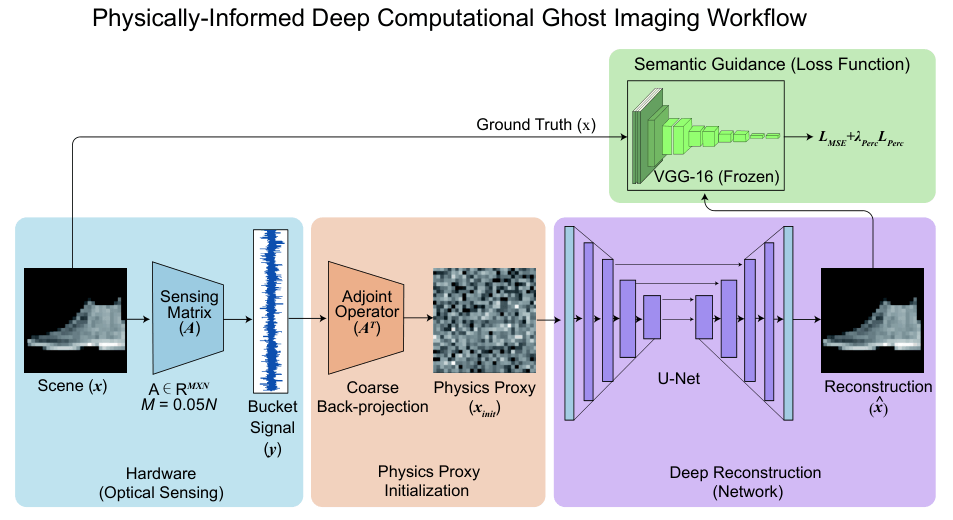
Computational Ghost Imaging (CGI), also known as single-pixel imaging, offers hardware-efficient compressive acquisition by modulating the light field using structured spatial patterns and measuring aggregated intensity with a bucket detector, so the scene can be optically compressed before readout. That is attractive for IoT devices and robots on flaky links, but it comes with a nasty inverse problem. At a 5% sampling rate on a 28x28 image, the system acquires only 39 measurements, rendering the inverse problem severely underdetermined.
Existing approaches fail in characteristic ways. Classical compressive sensing solvers produce structured artifacts. Pure U-Nets trained with mean squared error tend to oversmooth. GAN-based translators sharpen the image but can hallucinate textures that do not match what the sensor actually measured. Under extreme undersampling, pixel-wise supervision tends to favor conservative averages and suppress the high-frequency cues required by classifiers.
Two ingredients, one loss
PISE combines two ideas that individually are not new but interact in a useful way:
- Physics anchor via adjoint operator. Instead of learning a black-box map from measurement vector to image, the network is fed a deterministic proxy
x_init = A^T y. Although back-projection is aliased and noisy at 5%, it preserves crucial spatial structure and object localization encoded by the forward model. The adjoint (transpose of the sensing matrix) is basically a cheap, physically consistent first guess. - Semantic loss via frozen VGG-16. A U-Net refines the proxy, supervised by a mix of MSE and a perceptual loss computed on VGG features. Grayscale inputs are replicated to 3 channels and ImageNet-normalized before feeding into VGG-16, and features are taken from layers relu1_2, relu2_2 and relu3_3. The weights are set to lambda_mse = 1.0 and lambda_perc = 0.05.
Sensitivity analysis indicates that a perceptual weight above 0.1 induces oscillatory artifacts, while below 0.01 the model reverts to MSE-like smoothing. The perceptual term keeps gradients from collapsing, and the adjoint prior keeps the network honest about the measurements.

What the numbers show
The main experiments use Fashion-MNIST at 5% sampling, with CIFAR-10 as a secondary robustness check under Poisson noise and 8-bit quantization. Classification accuracy on a frozen classifier is the headline metric, not PSNR.
The five-run statistics tell the clearest story. The MSE baseline gets 80.51 plus or minus 2.12 percent on ResNet, while PISE reaches 83.08 plus or minus 0.23 percent, an accuracy gain paired with roughly 9x lower run-to-run variance. An ablation study shows that perceptual loss alone (without the physics anchor) actually peaks slightly higher on accuracy but with much larger gradient norms, hinting at unstable optimization.
Robustness under noise is another win. The standard U-Net drops 0.31 dB in strong noise, while PISE drops only 0.19 dB and stays competitive with the MSE baseline at sigma = 0.2.

On efficiency, PISE inherits the U-Net backbone rather than the iterative unfolding of ISTA-Net+ or ADMM-CSNet. The result is roughly a 6x inference speedup over the physics-based baselines, thanks to better GPU parallelization even though the theoretical FLOP counts favor the unfolding methods.
Where it fits, and where it does not
PISE is aimed squarely at machine-in-the-loop pipelines: single-pixel sensors on drones, industrial cameras behind narrow radio links, or medical devices where photon budgets are tight and only a classifier consumes the output. It is not a general-purpose reconstruction model. On the pix2pix-style cGAN baseline, accuracy actually reached 25.94% on CIFAR-10 versus PISE's 21.64%, but the authors note the GAN's outputs can drift away from measurement-faithful structures, which matters when the reconstruction has to be trusted.
The paper is honest about the limits. The evaluation uses simulated measurement operators and synthetic noise, and full hardware evaluation is deferred. VGG features pretrained on natural images may also be suboptimal for small grayscale imagery, so domain-specific feature networks are worth exploring. Jointly learning the sensing patterns alongside reconstruction is flagged as future work.
The deeper takeaway
The real contribution is not any single trick but a demonstration that physics priors and semantic priors regularize each other. The adjoint proxy stops the perceptual loss from hallucinating; the perceptual loss stops the physics prior from collapsing to blurry averages. That combination produces a small accuracy bump but a dramatic stability improvement, which is arguably the more important number for anyone actually deploying models on hardware where you cannot afford a bad run. Code, pretrained checkpoints, and configurations are on GitHub.