
PIER Cuts Ship CO2 by 10% Without Ever Needing a Weather Forecast
An offline reinforcement learning framework called PIER cuts shipping CO2 by 10% and eliminates catastrophic fuel waste without needing weather forecasts.
 Pro
Takeaways
- PIER is an offline RL framework that learns fuel-efficient ship routing from historical AIS and ocean reanalysis data.
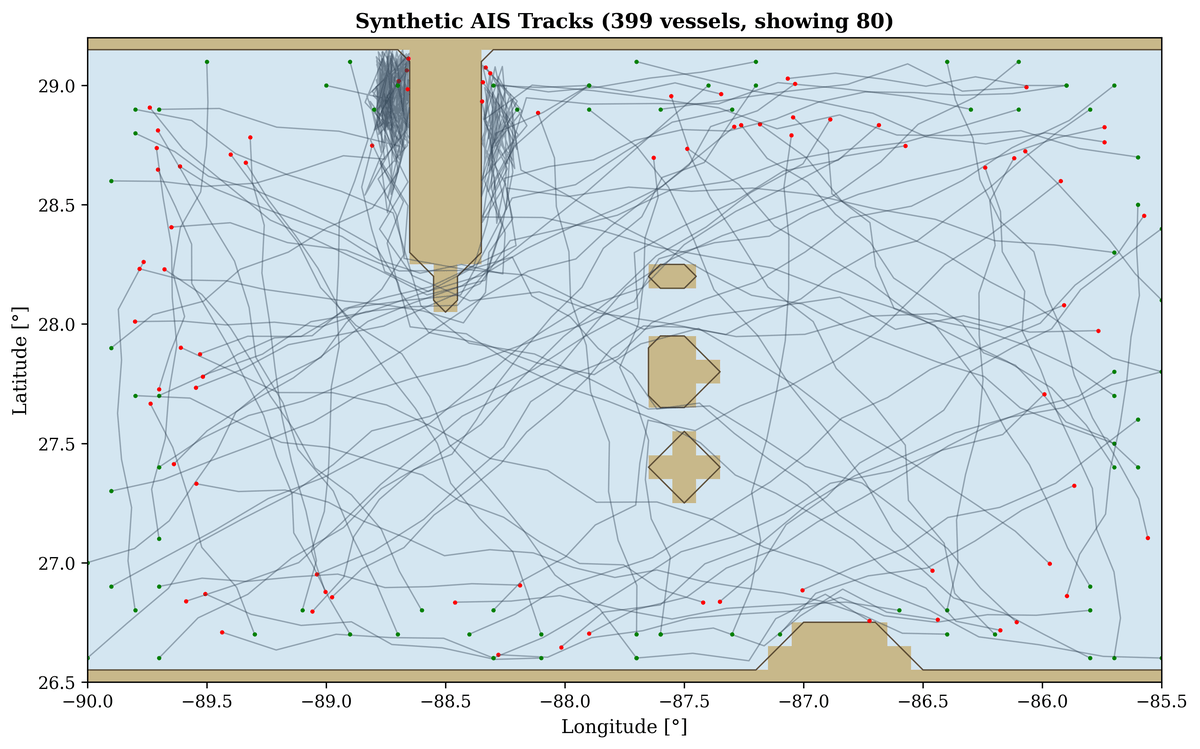
- Cuts mean CO2 emissions 10% versus great-circle routing across 840 Gulf of Mexico voyages in 2023.
- Reduces catastrophic fuel-waste voyages from 4.8% to 0.5%, a 9-fold drop in tail risk.
- Matches fastest real AIS transits with 23.1x lower variance across observed vessel behavior.
- Forecast-independent: A* wave protection degrades 4.5x under forecast uncertainty, PIER stays constant.
- Architecture transfers to wildfire evacuation, aircraft trajectory optimization, autonomous navigation in unmapped terrain.
Container ships and tankers still plan voyages the way sailors did a century ago: draw a great-circle line between two ports and hope the weather cooperates. That heuristic is expensive when it fails, and it fails often enough to matter. A new offline reinforcement learning framework called PIER (Physics-Informed, Energy-efficient, Risk-aware routing) shows that a policy trained on historical vessel tracks and ocean reanalysis data can cut mean CO2 emissions by 10% and, more importantly, almost entirely eliminate the tail of catastrophically bad voyages, all without ever touching a live simulator or a weather forecast at inference time.
A three-percent problem hiding in plain sight
Global shipping moves most of world trade and produces nearly 3% of global greenhouse gas emissions. That figure sounds modest until you consider the scale: the industry emits more CO2 annually than the entire nation of Germany, and demand keeps climbing. In 2023 the International Maritime Organization set a target of effectively zero emissions by 2050, with a 20% interim cut by 2030.
Weather routing, the practice of picking a path based on winds, waves, and currents rather than pure geometry, is one of the cheapest levers available. The IMO has publicly stated that it saves at least 3% in fuel consumption, and for some vessels such as container ships that number can reach 10%. The catch is that the classical algorithms doing this work, mostly variants of A* search over forecast grids, degrade sharply when the forecast is wrong. Forecasts are wrong all the time.
Why offline RL, and why physics
Reinforcement learning fits sequential routing decisions well, but it has a chicken-and-egg problem in maritime domains: training RL agents typically requires direct interaction with the real environment, which is dangerous and costly. Offline RL has emerged as an alternative, where agents learn from pre-collected datasets. There is no high-fidelity ship simulator you can spin up, and letting a policy explore live in the Gulf of Mexico is not an option.