
PIE Bakes Physics Into Evolutionary AI, Hitting Near-Perfect Quantum Control
A new framework ports the physics-informed trick from PINNs into evolutionary algorithms, embedding Schrödinger dynamics directly into the fitness function for quantum control.
 Pro
Takeaways
- PIE ports the physics-informed idea from PINNs into evolutionary algorithms via the fitness function.
- Applied to quantum control problems governed by the Schrödinger equation.
- Fitness = state deviation + λ · control energy, with a multi-objective Pareto variant.
- Tested with 10 single-objective and 5 multi-objective evolutionary algorithms across 3 benchmarks.
- Multi-objective NSGA-II hits fidelity 1.00 on superconducting circuits, beating weighted-sum baselines.
- No universal winner: DE, MMES, SDAES, PESA2, and MOEA/D each dominate different settings.
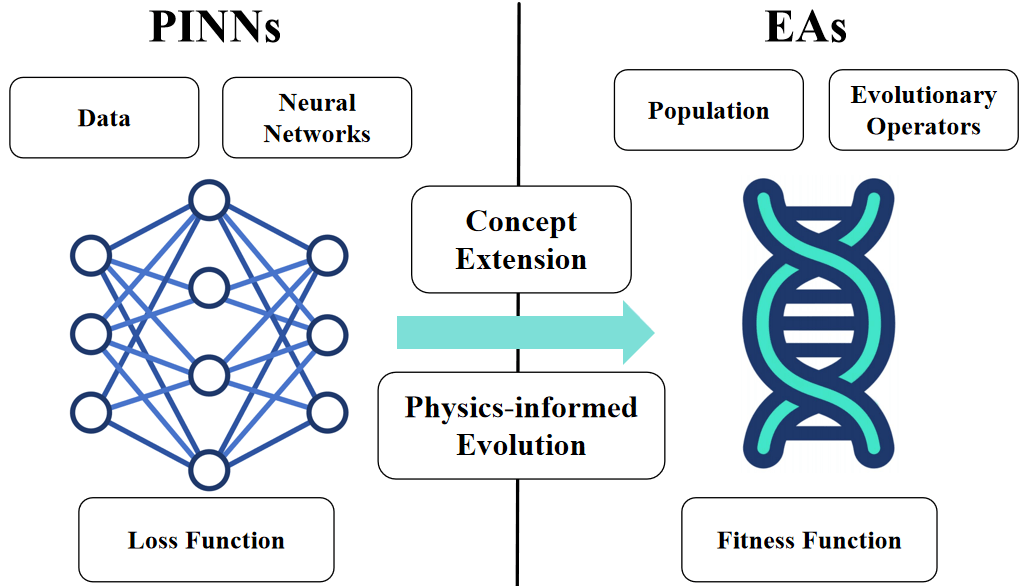
Physics-Informed Neural Networks (PINNs) work by baking the governing equations of a system directly into the loss function, so gradient descent has to find solutions that both fit the data and obey physics. A new paper asks an obvious but surprisingly unexplored question: if that trick works for gradient-based learning, why not do the same for evolutionary algorithms, where the loss is replaced by a fitness function?
The result is Physics-Informed Evolution (PIE), a framework that folds physical laws into the evolutionary fitness landscape. As a concrete test case, the authors apply it to quantum control problems governed by the Schrödinger equation, where the goal is to design time-varying control fields that steer a quantum system from an initial state to a target state.
Why quantum control breaks optimizers
Quantum control is a natural stress test. The evolution of quantum states is highly sensitive to control fields, and the landscape is riddled with local optima that trap traditional solvers in suboptimal strategies. Gradient-based methods struggle here, which is why evolutionary approaches, being gradient-free and population-based, are attractive.
Raw fidelity, meaning how close you get to the target state, is a lousy fitness signal on its own. Good solutions cluster in distant regions of the search space, and no physical prior guides the search toward efficient control fields. That is exactly the gap PIE tries to fill.