
piDMD Predicts Complex Physics Simulations With 10x Less Error
A new arXiv paper proposes piDMD, a data-driven surrogate that predicts nonlinear system behavior at unseen parameter values without retraining.
 Pro
Takeaways
- New arXiv paper introduces parameter-interpolated DMD, a surrogate that predicts nonlinear systems at unseen parameter values.
- Method embeds parameter-affine structure directly into DMD regression, avoiding per-sample models plus interpolation.
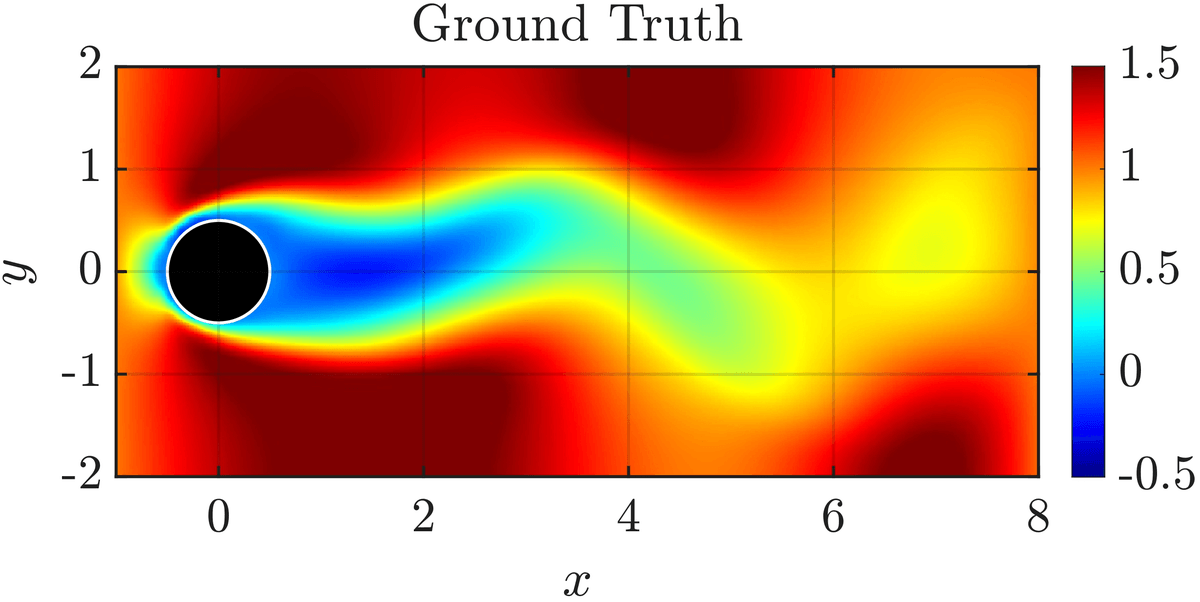
- Validated on cylinder flow, electron beam oscillations, and virtual cathode oscillations via EMPIC simulations.
- Beats Exact DMD, Stacked DMD, and rKOI baselines on accuracy with fewer training samples.
- Handles multi-dimensional parameter spaces where grid interpolation becomes impractical.
- Requires known parameter-affine functions; authors plan neural-network extensions to automate this.
A group of researchers has posted a paper on arXiv introducing parameter-interpolated dynamic mode decomposition (piDMD), a reduced-order modeling technique that predicts how nonlinear physical systems behave when their governing parameters change. The method embeds known parameter-affine structure directly into the DMD regression step. Existing parametric DMD approaches interpolate modes, eigenvalues, or reduced operators and can be fragile with sparse training data or multi-dimensional parameter spaces. piDMD instead learns a single parameter-affine Koopman surrogate across multiple training parameter samples and predicts at unseen parameter values without retraining.
One naming note up front: an unrelated method called physics-informed DMD already uses the same acronym. That earlier work by Baddoo and colleagues integrates physical principles such as symmetries, invariances, and conservation laws into DMD by restricting admissible models to a matrix manifold as a Procrustes problem. The new paper reuses the piDMD abbreviation for a different idea centered on parameter interpolation.
Why current parametric surrogates struggle
Dynamic mode decomposition fits a linear operator to snapshots of a dynamical system, extracting spatial modes and their temporal evolution. It works well for a fixed system, but real engineering studies sweep parameters such as Reynolds number, magnetic field strength, or geometry, and you want a surrogate that generalizes across those sweeps without rerunning an expensive simulation.