
Personality Tests for AI Models Measure Nothing About Real Behavior
New research shows LLMs game personality tests by spotting the trait keywords, and questionnaire scores fail to predict how models actually respond to users.
 Pro
Takeaways
- Human psychometric questionnaires (PVQ, BFI) fail to predict how LLMs actually respond in real user interactions.
- Cross-method Spearman ρ between questionnaire and generation-probability profiles drops to 0.11–0.31 across 8 open models.
- LLMs identify what construct standard items measure with F1 up to 0.83, but only 0.05–0.11 for realistic scenarios.
- Item transparency, not stable dispositions, explains the neat structure in questionnaire responses.
- Persona prompts shift questionnaire scores toward human demographic patterns but produce incoherent shifts in real generation.
- Read the full paper or the Value Portrait dataset used as the behavioral benchmark.
A new study argues that the cottage industry of giving large language models the Big Five and Schwartz values tests is measuring the wrong thing. When researchers score models on the same instruments used on humans, the resulting personality profiles look neat, stable, and even shift plausibly under persona prompting. Yet the paper shows those profiles have almost nothing to do with how the models actually respond to real user queries.
Putting a chatbot on the couch doesn't work
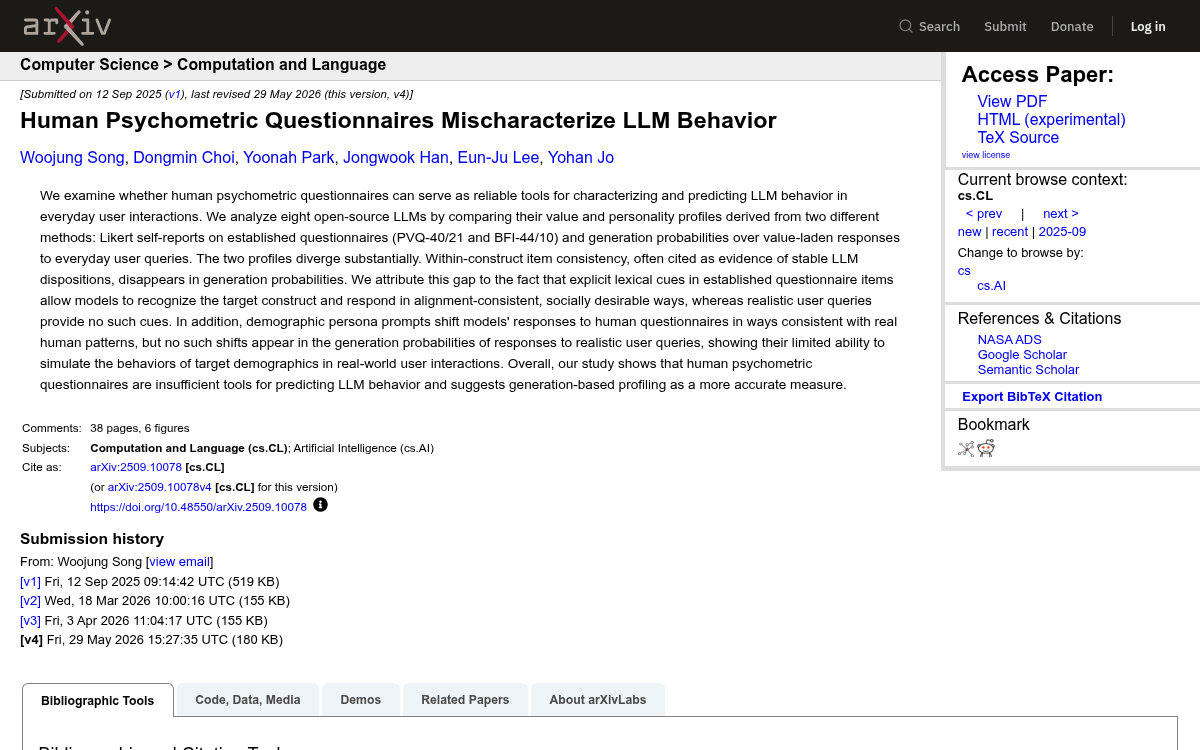
Prior work has treated tools like the Portrait Values Questionnaire (PVQ) and the Big Five Inventory (BFI) as valid probes of LLM dispositions, reporting that models have consistent values and traits. The authors examined eight open-source models by comparing profiles derived two ways: standard Likert self-reports on PVQ-40/21 and BFI-44/10, and generation probabilities over value-laden responses to everyday user queries. The two profiles diverge substantially.
The core critique is about ecological validity. A Likert score of 5 on "I see myself as someone who has a forgiving nature" tells you how the model fills a blank on a survey. It says nothing about what the model will generate when a user asks for advice about a fight with their partner.
How the generation-probability profile works
Rather than asking models to rate themselves, the team used the Value Portrait (VP) dataset. VP comprises 520 query-response pairs derived from 104 real-world queries drawn from human-LLM conversations (ShareGPT, LMSYS) and human-human advisory archives (Reddit, Dear Abby), spanning everyday requests and value-laden interpersonal dilemmas. Each query is paired with five candidate responses annotated for Schwartz values and Big Five traits, validated through a correlation study with 681 human raters.