
Penn State's A-Evolve Lets AI Agents Fix Their Own Failures After Deployment
A new position paper argues LLMs need a third scaling axis beyond training and inference: an autonomous evolver agent that patches deployed systems in place.
 Pro
Takeaways
- Position paper argues LLMs need a third scaling axis beyond train-time and inference-time compute: agentic evolution.
- A-Evolve elevates the update rule to an autonomous evolver agent with Diagnose, Plan, Update, and Verify stages.
- Persistent artifact state splits into knowledge, tool, and validation registries the evolver can surgically edit.
- On AppWorld, Haiku 4.5 with A-Evolve hits 64% task goal completion versus 42% for vanilla Sonnet 4.
- Ablations show verification is the critical stabilizer; without it, brittle patches accumulate and regress the system.
- Code available on GitHub under MIT, installable via pip install a-evolve.
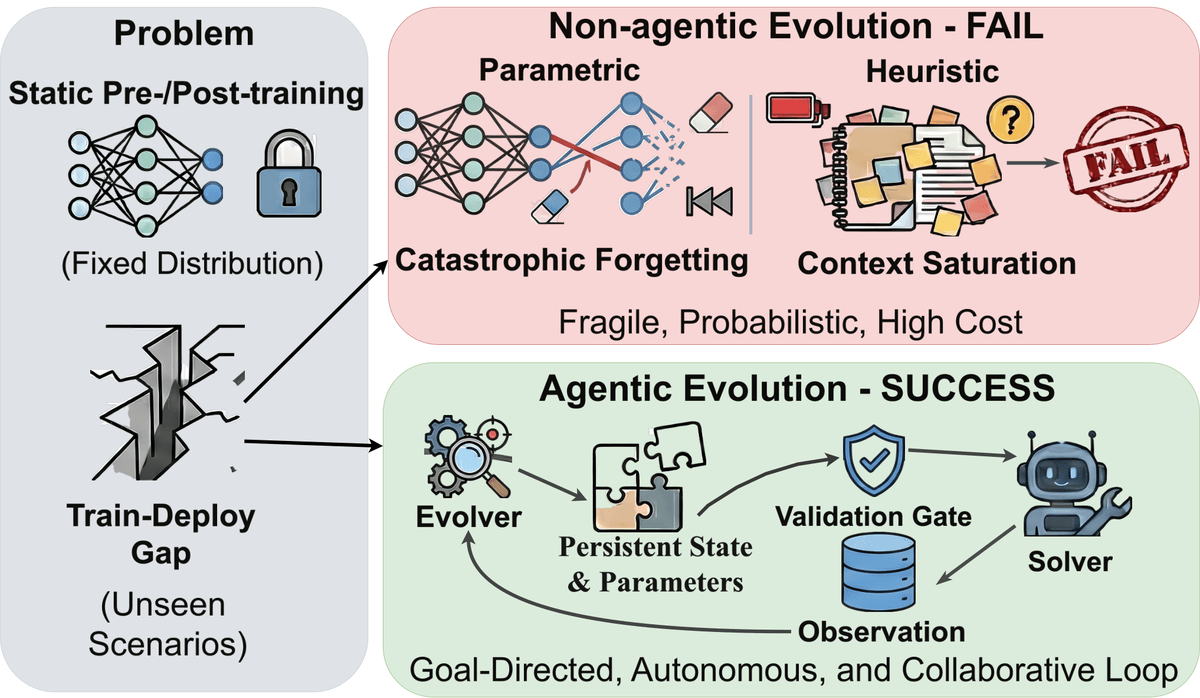
Deploying a large language model into production usually feels like sending it off a cliff. The model was trained on a fixed snapshot of the world, and the moment it hits real users, APIs shift, log schemas change, and edge cases pile up. A new position paper from researchers at Penn State, Amazon, and Duke argues that neither more pretraining nor longer chains of thought will fix this, and proposes a third scaling axis called agentic evolution, along with a working framework called A-Evolve.
The gap nobody trains for
The core problem the authors name is the train-deploy environment gap. Once deployed, models trained with finite training data cannot exhaustively anticipate the infinite variety of real-world cases, shifting APIs, and evolving constraints, which means static systems inevitably degrade over long deployment horizons.
Current fixes fall into two buckets, and both are limited. Parametric evolution methods such as test-time training or online fine-tuning update model weights using recent observations, but these updates are opaque, hard to govern, and risk catastrophic forgetting under distribution shift. The other camp appends text to a memory bank and hopes retrieval will do the rest. These lightweight approaches treat evolution as a storage or search problem, so as experience accumulates, memory saturates with noisy, unverified text and improvements show diminishing returns.
The authors argue both approaches share one deeper flaw: the update rule itself has no agency. It cannot diagnose why something failed, decide what to change, or evaluate whether a proposed fix will hold up.
Making the update rule itself an agent
Their position, stated bluntly, is that LLM evolution has to be agentic. Instead of a fixed update pipeline, they promote the update rule to a full-fledged optimizer agent with its own reasoning loop. Three principles anchor the design:
- Goal-oriented (what to change): the evolver diagnoses failures and targets the specific artifact responsible, rather than nudging weights or dumping context.
- Autonomy (when to change): updates are conditional decisions with an explicit commit or no-op, not a fixed schedule triggered on every failure.
- Compositional (how to change): improvements are structured modular artifacts like tools and tests, produced by cooperating sub-agents and only accepted after verification.
The concrete instantiation is A-Evolve, a general framework built around a persistent artifact state, a solve-evolve control loop, and an explicit evolver agent.

Inside the persistent artifact state
Rather than treating deployment context as scratch memory, A-Evolve treats it as a versioned, editable filesystem the evolver can surgically modify. The state is split into three registries:
- The knowledge registry stores structured or textual artifacts such as schemas, workflows, interface contracts, and exemplars, addressable and versioned for retrieval, patching, and replacement.
- The tool registry contains executable functions with explicit input-output signatures and associated tests, providing deterministic action primitives at solve-time and diagnostic instruments at evolve-time.
- The validation registry holds unit tests, regression suites, and optional human review hooks, and grounds the commit decision so updates are only accepted if they pass verification.
The four-stage evolver loop
Every time the evolver runs, it decomposes the work across four cooperating functions:
- Diagnose analyzes the trajectory buffer and identifies actionable failure causes, using batch aggregation over roughly 10 episodes to distinguish real capability gaps from stochastic noise.
- Plan translates the diagnosis into a structured edit plan, choosing among a restricted operator set: add, patch, refactor, prune over tools, schemas, and tests.
- Update executes the plan, synthesizing concrete artifact changes with provenance and accompanying tests.
- Verify runs the candidate update against the validation registry and returns a binary commit decision.
Crucially, the solve phase treats artifacts as read-only for reproducibility, while the evolve phase runs asynchronously with its own compute budget. This clean split means task inference does not compete with self-improvement.
The results on AppWorld
The team evaluated on AppWorld, a benchmark for tool-using agents with executable environments and unit tests for goal verification, using 50 training tasks and 50 test tasks. Claude Sonnet 4.5 served as the evolver backbone across solvers ranging from Haiku 4.5 to GPT-5 and Gemini 3 Flash.
Two numbers stand out. A-Evolve reached 64% task goal completion on Claude Haiku 4.5 and 82% on Gemini 3 Flash, compared to 46% and 52% for the workflow-memory baseline AWM, and 32% and 56% for vanilla. Even more striking, Haiku 4.5 augmented with A-Evolve reached 64% TGC versus 42% for a vanilla Sonnet 4, meaning persistent artifact refinement can beat simply swapping in a stronger backbone.
Ablations point at verification as the critical stabilizer. Among all variants, removing verification degrades the most, because committing updates without validation allows brittle or overfit patches to accumulate, leading to regressions and unstable long-horizon behavior. Case studies show that unvalidated evolvers cheerfully commit tools with syntax errors, poisoning the context for every future solve.
The evolution-scaling hypothesis
The paper's most provocative claim is that evolution is itself a scaling axis. They call this the evolution-scaling hypothesis: holding the environment and solve-time compute fixed, throwing more compute at the evolver systematically raises the achievable performance ceiling. Empirically, A-Evolve's performance climbs monotonically as evolution steps go from 1 to 12, while AWM plateaus quickly. Larger evolver models also produce fewer verification failures and more generalizable artifacts, converting compute into durable capability rather than opaque weight drift.
Getting your hands on it
The A-Evolve repository is public under an MIT license and installable via pip install a-evolve. Beyond the AppWorld results in the paper, the repo reports that a Claude Opus base evolved with A-Evolve reached top-tier scores on MCP-Atlas (79.4%), SWE-bench Verified (76.8%), and Terminal-Bench 2.0 (76.5%). The core API is minimal:
import agent_evolve as ae
evolver = ae.Evolver(
    agent="swe-verified",
    benchmark="swe-verified",
)
results = evolver.run(cycles=10)
To make a custom agent evolvable, you implement one method, solve(), on a BaseAgent subclass. The framework mutates a standard directory layout containing prompts/, skills/, tools/, and memory/, with every accepted mutation tagged in git for rollback. Custom evolution algorithms slot in through an EvolutionEngine.step() interface.
Where it fits and where it does not
Agentic evolution is best suited to deployments with recurring failure patterns, tool-heavy agents, and environments where APIs and schemas drift. It is likely overkill for short-lived, closed-domain tasks where inference-time reasoning already suffices. And because the framework depends on strong evolver backbones, the paper's own ablations show that smaller evolvers hallucinate root causes and generate brittle updates that fail verification, so the approach inherits the cost profile of running a capable model as your continuous self-improvement engine. That trade-off is exactly what the authors want you to make: paying compute up front to compile transient reasoning into durable capability that never needs to be rediscovered.