
Penn State Finds Multi-Agent AI Committees Collapse Into Chaos Under Tiny Wording Changes
A new paper shows that multi-LLM committees can produce chaotically divergent decisions even at temperature 0, and that architecture choices like roles and model mix are the main culprits.
 Pro
Takeaways
- Core finding: Multi-LLM committees amplify tiny prompt perturbations into divergent decisions, even at temperature 0 and under fully deterministic execution.
- Two instability routes: Role differentiation in homogeneous committees (λ̂=0.0541) and model heterogeneity in no-role committees (λ̂=0.0947) each independently drive divergence.
- Deeper than API noise: A deterministic hosted benchmark (Qwen2.5-7B, greedy decoding, pinned seeds) shows sensitive dependence on initial conditions survives even when exact reruns are identical.
- Fix: shorten memory windows: Reducing agent memory from k=15 to k=3 prior rounds consistently attenuates divergence; removing the Chair role also helps significantly.
- Non-additive interactions: Mixed-model committees with roles (λ̂=0.0519) are less unstable than mixed-model no-role committees (λ̂=0.0947) -- more diversity does not monotonically mean more chaos.
- Practical call to action: The paper proposes stability auditing -- probing committees with meaning-preserving variants -- as a core design requirement before deployment.
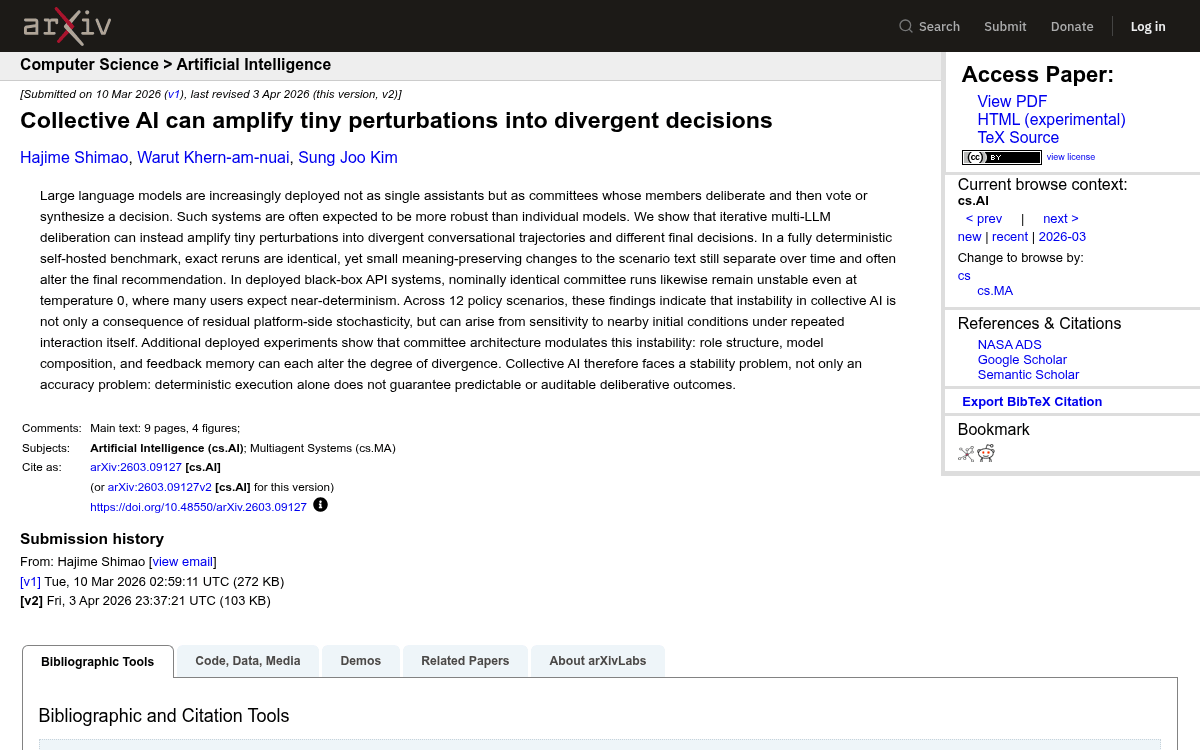
The promise of multi-agent AI systems is simple: if one model can be wrong, a committee of models deliberating together should be more reliable. That intuition turns out to be dangerously incomplete. A new paper, "Chaotic Dynamics in Multi-LLM Deliberation", shows that five-agent LLM committees can amplify tiny, semantically meaningless perturbations into completely different final decisions -- and that setting temperature to 0 does almost nothing to stop it.
The Problem Nobody Was Measuring
Multi-agent frameworks like AutoGen, MetaGPT, and AgentVerse have made it easy to spin up committees of LLMs that debate a question and vote on an answer. The implicit assumption baked into most deployments is that if you lower the temperature and use capable models, the system will behave consistently. If nominally identical committee runs diverge into different trajectories and final decisions, institutions face uncertainty that standard one-shot model evaluation does not capture -- and this concern is strongest at T=0, where if instability persists, unpredictability is structural rather than a temperature artifact.
The researchers -- from Penn State, McGill, and American University -- frame this as a dynamical systems problem. A deliberating committee is not just a bag of independent votes. It is a feedback system: each round, agents read each other's prior arguments and update their positions. Feedback systems can stabilize noise, but they can also amplify it. The question is which one happens in practice.
Measuring Chaos with a Lyapunov Exponent
To quantify instability, the paper borrows a tool from chaos theory: the Lyapunov exponent (denoted λ̂). In classical dynamical systems, a positive Lyapunov exponent means two nearby starting points will diverge exponentially over time -- the hallmark of chaotic behavior. Here, the authors adapt this idea empirically: they track how the committee's average preference vector (a point on a simplex over three policy options) evolves across multiple runs, and measure how fast those trajectories separate.
Formally, they compute the mean pairwise distance between trajectories at each round:
# Simplified version of the divergence index
import numpy as np
def mean_pairwise_distance(trajectories):
    # trajectories: shape (R, T, 3) -- R runs, T rounds, 3-option simplex
    R, T, _ = trajectories.shape
    D = []
    for t in range(T):
        dists = []
        for i in range(R):
            for j in range(i+1, R):
                dists.append(np.linalg.norm(trajectories[i,t] - trajectories[j,t]))
        D.append(np.mean(dists))
    return np.array(D)
# lambda_hat = slope of log(D(t)) over rounds 3-20
# positive slope = exponential trajectory separation
A positive λ̂ indicates exponential separation of trajectories, estimated as the slope of log D(t) over rounds 3 to 20. This is not a formal mathematical proof of chaos -- the authors are careful to say so -- but it is a practical, measurable signal of whether a committee's behavior is reproducible.
Two Independent Routes to Instability
The paper runs a factorial experiment across 12 policy scenarios (spanning immigration, health, climate, income, speech, and AI governance) and identifies two architectural choices that each independently drive divergence:
- Route A -- Role differentiation: Assigning differentiated roles (e.g., Chair, Welfare, Rights) to agents significantly increases divergence. The Chair role, in particular, acts as a dominant amplifier due to its synthesis-focused behavior and dynamic switching patterns.
- Route B -- Model heterogeneity: Mixing different LLM models (e.g., GPT-4.1, Claude Sonnet, Gemini) within the same committee also leads to elevated divergence, as this heterogeneity introduces variability in agent responses that propagates through the deliberation process.
The key numbers from the main benchmark scenario (HL-01, a health policy question) tell the story clearly:
| Committee Configuration | λ̂ (divergence) |
|---|---|
| Homogeneous, no roles | 0.0221 |
| Homogeneous, with roles | 0.0541 |
| Mixed models, no roles | 0.0947 |
| Mixed models, with roles | 0.0519 |
Crucially, these routes do not combine additively: a mixed-model committee with roles can sometimes be less unstable than one without roles, indicating complex non-additive interactions. More diversity does not monotonically mean more chaos.

The Deeper Finding: Deterministic Chaos
The most unsettling result is not about API randomness -- it is about something more fundamental. The team built a fully deterministic hosted benchmark using Qwen2.5-7B-Instruct with greedy decoding, pinned seeds, and deterministic CUDA/PyTorch settings. In this environment, running the exact same committee twice produces the exact same output, byte for byte. Then they introduced meaning-preserving perturbations: tiny surface-level rewrites of the scenario text (reformatting, minor rephrasing) that change nothing about the facts, options, or constraints.
Under these controlled perturbations, deterministic committees still fan out over rounds -- exact reruns collapse to a single trace, yet nearby prompt variants separate over time in both ROLES and NOROLES conditions. In some scenarios, a fragility value of 0.60 means the plurality recommendation appears in only 40% of nearby variants -- the same underlying case yields materially different committee recommendations under tiny wording changes that preserve every substantive fact.
This is the key distinction the paper draws: instability in collective AI is not reducible to ordinary sampling noise or provider-side randomness alone -- it can also arise from sensitivity to nearby initial conditions under repeated interaction itself. Even if OpenAI or Anthropic fixed every source of non-determinism in their APIs tomorrow, this problem would remain.
What You Can Actually Do About It
The paper does not just diagnose the problem -- it points toward fixes. The most actionable lever is memory window size. By default, each agent in the committee sees the last k=15 rounds of arguments when forming its next response. This recursive recycling of prior arguments is the main amplification pathway.
- Shortening the agents' memory window (e.g., from k=15 to k=3 arguments) consistently attenuates divergence across various scenarios, indicating that limiting the history available to agents can prevent early-round perturbations from amplifying over time.
- Removing or modifying the Chair role significantly reduces the Lyapunov exponent, suggesting that redesigning how central coordination roles operate can enhance stability.
- A stricter memory-collapse variant (k=1) further reduces
λ̂in tested scenarios, though it does not eliminate divergence entirely.
The authors frame this as a control problem, drawing an analogy to the "control of chaos" literature in nonlinear dynamics, where small targeted interventions can stabilize otherwise unstable trajectories without killing the system's flexibility. The goal is not to collapse deliberation into a trivial one-step vote, but to suppress perturbation amplification while preserving the diversity of reasoning that makes committees useful in the first place.
Who Should Care, and When
If you are running a multi-agent pipeline for low-stakes tasks -- code generation, brainstorming, document drafting -- the instability documented here is probably not your primary concern. But the paper is directly relevant to anyone building systems where the committee output feeds into a real decision:
- AI governance systems or policy recommendation tools
- Multi-agent evaluation pipelines (LLM-as-judge committees)
- Automated compliance or risk-assessment workflows
- Any system where auditability and reproducibility are regulatory requirements
For governance, committee architecture must be audited as a joint design system rather than tuned along a single "diversity" axis -- and reproducibility is a governance property, not only an engineering convenience. A single persuasive committee transcript cannot be treated as representative of the committee's behavior; you need to probe the neighborhood around that transcript.
The practical recommendation the paper makes is stability auditing: before deploying a multi-LLM committee, run it across a set of meaning-preserving prompt variants and measure λ̂. A committee may produce a plausible answer in a single run and still be fragile in the neighborhood of that run -- for governance, the relevant question is not only whether an AI committee can generate a persuasive recommendation, but whether that recommendation is stable under perturbations that ought to be innocuous.
Code and experiment scripts are available as supplementary material with the paper (Code S1), implemented in Python 3.11 with NumPy, SciPy, and Matplotlib. The benchmark JSONL run artifacts are also released as Data S1, making it straightforward to replicate the divergence measurements on your own committee configurations.