
Peking University's SteerRM Strips AI Reward Model Bias Without Retraining
A new training-free debiasing method uses sparse autoencoders to surgically remove reward models' preference for pretty formatting over correct answers.
 Pro
Takeaways
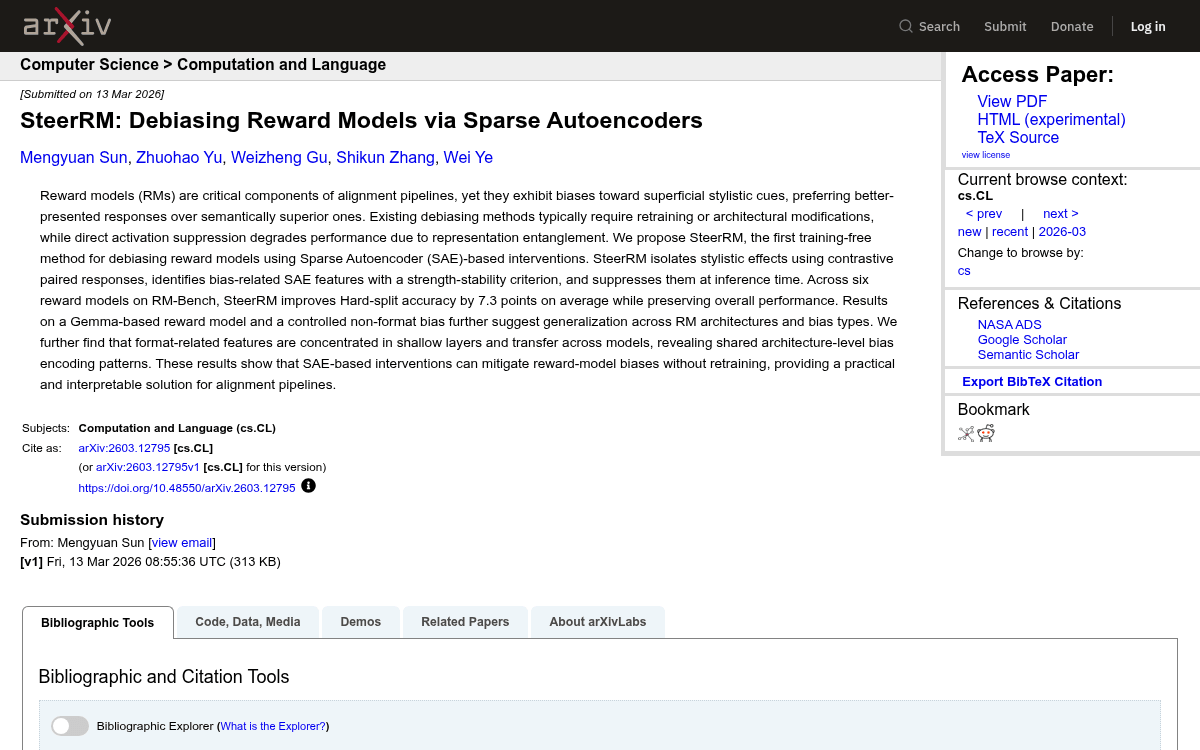
- SteerRM is the first training-free method to debias reward models using Sparse Autoencoder interventions.
- Improves RM-Bench Hard-split accuracy by 7.3 points on average across six LLaMA reward models while preserving overall performance.
- Three-stage pipeline: synthesize paired formatted/plain responses, identify format-sensitive SAE features, zero them out at inference.
- Direct activation subtraction collapses accuracy to near-random due to representation entanglement, proving SAE decomposition is essential.
- Format bias concentrates in Transformer layers 1-3 and transfers across models built on the same base architecture.
- Generalizes to Gemma-based reward models and politeness bias; code available.
Reward models are the invisible scorekeepers of modern LLM alignment, and they have a dirty secret: they often prefer answers that look good over answers that are actually good. A new paper from Peking University introduces SteerRM, a training-free technique that uses sparse autoencoders to identify and suppress the specific internal features responsible for this bias, without touching a single model weight.
The scorekeeper has a formatting fetish
Reward models (RMs) act as learned proxies for human preferences during reinforcement learning from human feedback (RLHF). They score prompt-response pairs and effectively decide which behaviors get reinforced during training. The problem is that they don't just judge on semantic content. RMs assign systematically different scores to responses that share identical semantic content but differ only in surface formatting, such as Markdown versus plain text.
The consequences are ugly. This bias manifests when RMs assign higher scores to factually incorrect but well-formatted responses than to correct but plainly formatted answers. On RM-Bench's Hard split, which pits pretty-but-wrong responses against plain-but-correct ones, many popular reward models score near random.
Fixing this normally requires retraining, architectural surgery, or post-hoc score calibration, all of which add cost and complexity. A more direct approach, simply subtracting the average "markdown direction" from hidden activations, tends to blow up the model. The bias direction is entangled with genuine content signals, so removing it also destroys the model's ability to evaluate quality.
Sparse autoencoders as scalpels
SteerRM sidesteps this by using Sparse Autoencoders (SAEs) as an interpretability tool. SAEs decompose a model's hidden states into a large dictionary of sparse, monosemantic features, where each feature ideally corresponds to one interpretable concept. If format bias lives in a small handful of those features, you can zero them out and leave everything else alone.

The pipeline has three stages:
- Format-controlled pair synthesis. Generate 500 prompts across chat, reasoning, math, and code, each paired with a Markdown response and a plain-text version containing identical wording. GPT-4.1 mini did the generation, with strict regex validation and manual audits to ensure the plain version only differed by removing markup.
- Feature identification. Run both versions through the reward model, capture SAE latents, and compute per-feature differences. Rank features using a strength-stability score: mean paired difference divided by its standard deviation, so features that consistently fire on formatting cues float to the top. Take the global top-10.
- Inference-time steering. Register forward hooks on selected layers. When a hidden state passes through, encode it with the SAE, zero out the identified format features, decode back to hidden state, and let the model continue.
Format bias lives in the shallow end
Before intervening, the authors had to figure out which layers to touch. They used LlamaScope, a pretrained SAE suite for Llama-3.1-8B, and measured reconstruction quality across layers of the reward models. Layers 0-9 consistently exhibit good reconstruction quality, while metrics degrade sharply beyond layer 9, suggesting deeper layers drift too far from base-model representations after reward-model fine-tuning.
Within that band, format-related features cluster even more tightly. Format-related features are primarily concentrated within the initial layers of the Transformer (Layers 1-3), revealing that format biases are encoded as surface-level signals in the shallow representation hierarchy. This matches the classical picture of Transformers, where early layers handle syntax and surface patterns before higher layers build abstract meaning.
The numbers
Tested across six LLaMA-3.1-8B reward models on RM-Bench, SteerRM lifts Hard-split accuracy by 7.3 points on average while preserving overall performance. Individual gains on Hard ranged from 3.4 to 10.3 points. Normal-split accuracy (where responses share formatting) barely moves, an average change of 1.0 point, which is exactly what you want: the model still evaluates content correctly when format is not a confounder.
The contrast with naive activation subtraction is stark. Activation suppression achieves substantial improvements on the Hard split, but it simultaneously causes severe degradation on Normal and Easy splits, leading to overall average accuracy dropping to near-random levels, between 47.6% and 59.5% across all six models. That collapse is the whole reason SAE decomposition matters: sparse features let you cut the format signal without severing content signals it happens to correlate with.
The features travel
Two findings extend the method beyond a single setup. First, the same feature set identified on one reward model transfers to others built on the same base architecture. Features found on Skywork applied to five other Llama-3.1 reward models still delivered Hard-split gains, including +14.2 points on URM and +28.4 points on Tulu. Format bias, it seems, is baked into shared architecture-level representations rather than individual training runs.
Second, the pipeline generalizes beyond Markdown. On a Gemma-2-2B reward model using Gemma Scope SAEs, Hard-split accuracy climbed from 39.1% to 44.8%. And in a controlled politeness-bias experiment, where phrases like "glad to help" were injected into rejected responses to fool the model, Skywork's accuracy fell from 65.5% to 61.0%. SteerRM applied to politeness features restored it to 66.0%.
The interpretability payoff is also concrete. Inspecting top-ranked features on Neuronpedia showed them consistently firing on Markdown syntax: bold markers, list bullets, code block delimiters, and heading indicators. One layer-0 feature acted as a raw double-asterisk detector, activating on ** tokens regardless of context.
When to reach for it
SteerRM is worth considering if you are running an existing reward model in an RLHF or best-of-N pipeline and suspect it is being gamed by stylistic tricks. It requires no retraining, adds roughly 10-15% inference overhead, and only needs a compatible pretrained SAE dictionary, which currently means Llama-3.1-8B or Gemma-2 backbones. The code is available on an anonymized repo.
The limitations are real. Easy-split accuracy typically drops by around 5 points because the model loses a legitimate shortcut where well-formatted responses genuinely are better. Cross-model feature transfer can drag average accuracy down when the target model relies on formatting features differently than the source. And the whole approach hinges on having a pretrained SAE for your backbone, which is not yet universal.
Still, the broader lesson is compelling. Interpretability tools built for understanding models are becoming tools for controlling them, and reward-model debiasing may be one of the cleaner applications: a well-defined bias, sparse features that isolate it, and a benchmark that measures the fix.