
Peking University's ShuttleEnv Teaches AI Badminton Strategy Without Physics
Peking University researchers built a data-driven badminton simulator that skips physics engines, uses two probabilistic models, and trains PPO agents to 98% win rates.
 Pro
Takeaways
- Peking University released ShuttleEnv, a data-driven RL environment for badminton grounded in elite-player match data.
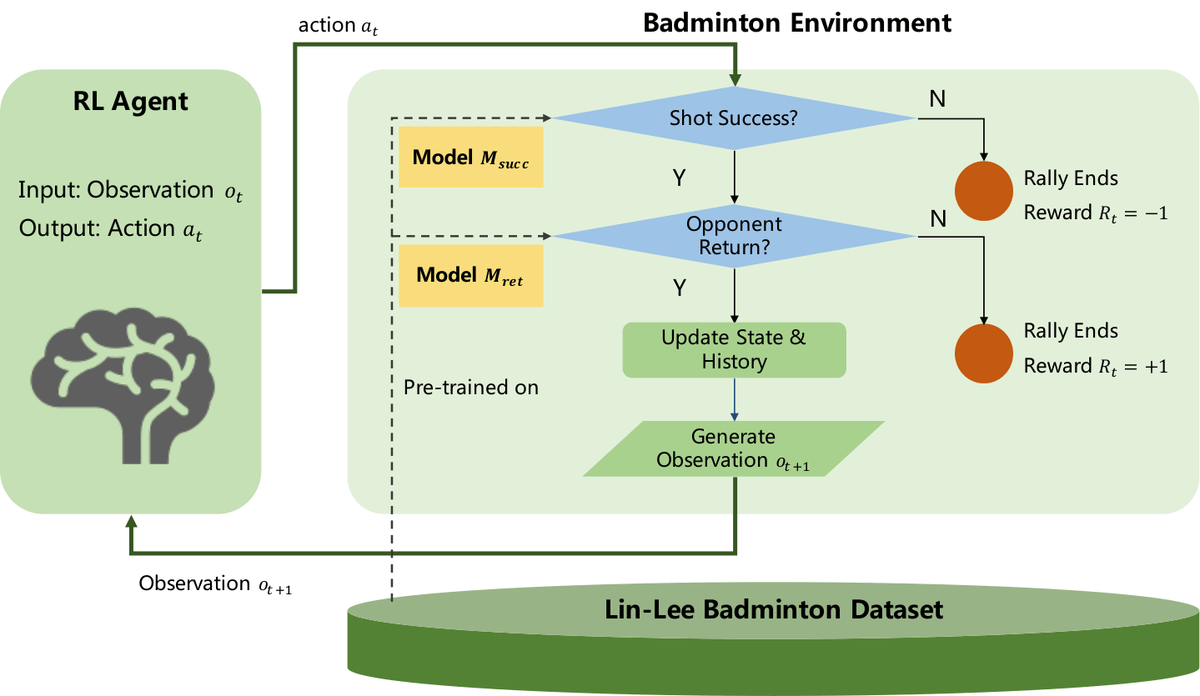
- Rally dynamics are simulated via two learned probabilistic models: shot success and opponent return, skipping physics simulation entirely.
- Trained on the Lin-Lee dataset covering hand-annotated rallies from Lin Dan vs Lee Chong Wei matches.
- PPO agents reached 98.3% win rate vs a fixed opponent, compared to 33.2% for behavioral cloning.
- Ships with a 3D visualization module using humanoid mesh models to render tactical decisions as embodied play.
- Full paper on arXiv; no public code release announced yet.
Badminton has been a curious blind spot in reinforcement learning research. Football simulators exist, chess and Go are solved playgrounds, but a sport built entirely on split-second one-versus-one tactical duels never got a proper RL environment. A team from Peking University is closing that gap with ShuttleEnv, a simulator that models rallies as sequences of tactical choices rather than trying to compute shuttlecock aerodynamics.
The pitch is straightforward: an interactive, data-driven simulation for badminton, designed to support reinforcement learning and strategic behavior analysis, grounded in elite-player match data and using explicit probabilistic models to simulate rally-level dynamics. No physics engine, no sim-to-real headaches, just a learned model of how real rallies actually unfold.
Why physics simulators were the wrong tool
Prior work in computational badminton has mostly stayed in supervised territory, predicting the next stroke from historical match data. The most notable predecessor is the CoachAI Badminton Environment, a reinforcement learning setup tailored for AI-driven sports analytics that offers realistic opponent simulation for training, visualizations for evaluation, and performance benchmarks for assessing agent capabilities.
ShuttleEnv makes a different bet. Physics-based simulators carry heavy modeling complexity and sim-to-real problems, while team-sport environments like Google Research Football emphasize coordination between many agents. Badminton poses the opposite problem: two players, extremely short time horizons, and dense tactical interaction. The authors argue this needs its own abstraction, one that treats a rally as a sequence of high-level decisions rather than a continuous physics problem.