
Peking University's SceneAssistant Lets AI Build and Fix 3D Blender Scenes Automatically
A visual-feedback agent uses vision-language models and a small set of action APIs to generate open-vocabulary 3D scenes from text without predefined spatial rules.
 Pro
Takeaways
- SceneAssistant is a VLM agent that generates open-vocabulary 3D scenes via iterative visual feedback in Blender
- Uses a compact action API of ~13 primitives instead of raw Blender Python
- Backbone stack: Gemini-3.0-Flash for reasoning, Hunyuan3D plus Z-Image for asset generation
- Beats Holodeck and SceneWeaver on indoor scenes with 61.25% human preference rate
- BVH collision detection and visual prompt overlays proved essential in ablations
- Struggles with dense scenes and stochastic asset failures; supports human-in-the-loop edits via natural language
Building a 3D scene in Blender is tedious. You place, rotate, and scale hundreds of assets while eyeballing whether the chair actually faces the desk. A new paper from Peking University and NVIDIA, SceneAssistant, proposes a way to hand that work to a vision-language model that iteratively looks at rendered images and edits the scene until it matches a text prompt.
The framework is open source on GitHub, and it targets a problem most existing text-to-3D pipelines dodge: generating scenes that are not restricted to a fixed domain like bedrooms or living rooms.

Why current text-to-3D pipelines get stuck
Most modern 3D scene generators fall into two camps. Data-driven models trained on datasets like 3D-FRONT produce scenes as NeRFs or 3D Gaussians, but these are hard to edit and constrained by whatever furniture categories the dataset contains. The other camp uses LLMs to emit spatial constraints, which get resolved into positions by a solver.
The catch is that these approaches rely on a restricted set of predefined spatial relationship primitives (e.g., on, face to, in front of), which are often tailored to specific domains such as indoor environments. Ask for a picnic in a park or a pyramid of coke cans, and the vocabulary of relationships breaks down. Holodeck, LayoutVLM and several other works employ LLMs to generate spatial constraints and then search or optimize layouts, but these systems are open-loop: once the layout is emitted, nothing checks whether the rendered result actually looks right.
The core bet: VLMs already know where things go
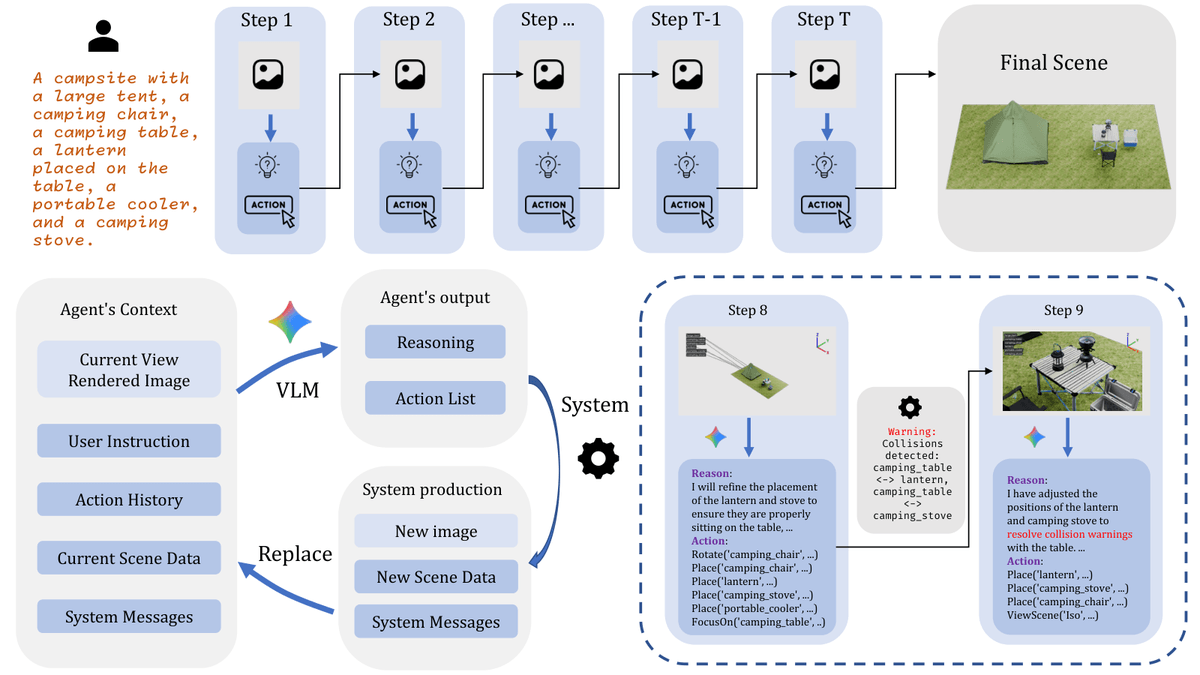
SceneAssistant's authors argue that recent VLMs already have enough latent spatial reasoning to plan layouts directly, if you give them the right tools and a feedback loop. Instead of asking the model to write raw Blender Python (which they found compromises reasoning with syntax overhead), they wrap operations in a compact set of atomic actions the agent calls like function primitives.
The action API covers three areas:
- Object management:
Create(which calls a 3D asset generator),Duplicate,Delete - 6-DoF manipulation:
Translate,Place,Rotate,Scale - Camera control:
ViewScene,FocusOn,RotateCamera,MoveCamera
Plus two utilities: GenerateFloorTexture and Finish. Combined with Rotate, which sets the object's rotation angles along the XYZ axes, these two actions cover all six degrees of freedom for an object, enabling any arbitrary spatial arrangement. Because objects generated by asset models are typically normalized in size, whereas real-world scenes often require varied object dimensions, they introduce the Scale action.
How the loop actually runs
The agent follows the ReAct paradigm, alternating reasoning and action. At each step:
- The VLM receives a rendered image of the current scene, the object metadata as JSON, and any system messages from the last step.
- It writes a short reasoning trace, then emits a JSON list of action calls.
- The backend executes the batch in Blender, checks for issues, and renders the next frame.
Two backend safeguards make the loop robust. A BVH tree-based algorithm automatically detects collisions among meshes in the scene. If a collision is detected, a corresponding notification is added to the system message for the agent. Objects that clip below the floor get lifted automatically. And Create calls must be issued in a batch by themselves, so the agent sees what the asset generator produced before trying to place it.
The stack under the hood: Gemini-3.0-Flash as the core VLM backbone. For 3D asset generation, they employ a multi-stage pipeline centered on Hunyuan3D. Since Hunyuan3D needs an image, they first generate one with Z-Image, remove the background, and then reconstruct the mesh. Max operating steps is set to 20.
Results across indoor and open-vocab scenes
The evaluation covers 30 prompts (8 indoor, 22 open-vocabulary), each scored by 10 human raters on a 1 to 10 scale for layout correctness and object quality, plus a preference vote.

On indoor scenes SceneAssistant scored 6.888 layout / 6.950 object quality vs Holodeck (4.475 / 4.763) and SceneWeaver (5.800 / 6.150), and picked up 61.25% of the preference votes. On the open-vocabulary set, ablated variants without the action APIs (NoActionAPI) or without visual feedback (NoVisFeedback) both underperformed the full system by 3 to 6 preference points, confirming that both the abstraction layer and the closed loop matter.
Interestingly, Holodeck and SceneWeaver define spatial relationships among objects (e.g., "against_wall") to determine their relative positions, which often results in objects being placed flush against walls. SceneAssistant emits absolute coordinates directly, which gives more flexible arrangements.
What the ablations reveal

Two design choices carry real weight. Removing the visual prompting overlays (object labels rendered on top of each mesh, plus a coordinate axis HUD) makes the agent lose track of which object is which and produces disorganized layouts. Removing the explicit collision feedback means the VLM has to infer intersections purely from the render, and it frequently misses them, leaving objects clipping through each other.
Where it breaks
The authors are candid about the failure modes. The agent tends to spawn all the objects it needs up front and then try to arrange them simultaneously, which produces messy batches even though the prompt tells it to work incrementally. It also underuses camera controls, sticking to ViewScene and FocusOn even when a different angle would reveal a problem. And because both the VLM and Hunyuan3D are stochastic, some prompts need multiple runs to get a clean result, or a human nudge through the system-message channel that also powers the natural-language edit interface.
If you are building tooling for game prototyping, robotics simulation, or any pipeline that needs editable Blender scenes from text, this is worth a look. The generated output is real geometry with named objects and coordinates, not a Gaussian splat, which means you can drop the scene into a downstream engine and keep editing.