
Peking University's SaPaVe Teaches Humanoid Robots to Look Before They Grab
SaPaVe teaches robots to move their camera before they move their hands, beating GR00T N1 and π0 by up to 31.25 percent on real-world tasks.
 Pro
Takeaways
- SaPaVe unifies semantic active perception and active-view execution in one end-to-end VLA framework, accepted as a CVPR 2026 Highlight.
- Beats GR00T N1 and π0 by up to 31.25% success rate on real-world humanoid manipulation tasks.
- Introduces ActiveViewPose-200K, a 200k image-language-camera-movement dataset for learning where to look.
- Ships ActiveManip-Bench: 12 tasks, 100 objects, 20 scenes on Isaac Sim with occluded and out-of-view splits.
- Uses decoupled action heads plus Universal Spatial Knowledge Injection to stay robust under moving viewpoints.
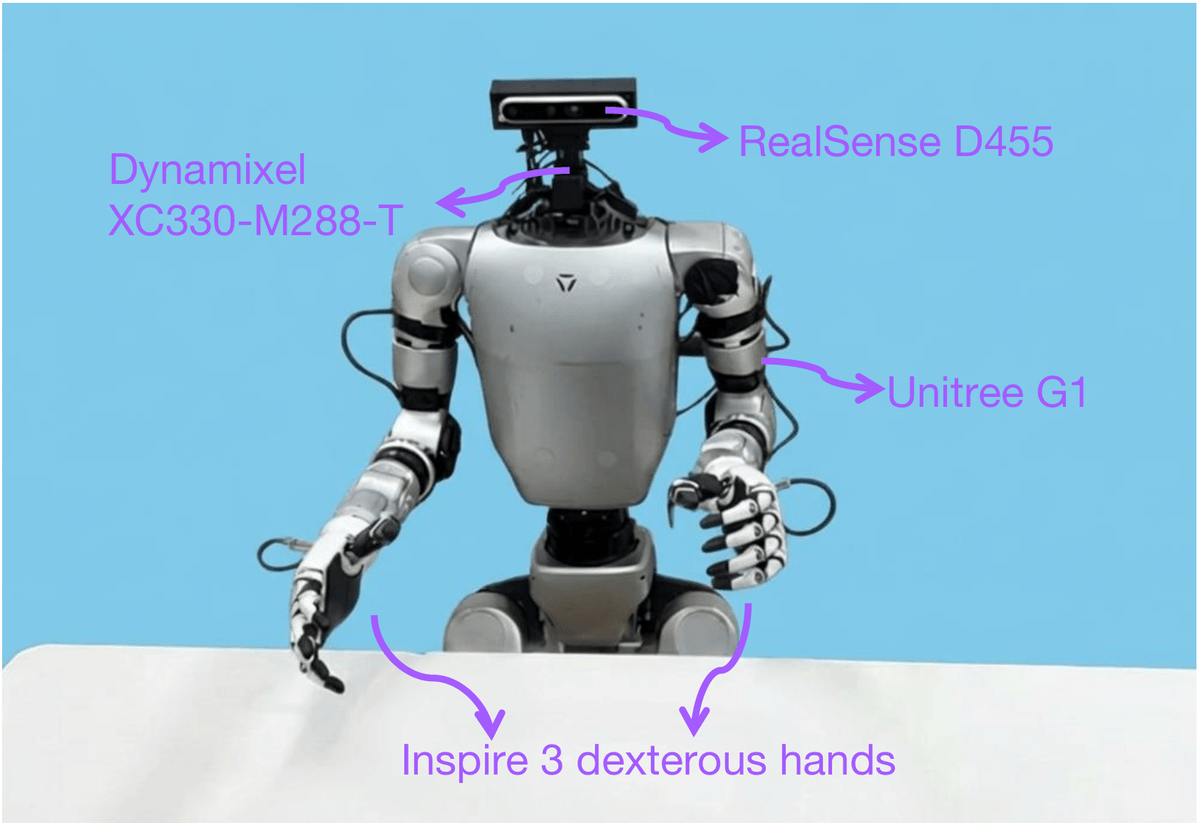
- Real-world deployment on Unitree G1 + Inspire 3 hands + RealSense D455 hits 85% average task success. Paper.
Most vision-language-action models for robots assume the camera is already looking at the right thing. That assumption breaks the moment an object is behind a cabinet door, hidden behind another object, or simply outside the field of view. A team from Peking University, Beihang University, and the Beijing Academy of Artificial Intelligence has released SaPaVe, a CVPR 2026 Highlight paper that gives a humanoid robot the ability to decide where to look first, then execute the manipulation once it has the right view.
Extensive experiments in both simulation and real-world environments show that SaPaVe outperforms recent vision-language-action models such as GR00T N1 and π0, achieving up to 31.25% higher success rates in real-world tasks. The framework hits 84.3% success on semantic active perception and 85% on real hardware active manipulation.
Why fixed cameras keep failing
Active perception and manipulation are crucial for robots to interact with complex scenes. Existing methods struggle to unify semantic-driven active perception with robust, viewpoint-invariant execution. In practice, current VLA models such as GR00T N1 and π0 are trained on demonstrations where the camera is bolted in place. If you swap in a robot with a movable head, two problems appear at once:
- The model has no idea how to command the camera semantically ("look inside the drawer", "check behind the bottle").
- Even if you move the camera, the manipulation policy that was trained on a fixed viewpoint becomes brittle because the pixels no longer match its training distribution.
Prior work has tried to solve this by stuffing camera motion and arm motion into a single shared action space. That tends to blur the two behaviors and needs enormous amounts of paired data to work.
Decoupling the eyes from the hands
SaPaVe stands for Semantic active Perception and active View Execution, and its central design choice is to keep those two things architecturally separate. The approach decouples camera and manipulation actions rather than placing them in a shared action space, and follows a bottom-up training strategy: it first trains semantic camera control on a large-scale dataset, then jointly optimizes both action types using hybrid data.

The model ingests RGB frames, optional geometric inputs, and a language instruction, then produces two distinct output streams: camera actions for the active head, and manipulation actions for the arm and hand. A dedicated camera adapter stores the perception prior, while a module the authors call Universal Spatial Knowledge Injection lets the manipulation head consume arbitrary 3D geometry (depth, point clouds) so it stays stable as the viewpoint changes. By first leveraging large-scale semantic camera control data, they use a decoupled action space to learn semantic active perception, acquired as prior knowledge in a camera adapter. They then integrate Universal Spatial Knowledge Injection to handle arbitrary geometric inputs, improving active-view execution.
Two stages, bottom-up
Training happens in two phases:
- Stage 1 - learn to look. The model is trained on ActiveViewPose-200K to predict a camera movement given an image and a natural-language task. This is where the "where to look" prior lives.
- Stage 2 - learn to act while looking. The manipulation head is trained jointly on mixed data that includes active camera control plus task execution. Because the camera head is already competent, the model does not have to learn perception and control from scratch simultaneously.
This is the data-efficiency argument. You get the expensive semantic-viewpoint skill from a large image-language dataset that does not need any teleoperated manipulation trajectories, and you only need a smaller manipulation dataset for the second stage.
ActiveViewPose-200K, the missing training set
To support this framework, they introduce ActiveViewPose-200K, a dataset of 200k image-language-camera movement pairs for semantic camera movement learning, and a 3D geometry-aware module that improves execution robustness under dynamic viewpoints. The dataset was built through a semi-automatic pipeline that curates 3D assets, procedurally generates indoor scenes, annotates optimal camera movements per task, and uses an LLM to rewrite instructions for linguistic diversity.

It covers five active-perception scenarios that are surprisingly hard for current VLMs:
- Visual centering (put the target object in the frame).
- Spatial directives ("look to the left of the sink").
- Commonsense search ("find something to drink").
- Conditional reasoning ("look at the container that is open").
- Container interaction (peer into a drawer, cabinet, or fridge).
ActiveManip-Bench: the first benchmark past fixed views
The authors also present ActiveManip-Bench, the first benchmark for evaluating active manipulation beyond fixed-view settings. Built on NVIDIA Isaac Sim, it features a humanoid robot with an active head camera and contains 12 tasks, 100 objects, and 20 scenes across three visibility conditions: unoccluded, occluded, and out-of-view.
Tasks span atomic operations like pick, reorient, and open/close, as well as longer horizons like fetch-from-drawer, fetch-from-cabinet, and liquid pouring. The occluded and out-of-view splits are the point of the benchmark, since that is where a fixed-camera baseline simply cannot see the object it needs to grasp.

Numbers on real hardware
The team deploys SaPaVe on a Unitree G1 humanoid equipped with Inspire 3 dexterous hands and a custom active head carrying a RealSense D455 RGB-D camera. Headline results:
| Evaluation | Success rate |
|---|---|
| Semantic Active Perception (ActiveViewPose) | 84.3% |
| ActiveManip-Bench (simulation average) | 74.83% |
| Real-world active manipulation average | 85.00% |
On semantic active perception, SaPaVe beats Gemini-2.5-Pro and other strong VLM baselines. In real-world evaluation the team tests occluded pick-and-place, out-of-view pick-and-place, and their articulated equivalents, plus generalization to unseen objects, unseen scenes, and lighting changes.
What is actually new here
The interesting research claim is not "add a movable camera to a VLA." It is that tightly coupled perception and execution, when trained with decoupled yet coordinated strategies, enable efficient and generalizable active manipulation. Concretely, the paper argues three things:
- Separating the camera action head from the manipulation action head prevents cross-interference during training.
- Semantic viewpoint selection can be learned from static image-language data, without paired manipulation trajectories, which is much cheaper to collect.
- Injecting 3D geometry (point cloud / depth) into the manipulation head is what makes the policy survive when the camera actually moves.
Where it fits and where it does not
This work is most useful if you are building a mobile or humanoid platform with an active head or wrist-mounted camera and you want it to handle everyday clutter: opening drawers, retrieving objects from cabinets, pouring liquid, or grasping things that start out of frame. It is less relevant for stationary industrial arms where camera placement is already optimized and viewpoints do not change.
A few caveats worth flagging. The benchmark, while a first of its kind, is bounded at 12 tasks and one embodiment; broader generalization to different robot bodies is still an open question. The 3D geometry module presumes access to depth or point clouds, which mid-tier RGB-only setups will not have. And the arXiv page for the code and dataset points to the paper and project site as the current release channels, so full open-source availability of ActiveViewPose-200K and ActiveManip-Bench will depend on what the authors ship alongside the CVPR camera-ready.
Still, this is a clean statement of a problem the field has been dancing around: real robots do not have fixed cameras, and treating perception as a passive input is holding VLA models back. Decoupling the eyes from the hands, and training the eyes first, looks like a template other groups will copy.