
Peking University's Pocket-K Detects Deadly Blood Disorder From a Smartwatch ECG
A foundation-model fine-tune reads a single ECG lead to flag high potassium, hitting AUROC 0.94 internally and enabling handheld screening in seconds.
 Pro
Takeaways
- Pocket-K fine-tunes the ECGFounder foundation model on Lead I ECG to detect hyperkalemia non-invasively.
- Trained and validated across 34,439 patients and 62,290 ECG-potassium pairs from two Chinese hospital systems.
- Reached AUROC 0.936 internally, 0.858 temporally, and 0.808 on an external site with different ECG hardware.
- Negative predictive value exceeded 99.3% externally, positioning the tool as a rule-out screener rather than a diagnostic.
- Handheld prototype streams a 30-second Lead I trace over Bluetooth to a phone for near-real-time risk scoring.
- Code released at github.com/Tangoz1003/Pocket-K; raw hospital data remains restricted.
A team from Peking University and collaborating hospitals has built Pocket-K, a single-lead AI-ECG model that flags dangerously high blood potassium from the kind of short, one-electrode trace a smartwatch or handheld device already produces. It is fine-tuned from an existing ECG foundation model, validated on more than 62,000 ECG-potassium pairs across two Chinese health systems, and paired with a Bluetooth prototype that returns a risk score in seconds.
Why a blood test is the bottleneck
Hyperkalemia - venous serum potassium above 5.5 mmol/L - is a common and potentially fatal electrolyte abnormality and a major risk factor for malignant arrhythmia and sudden cardiac death. It is especially frequent in patients with chronic kidney disease and heart failure, and its incidence rises as renal function declines. The problem is monitoring: confirmation requires a venous blood draw and lab measurement, which is invasive, intermittent, and tied to a clinical facility, so high-risk patients cannot be checked often between visits.
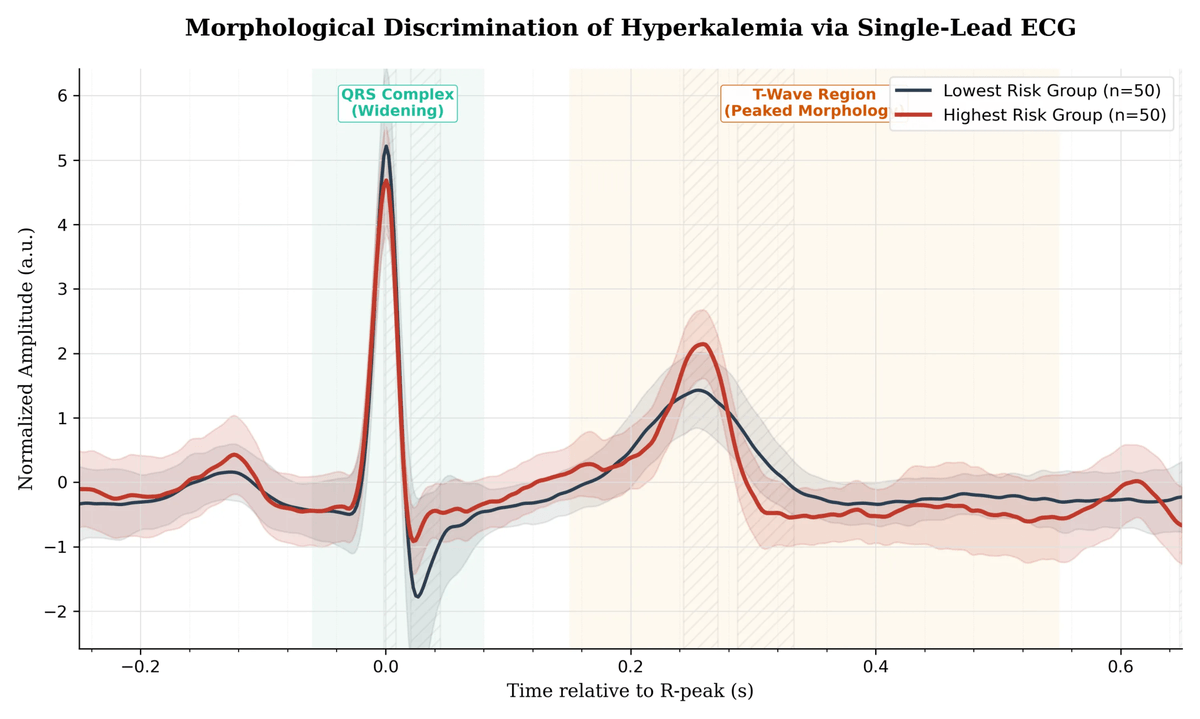
Hyperkalemia does leave fingerprints on the ECG, such as peaked T waves and widened QRS complexes, but visual interpretation alone has limited sensitivity even for experienced clinicians. Earlier deep learning work on standard 12-lead ECGs showed strong diagnostic performance, but the 12-lead workflow is impractical for home surveillance. Single-lead evidence, meanwhile, has come from small single-centre studies without rigorous multi-site validation.