
Peking University's OmniClone Cuts Humanoid Robot Control Error by 66% on One GPU
A new humanoid teleoperation stack cuts joint tracking error by 66%, runs on one consumer GPU, and works across operators from 1.47m to 1.94m tall.
 Pro
Takeaways
- OmniClone cuts whole-body humanoid teleoperation MPJPE by over 66% using a single RTX 4090 and 30 hours of motion data.
- OmniBench, a new diagnostic benchmark, evaluates policies across 18 stratified motion and difficulty categories on unseen motions.
- Subject-agnostic retargeting works across operators from 1.47 m to 1.94 m tall with no per-user calibration.
- End-to-end latency is around 80 ms via UDP transport and a FIFO buffer with zero-order hold for dropped packets.
- A GR00T N1.6 VLA post-trained on 50 demos hits 85.71% and 80.00% on pick-and-place tasks.
- Code, models, and datasets are open-sourced at the OmniClone GitHub repository.
Controlling a humanoid robot with your whole body sounds like a solved problem in demo reels, but the reality is messier. Most published systems look great on the specific motions their authors trained them on, then quietly fall apart when someone shorter puts on the motion capture suit, when the network stutters, or when the operator crouches instead of standing. A team from BIGAI, Peking University, and Beijing Institute of Technology has released OmniClone, a teleoperation system that tries to fix these cracks with better diagnostics, a leaner training recipe, and infrastructure fixes the community has largely ignored.
The headline number: an optimized training data recipe combined with subject-agnostic retargeting and robust communication cut Mean Per-Joint Position Error (MPJPE) by over 66% while requiring orders-of-magnitude fewer computational resources than comparable methods. The whole thing trains on a single RTX 4090.
The evaluation problem nobody wants to talk about
Before building anything, the authors argue the field has been grading itself on a curve. Existing systems are validated using aggregate metrics that conflate distinct motion regimes, masking critical failure modes. A single average tracking error looks fine even when a policy is actually great at standing manipulation and terrible at deep squats.
Their answer is OmniBench, a diagnostic benchmark that stratifies evaluation across six motion categories (loco-manipulation, manipulation, squatting, walking, running, jumping) and multiple difficulty levels. Reference motions are generated by HY-Motion-1.0 and retargeted to the humanoid, so evaluation happens on sequences the policy has never seen. Each category gets 60 episodes at 30 Hz, and results are split by workspace height (high, medium, low) or by dynamic intensity (fast, medium, slow).
Run against this grid, prior state-of-the-art systems reveal their soft spots. GMT and Twist2, the two baselines, hit reasonable MPJPE on standard standing manipulation but degrade sharply on lower-body agility tasks and jumping. OmniClone is designed for affordable, reproducible, and versatile whole-body control across diverse operator body shapes and task scenarios.

Inside the policy: a transformer plus a picky diet
The control policy is a transformer-based actor-critic trained via teacher-student distillation. The teacher gets privileged observations (full joint states, body link velocities, gravity, reference motion) and is trained with PPO. The student is then distilled with DAgger, but stripped of observations that are hard to estimate on real hardware, such as per-link angular velocities. To compensate, the student sees several frames of future reference motion.
The architecture is deliberately modest. The teacher uses embedding dimension 256 with 4 input tokens; the student doubles the embedding to 512 and uses 2 input tokens, both with 4 attention heads. Training runs in Isaac Lab on a single RTX 4090: about 60 hours for the teacher across roughly 33K PPO steps with 4,096 parallel environments, then another 22 hours for distillation. Total budget is around 80 GPU hours.
The more interesting finding concerns data composition. The team ablates four recipes and shows the final mix matters more than raw volume:
- Dynamic-heavy: great at jumps, collapses on manipulation and squats.
- Stable-heavy: good at squatting and loco-manipulation, loses dynamic agility.
- Balanced: improves both regimes but still contains biased sequences.
- OmniClone final: 60% manipulation motions, 40% split between dynamic and stable, with biased sequences filtered out.
A subtle point that generalizes beyond this paper: even though standing manipulation dominates the dataset, tiny changes to the remaining fraction dictate the policy's personality. Filtering a few bad dynamic sequences was enough to shift the model from unstable to reliable.
Fixing the boring parts
The infrastructure work is arguably where the practical gains live. Two problems get direct treatment:
- Retargeting mismatch across operators and hardware. Different MoCap systems and different human bodies produce deviations of up to 20 cm, which translate to about 20 mm of MPJPE damage in simulation. OmniClone computes a dynamic scaling factor from a single calibration frame and rescales incoming MoCap data to the robot's kinematics, removing per-operator manual calibration and stabilizing control regardless of the person in the suit.
- Network jitter and latency. A FIFO queue buffers
fframes of retargeted motion, with a zero-order hold that repeats the last valid observation when packets drop. Transport uses UDP between retargeting server and policy server. End-to-end latency lands around 80 ms.
Results across the grid
On OmniBench, OmniClone posts near-perfect success rate across all 18 stratified categories, while baselines drop noticeably on squats, low-altitude loco-manipulation, and jumps. Selected MPJPE numbers (in mm, lower is better):
| Task | GMT | Twist2 | OmniClone |
|---|---|---|---|
| Manip High | 71.4 | 151.1 | 24.4 |
| Loco-Manip Low | 180.5 | 210.5 | 51.3 |
| Squat Low | 140.1 | 181.1 | 37.7 |
| Run Fast | 130.9 | 180.4 | 49.2 |
| Jump High | 145.6 | 193.8 | 50.6 |
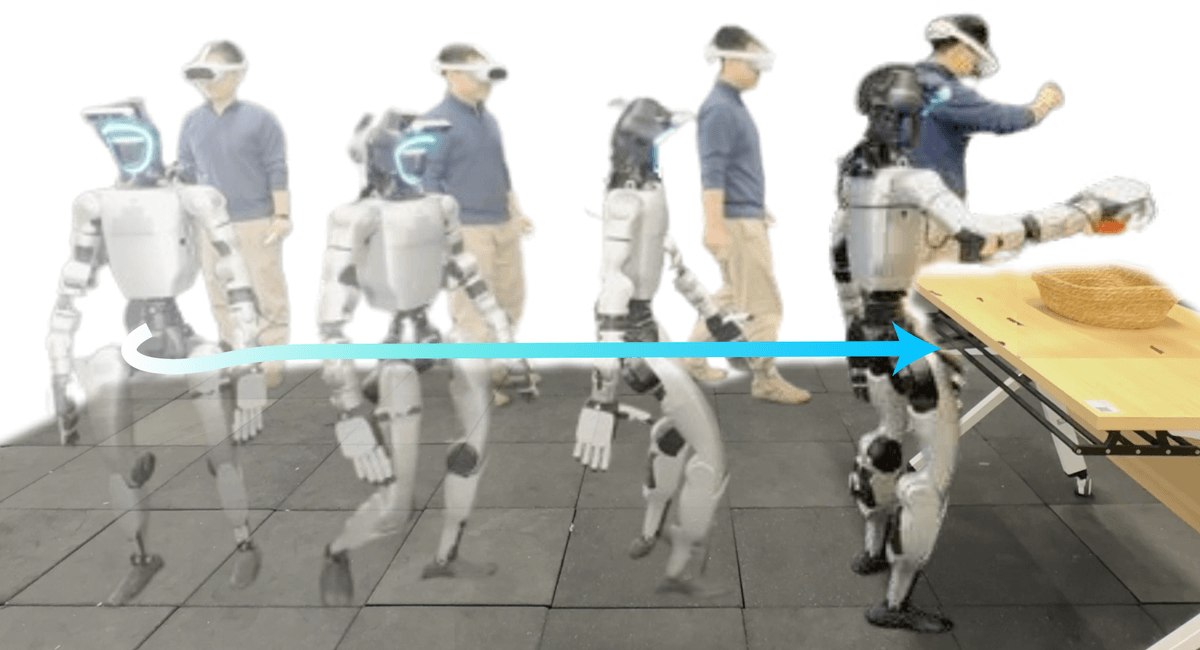
Real-world tests recruited six novices ranging from 1.47 m to 1.94 m in height. All completed a composite walk-plus-pick-and-place task within 5 to 7 practice trials, with no per-operator recalibration.
Feeding a VLA model
Because the same policy accepts references from any source, the team uses OmniClone as both a data-collection interface and a low-level controller for autonomy. They post-train NVIDIA's GR00T N1.6 vision-language-action model on just 50 full-body demonstrations, reporting 85.71% success on pick-and-place (21 trials) and 80.00% on squat-to-pick-and-place (5 trials). The VLA emits joint-space actions, which get converted via forward kinematics into body link positions that OmniClone tracks.

Where it shines, where it stumbles
Useful when you want to:
- Collect whole-body demonstrations on humanoid hardware without hiring a specialist operator.
- Run a single unified policy across teleoperation, motion playback from generative models, and downstream VLA policies.
- Reproduce results without a cluster; a consumer GPU and roughly 30 hours of motion data suffice.
Weak spots the authors are honest about: extreme dynamic regimes (high jumps in particular) still lag behind the rest of the grid, and OmniBench itself is currently simulation-only, without standardized real-world task protocols. Scaling the data recipe to close the agility gap without sacrificing balance is called out as the natural next step.
Availability
The GitHub repository is public, and the project promises full implementation, pre-trained models, and demonstration datasets. Two companion releases are also mentioned on the project page: Any2Humanoid, which handles diverse control interfaces including motion playback, VLA, and real-time teleoperation, and Sim2Anything, which transfers motions from simulation to real humanoid platforms. Hardware for the reported experiments is the Unitree G1-Comp with a head-mounted Intel RealSense D455.