
Peking University's NavSpace Reveals GPT-5 Fails Basic Robot Navigation at 14%
NavSpace is the first benchmark to systematically test spatial intelligence in robot navigation, exposing major blind spots in GPT-5, Gemini, and every major nav model
 Pro
Takeaways
- NavSpace is the first benchmark specifically designed to evaluate spatial intelligence in navigation agents, with 1,228 manually collected trajectory-instruction pairs across 6 task types.
- 22 models were tested, including GPT-5, Gemini 2.5 Pro, and top navigation models -- all struggled, with most open-source MLLMs scoring below 10% success rate.
- GPT-5 achieves only 14.2% average success; dedicated navigation models like NaVid (20%) and StreamVLN (19.2%) outperform it despite being smaller.
- SNav, a new 7B navigation model from the same team, reaches 26% average success rate by training on synthetically generated spatially-grounded instruction data.
- Real-world tests on a quadruped robot confirmed the benchmark findings: SNav scored 32% vs. NaVid's 14% and NaVILA's 6%.
- The full benchmark dataset, evaluation suite, annotation pipeline, and SNav training code are open-sourced on GitHub.
Ask a robot to "go to the second floor, walk through the corridor, and stop by the bed at the end," and you've just handed it a problem that today's best navigation models largely can't solve. NavSpace, a new benchmark from Peking University and Shanghai AI Lab accepted at ICRA 2026, is the first to systematically measure that failure -- and the results are sobering across the board.
Prior benchmarks mainly focus on semantic understanding but overlook systematically evaluating navigation agents' spatial perception and reasoning capabilities. Existing tasks like Visual Language Navigation (VLN) -- where an agent moves to a location based on landmark descriptions -- reward models that can match words like "sofa" or "kitchen" to visual features. But they never ask: can the agent count floors, measure distances in meters, or reason about what it would look like from a different object's point of view? NavSpace asks all of those questions.
The Gap Nobody Was Measuring
The embodied AI field has made real progress on semantic navigation. Models can find objects by name, follow dialogue, and navigate crowded environments. While current VLN, Object Goal Navigation, and Demand Driven Navigation benchmarks have advanced multimodal understanding, they neglect the systematic assessment of spatial intelligence, which is crucial for complex, everyday navigation tasks. The practical consequence: a robot that aces standard benchmarks can still fail to execute "turn right 90 degrees and walk 3 meters."
To execute real navigation instructions, a navigation agent must perceive and reason about space layout, scale, agent-object relative orientations, and environmental state. These are the skills NavSpace was built to probe.

Six Tasks, One Benchmark
NavSpace is the first spatial intelligence benchmark for instruction navigation, stemming from questionnaire surveys and manually collecting 1,228 high-quality trajectory-instruction pairs. The six task categories were chosen by surveying 457 participants who selected which instruction types best reflect spatial intelligence:
- Vertical Perception: Identifying and navigating between floors -- e.g., "go to the topmost floor" or "stop halfway up the stairs."
- Precise Movement: Executing exact distances and angles -- e.g., "turn right 180°, go straight 1m, turn left 90° and go 5m."
- Viewpoint Shifting: Adopting another object's perspective -- e.g., "imagine you are the television in front of you; move toward your front-left."
- Spatial Relationship: Counting and ordering -- e.g., "turn left at the third door on your left" or "stop between the two brown sofas."
- Environment State: Conditional navigation -- e.g., "if you see the keys, stop; otherwise go to the front door."
- Space Structure: Understanding layout -- e.g., "walk around the dining table once" or "go to the farthest sofa."
The data was collected using a custom Habitat 3.0 simulator platform. Annotators teleoperated agents through photorealistic HM3D scenes, then wrote instructions with MLLM assistance, and a separate annotator had to successfully replay each trajectory before it was accepted -- a rigorous cross-validation step that kept quality high.
Every Major Model Struggles
The benchmark comprehensively evaluates 22 navigation agents, including state-of-the-art navigation models and multimodal large language models. The results expose a consistent pattern: spatial intelligence is a genuine blind spot across the entire field.
The average success rate of all open-source MLLMs falls below 10%, which is similar to Chance Level (Frequency). Even the best proprietary models struggle: GPT-5 achieves only 14.2% average success rate, and Gemini 2.5 Pro reaches just 11.2%. Dedicated navigation large models like NaVid (20.0%) and StreamVLN (19.2%) actually outperform these frontier LLMs on the benchmark -- suggesting that navigation-specific fine-tuning provides a real edge even when the base model is weaker.
The diagnosis for why MLLMs fail is particularly revealing. GPT-5 sometimes can correctly answer questions about precise distance, viewpoint shift, or environmental state. However, when it predicts concrete navigation actions, the actual actions are inconsistent with its initial perception. In other words, the model can reason about space in the abstract but cannot translate that reasoning into a sequence of physical moves -- a fundamental gap between spatial understanding and embodied action.
SNav: Injecting Spatial Intelligence
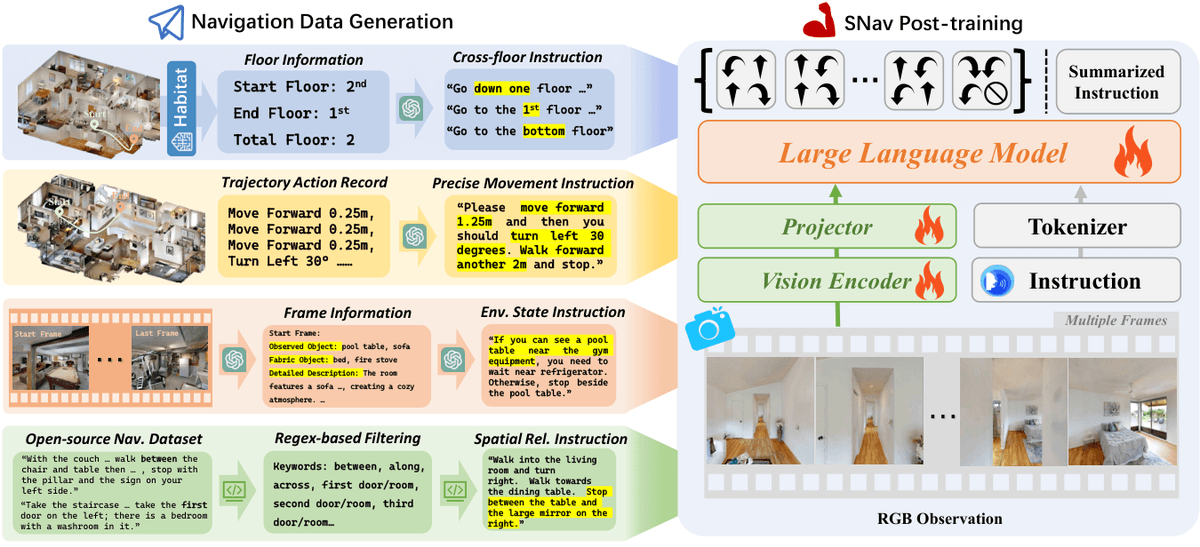
The paper doesn't just diagnose the problem -- it proposes a fix. The authors explore generating spatially intelligent navigation instructions from open-source datasets and leveraging these instructions to inject spatial perception and reasoning capabilities into navigation models, proposing SNav, a spatially intelligent navigation large model.
SNav's architecture is straightforward: a SigLIP vision encoder, a 2-layer MLP projector, and a Qwen2 LLM as the backbone, initialized from LLaVA-Video 7B. The key innovation is in the training data. The team built four automated pipelines to synthesize spatially-grounded instruction-trajectory pairs from existing open datasets:
- Cross-floor Navigation: Filters R2R trajectories by height difference, uses GPT-5 to detect stair frames, then rewrites instructions with explicit floor labels (e.g., "walk up to the top floor").
- Precise Movement: Samples random start/goal pairs in MP3D scenes, runs a shortest-path planner, merges consecutive actions, and paraphrases them into natural language (e.g., "walk forward 3 meters, then turn right 60°").
- Environment State: Extracts R2R trajectory pairs, queries GPT-5 on first and last frames to identify visible/invisible objects, then instantiates "if...otherwise..." instruction templates.
- Spatial Relationship: Mines R2R instructions using regex for ordinal phrases ("first door," "third room") and multi-object relational words ("between," "across").
The model is then fine-tuned with these synthetic pairs alongside standard navigation data -- a co-training approach that preserves general navigation ability while adding spatial reasoning.
Results That Hold Up in the Real World
SNav significantly outperforms all evaluated baseline models on NavSpace, achieving an average SR of 26.0%, compared to GPT-5's 14.2% and StreamVLN's 19.2%. The gains are especially large on Environment State (41.5% SR vs. StreamVLN's 28.0%) and Spatial Relationship (32.5% vs. 24.5%).
The team also ran real-world tests on an AgiBot Lingxi D1 quadruped robot across office, campus, and outdoor environments. The results held up:
| Model | Precise Movement | Viewpoint Shifting | Spatial Relationship | Environment State | Space Structure | Average |
|---|---|---|---|---|---|---|
| NaVILA | 0/10 | 0/10 | 1/10 | 0/10 | 2/10 | 6% |
| NaVid | 1/10 | 2/10 | 2/10 | 1/10 | 1/10 | 14% |
| SNav (Ours) | 3/10 | 4/10 | 4/10 | 1/10 | 4/10 | 32% |

What This Means in Practice
By deconstructing navigation into orthogonal spatial dimensions, the benchmark exposes fundamental limitations in existing models -- especially their inability to generalize from language-encoded spatial instructions to concrete navigational actions. This matters for anyone building robots or embodied agents that need to operate in real environments where people give natural, spatially-rich instructions.
The benchmark and code are publicly available. The official codebase includes NavSpace datasets for all six subtasks, a unified evaluation suite supporting LLMs and SNav, an annotation pipeline built on Flask and Habitat-Sim, and SNav training code runnable end-to-end from Habitat rendering to DeepSpeed SFT. The GitHub repository also includes the annotation web UI used to build the benchmark itself.
The honest takeaway from NavSpace is that spatial intelligence in embodied navigation is still largely unsolved -- even by the most capable frontier models. Success rates in the 10-26% range, on tasks that any human navigates effortlessly, show just how much ground remains to cover. SNav is a meaningful step forward, but the benchmark's real contribution is making the problem measurable for the first time.