
Peking University's MV-SAM3D Fixes Floating Objects in 3D Scenes Without Retraining
MV-SAM3D extends Meta's SAM 3D Objects with multi-view fusion and physics-aware pose optimization, no retraining required.
 Pro
Takeaways
- MV-SAM3D extends Meta's SAM 3D Objects to multi-view input without any retraining
- Two adaptive fusion strategies weight each viewpoint by attention entropy and geometric visibility
- Physics-aware optimization eliminates object interpenetration, dropping collision rate from 15.32% to 0%
- Beats EscherNet on GSO benchmark: 20.2 vs 21.5 Chamfer Distance with 2 views
- Uses Depth Anything 3 for metric pointmaps and camera pose estimation
- Code and inference scripts available at github.com/devinli123/MV-SAM3D
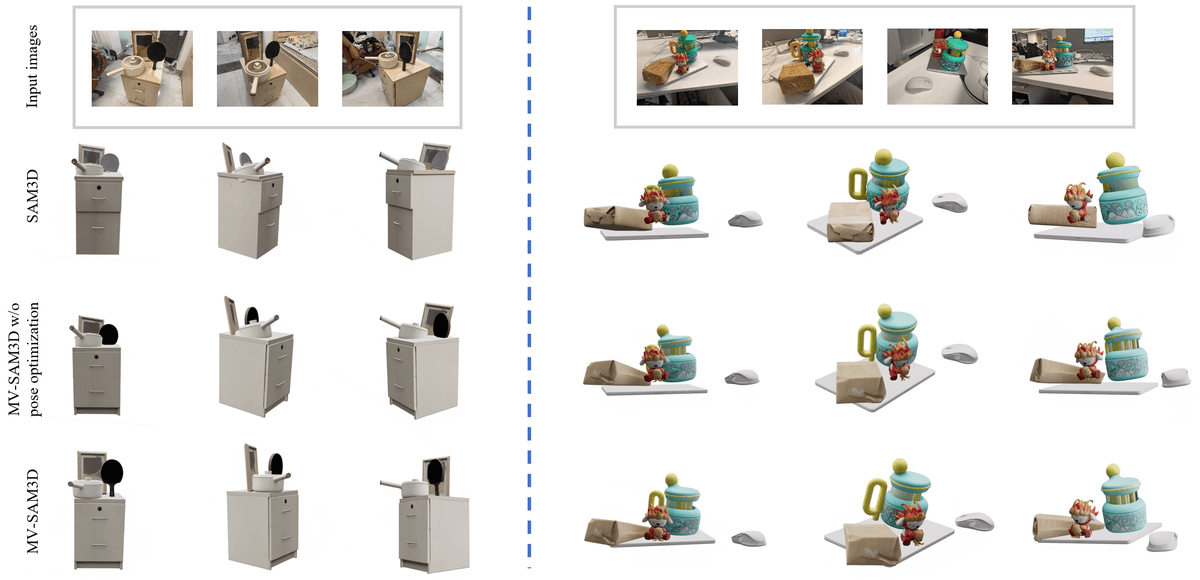
Meta's SAM 3D Objects showed that a single image can produce plausible 3D geometry, texture, and scene layout for multiple objects at once. But single-view generation has a hard ceiling: anything the camera cannot see has to be hallucinated, and when you have several objects, each one gets a pose estimated on its own, which produces scenes where mugs float above tables or keyboards intersect laptops. A team from Peking University and JD Explore Academy has released MV-SAM3D, a training-free extension that plugs multi-view inputs into SAM 3D's pipeline and adds physics constraints on top.
The paper makes two contributions that matter in practice. First, it lets you feed 2 to 8+ images of the same scene into an unmodified SAM 3D backbone and get a single 3D reconstruction that respects all of them. Second, it resolves the interpenetration and floating artifacts that plague per-object pose estimation. Both improvements are achieved without any additional training, and code is available on GitHub.
The naive-averaging trap
The obvious way to fuse multiple views in a diffusion model is to run the denoiser once per viewpoint and average the predicted velocities at each step, a technique called Multi-Diffusion. It works, but it treats every view as equally trustworthy at every 3D location. If four cameras see the front of a plush toy and one camera sees a black label on the back, the four frontal views drown out the single rear view, and the label disappears. Worse, hallucinated content from views where a region is occluded gets blended in with real observations.
MV-SAM3D fixes this with two complementary confidence signals that decide, per 3D point and per view, how much to trust each prediction:
- Attention-entropy weighting. When a latent point corresponds to a region the camera actually saw, the cross-attention collapses onto a small set of image patches. When the point is occluded, attention spreads diffusely across the whole image. Shannon entropy of the attention distribution becomes an implicit observation-confidence score, with low entropy meaning "this view really sees this point."
- Geometric visibility weighting. After Stage 1 produces coarse voxels, the framework transforms them into each camera frame and runs DDA ray tracing to compute a hard binary visibility mask. This catches cases where attention entropy is fooled, such as symmetric objects where the model confidently attends to the wrong side.
The two signals combine with a mixing coefficient. The paper shows a medicine box case where entropy alone bleeds the front-face texture onto the back because the two sides look structurally similar; adding visibility weighting cleanly separates them.

Making the scene physically real
For multi-object scenes, MV-SAM3D injects a physics loss directly into the flow matching trajectory during Stage 1 generation. The loss has two terms: a collision penalty on volumetric overlap and a contact term that encourages nearby surfaces to actually touch. Gradients from this loss steer the diffusion trajectory the same way classifier guidance would. A post-generation stage then does a global pose refinement on the final meshes using Chamfer distance to the metric depth from Depth Anything 3, plus the same collision and contact terms.
The ablation is striking. Without physics-aware optimization, collision rate is 15.32%. Layout injection alone drops it to 1.67%. Adding post-refinement takes it to 0.00% while pushing Acc@5cm from 60.23 to 91.66.
What the numbers say
On the Google Scanned Objects benchmark, MV-SAM3D beats EscherNet, the previous multi-view baseline, on Chamfer Distance and novel view synthesis metrics:
| Method | Views | CD (x10^-3) | PSNR | LPIPS |
|---|---|---|---|---|
| SAM3D (single-view) | 1 | 42.0 | 19.82 | 0.108 |
| EscherNet | 2 | 21.5 | 22.91 | 0.064 |
| MV-SAM3D | 2 | 20.2 | 23.45 | 0.059 |
| EscherNet | 5 | 17.5 | 25.09 | 0.043 |
| MV-SAM3D | 5 | 17.3 | 25.22 | 0.042 |
The gains are modest against EscherNet on raw geometry, but MV-SAM3D preserves layout awareness that pure reconstruction methods don't. An ablation on view count shows the biggest jump comes from 1 to 2 views (PSNR 19.52 to 21.08), with diminishing returns beyond that.
Practical notes
The repo ships two entry points: run_inference.py for the baseline and run_inference_weighted.py for the adaptive version. A multi-object call looks like this:
python run_inference_weighted.py \
  --input_path ./data/desk_objects0 \
  --mask_prompt keyboard,speaker,mug,stuffed_toy \
  --da3_output ./da3_outputs/desk_objects0/da3_output.npz \
  --merge_da3_glb \
  --run_pose_optimization
Inputs are per-object RGBA PNG masks and pointmaps from Depth Anything 3. Experiments were run on a single A100 80GB. The framework inherits SAM 3D's limitations for regions unobserved across all views, and it depends entirely on the base model's priors; if SAM 3D can't reconstruct an object class well, no amount of view fusion will fix that. It's best suited to real-world capture setups where you already have multiple photos of a cluttered scene, such as robotics manipulation datasets, AR asset digitization, or digital twin work where physical plausibility of the layout is what downstream tasks actually need.