
Peking University's HD-LIF Beats STBP Accuracy While Cutting Memory 10x
Peking University's HD-LIF model fixes the gradient mismatch that has held back SNN online training, beating STBP accuracy while slashing memory and power costs.
 Pro
Takeaways
- HD-LIF fixes online SNN training: A new neuron model from Peking University eliminates the gradient mismatch that made online SNN training worse than standard STBP training.
- State-of-the-art across 5 benchmarks: HD-LIF achieves 69.77% on ImageNet-1k and 83.00% on DVS-CIFAR10, beating all prior online and STBP methods.
- 15x parameter compression: Binary/ternary synaptic weights shrink model size dramatically -- ResNet-34 goes from 87MB to 10MB with higher accuracy.
- Full-stage optimization: Constant GPU memory during training, 30% fewer NOPs at inference, and up to 9x lower power consumption via spike quantization.
- Model family for different needs: Parallel, Mem-BN, and SECA variants let users trade off speed, accuracy, and power for their specific deployment target.
- Code available: github.com/hzc1208/HD_LIF -- accepted at CVPR 2026.
Spiking Neural Networks (SNNs) have long promised a future where AI runs on a fraction of the energy of today's GPU-hungry models. But getting them to train efficiently without sacrificing accuracy has been a stubborn open problem. A team from Peking University's Beijing Key Laboratory of Brain-inspired Spiking Large Models now has a compelling answer: the Hybrid-Driven Leaky Integrate-and-Fire (HD-LIF) model family, accepted at CVPR 2026, which simultaneously fixes the gradient problems that plagued online SNN training and delivers state-of-the-art results across every major benchmark.
Why SNNs are worth the trouble
SNNs mimic the dynamics of biological neurons and use binary spikes to communicate between layers. Because of their inherent sparsity, they are regarded as more energy-efficient than conventional ANNs and are widely used in low-power edge computing. The appeal is obvious for anyone building models that need to run on embedded hardware, neuromorphic chips like Intel Loihi, or any device where a GPU is not an option.
The standard way to train SNNs is Spatial-Temporal Back-propagation (STBP) -- think of it as backprop-through-time adapted for spiking neurons. The GPU memory required by STBP increases linearly with the number of time-steps, which becomes a serious bottleneck for longer sequences or deeper networks. Online training was proposed as the fix: instead of unrolling the full temporal computation graph, you update weights at every time-step and throw away the history. GPU memory stays constant regardless of how many time-steps you use.
The hidden cost of online training
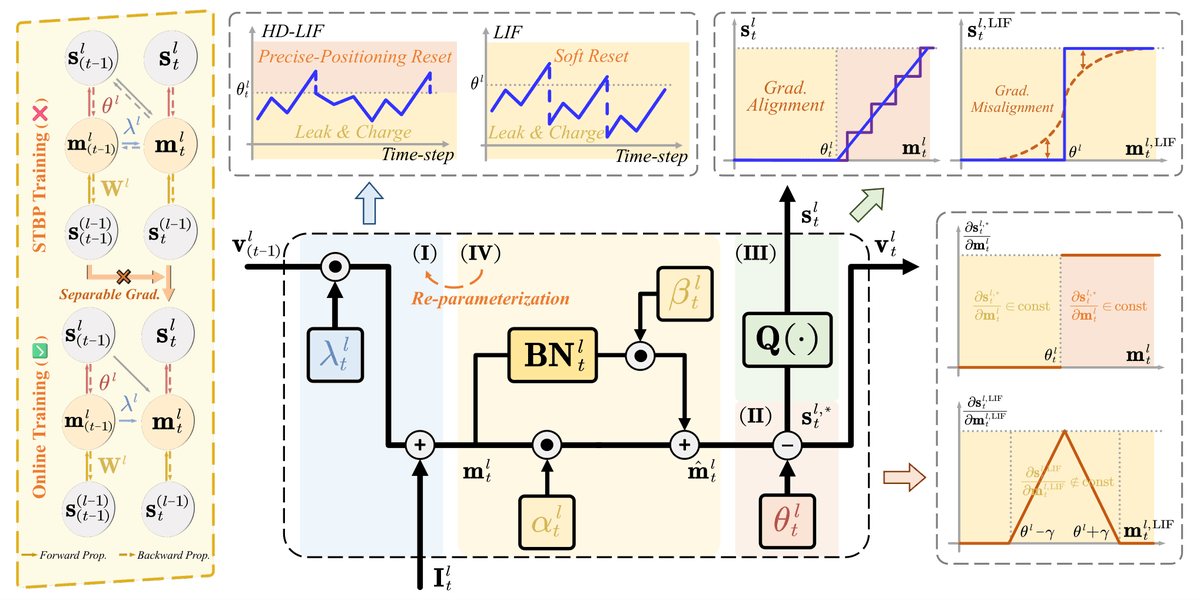
The catch is that cutting the temporal dependency during backprop introduces a mismatch between what the forward pass computes and what the backward pass optimizes. Current online learning frameworks cannot tackle the gradient discrepancy problem between the forward and backward process, merely aiming to optimize GPU memory, resulting in no performance advantages compared to STBP-based models in the inference stage. In other words, you save memory during training but end up with a worse model at deployment time -- a bad trade.
There are actually two distinct problems here:
- Gradient inseparability: The surrogate gradient function used to approximate the non-differentiable spike-firing step depends on the membrane potential value at each time-step. Since membrane potentials evolve unpredictably over time, the temporal gradient terms can't be cleanly separated and dropped without corrupting the gradient signal.
- Inference deployment gap: Most online learning methods neglect the optimization of computation time and memory usage during the inference phase, thus failing to demonstrate their advantages over STBP training when deploying SNN models.
A neuron that fixes its own gradients
HD-LIF's core insight is to redesign the neuron model itself so that the gradient problem disappears by construction. The standard Leaky Integrate-and-Fire (LIF) neuron charges up, fires a binary spike (0 or 1) when it crosses a threshold, then resets. HD-LIF keeps this behavior below the threshold but changes what happens above it.
Compared to vanilla LIF, HD-LIF can enhance gradient separability and alignment through the hybrid-driven spiking calculation mechanism, thereby overcoming the discrepancy between the forward and backward process of conventional online training. Specifically, HD-LIF introduces a Precise-Positioning Reset (P2-Reset): after firing, the membrane potential resets exactly to the threshold value and emits a floating-point spike proportional to how far above the threshold the potential was. This makes the surrogate gradient constant -- it no longer depends on the membrane potential value -- which is the mathematical condition needed for the temporal gradient terms to be safely dropped.

The synaptic weights are compressed to 1-bit or 1.5-bit representations (binary or ternary), which dramatically shrinks model size and reduces the multiply-accumulate operations that dominate power consumption on neuromorphic hardware. The 1.5-bit scheme further promotes weight sparsity, cutting Synaptic Operations (SOPs) even further.
A family of variants for every scenario
Rather than a single model, the authors release a family of variants that can be mixed and matched:
- Vanilla HD-LIF: The base model with P2-Reset and compressed weights. Already achieves gradient separability and outperforms STBP baselines.
- Parallel HD-LIF: Removes the leakage and charging processes entirely, allowing all time-steps to be computed simultaneously. Reduces Neural Operations (NOPs) by 30% at inference with minimal accuracy cost.
- Mem-BN HD-LIF: Adds a membrane potential batch-normalization layer that actively regulates the gradient separability during training. The BN parameters are fused back into the membrane parameters at inference time via reparameterization, so there is zero extra cost at deployment.
- SECA (Spiking Efficient Channel Attention): A lightweight channel attention module with only a single 1D convolution layer. It shares weights across time-steps and adds negligible parameter overhead while boosting accuracy by up to 1.8% on neuromorphic data.
What the numbers say
The results across five benchmarks are striking, especially given that HD-LIF uses far fewer parameters than competing methods. On ImageNet-1k with a ResNet-34 backbone, HD-LIF achieves 69.77% top-1 accuracy, exceeding prior online learning methods within fewer time-steps and saving more than 88% of synaptic parameter memory. The full comparison table tells the story:
| Dataset | Method | Params (MB) | Time-steps | Accuracy (%) |
|---|---|---|---|---|
| CIFAR-10 | GLIF (STBP) | 44.66 | 4 | 94.67 |
| CIFAR-10 | HD-LIF (Ours) | 2.82 | 4 | 95.59 |
| CIFAR-100 | SLTT (Online) | 44.84 | 6 | 74.38 |
| CIFAR-100 | HD-LIF (Ours) | 3.00 | 4 | 78.45 |
| ImageNet-1k | SLTT (Online) | 87.12 | 6 | 66.19 |
| ImageNet-1k | HD-LIF (Ours) | 10.06 | 4 | 69.77 |
| DVS-CIFAR10 | NDOT (Online) | 37.05 | 10 | 77.50 |
| DVS-CIFAR10 | HD-LIF (Ours) | 2.49 | 10 | 83.00 |
The ablation study on CIFAR-100 is equally revealing. Compared to a vanilla LIF baseline, HD-LIF can outperform LIF by 7.87% while saving 10x parameter memory and 9x power consumption. Adding the 4-bit spike quantization variant drops power consumption by another order of magnitude (from 0.26 mJ to 0.03 mJ per inference) with only a 0.54% accuracy penalty.
Where it fits and where it doesn't
HD-LIF is best suited for scenarios where you need to deploy SNNs on neuromorphic or edge hardware with tight memory and power budgets. The combination of binary/ternary weights, compressed spikes, and the Parallel HD-LIF variant makes the inference footprint genuinely small. It also handles neuromorphic event-camera data (DVS-CIFAR10) particularly well, which is the natural data modality for SNN deployment.
The main limitation is training overhead. Because HD-LIF involves more learnable parameters (per-timestep membrane leakage and threshold values), training is somewhat slower than vanilla LIF online training -- roughly 35-40 seconds per epoch versus 20 seconds for LIF on CIFAR-100 with a ResNet-18. The training GPU memory also increases slightly. This is a reasonable trade for the accuracy gains, but it's worth noting that HD-LIF does not reduce training cost relative to STBP; it reduces it relative to the memory explosion of STBP while recovering the accuracy gap that prior online methods left on the table.
The real breakthrough
Before this work, the SNN community faced an uncomfortable choice: use STBP and get good accuracy but exploding GPU memory, or use online training and get constant memory but worse accuracy. HD-LIF breaks that tradeoff by showing that the accuracy gap was never fundamental -- it was an artifact of a poorly designed neuron model. By redesigning the firing and reset mechanism so that gradients are separable by construction, the authors make online training genuinely competitive with STBP for the first time.
The code is publicly available on GitHub, and the paper was accepted to CVPR 2026. For anyone building SNN-based pipelines for edge inference, event-camera processing, or neuromorphic chip deployment, this is the training framework to benchmark against.