
Peking University's H2R Swaps Human Hands for Robot Arms in Training Videos
A new pipeline swaps human hands for rendered robot arms in egocentric video, boosting downstream manipulation success by up to 23% in the real world.
 Pro
Takeaways
- H2R rewrites egocentric human videos so a rendered robot arm replaces the human hand, closing the pre-training visual gap.
- Pipeline chains HaMeR hand pose, sim retargeting, SAM segmentation, and LaMa inpainting with camera-aligned compositing.
- Simulation gains of 1.3-10.2% across Robomimic, RLBench, PushT, CortexBench; up to 25.5 points on MoveCan alone.
- Real-world manipulation improves 3.3-23.3% across UR5, Leaphand, and dual-arm Franka/UR5e platforms.
- H2R-augmented SSv2 pre-training beats R3M pre-trained on the real DROID robot dataset on Robomimic.
- Authors release H2R-1M, 1M-frame datasets covering UR5, Leaphand, and Franka embodiments over SSv2 and Ego4D.
Robot learning has a data problem. Teleoperating a real arm to collect training demonstrations is slow and expensive, so researchers have leaned on massive egocentric human video datasets like Ego4D and Something-Something V2 as a cheap substitute for pre-training visual encoders. The catch: a policy that has spent months staring at human hands then has to deploy on a two-finger gripper or a dexterous Leaphand, and the pixels look nothing alike.
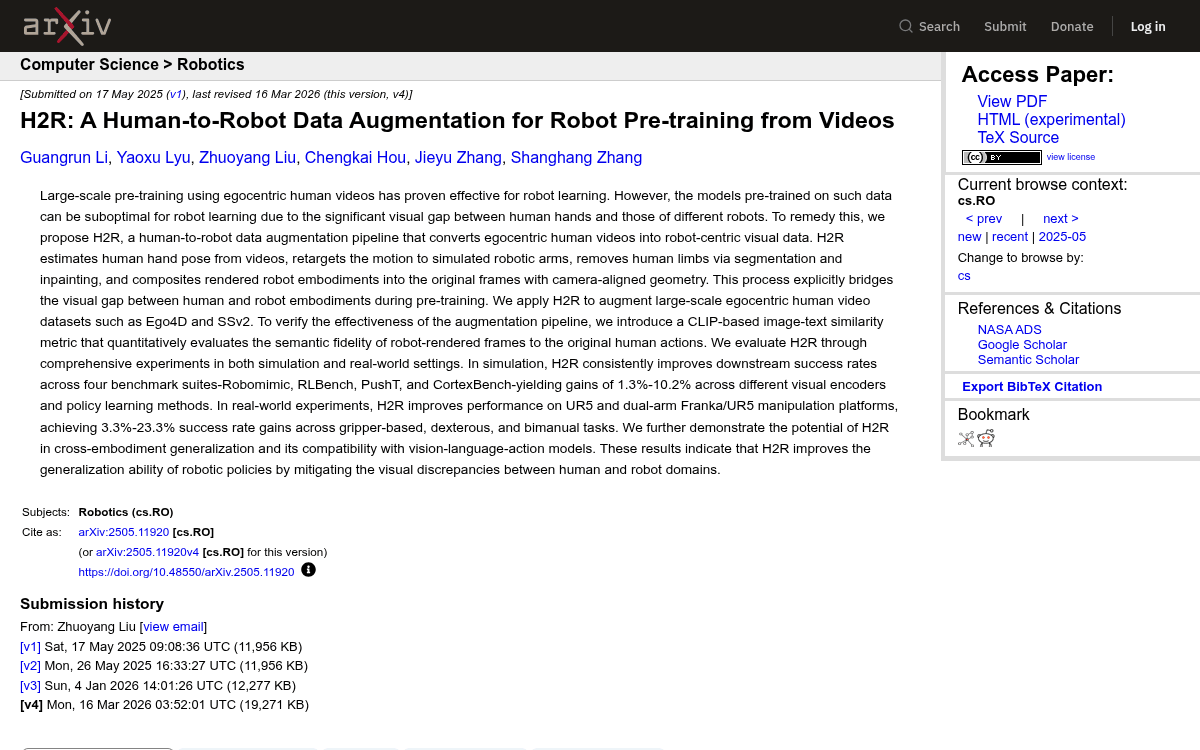
A team from Peking University and the University of Washington has released H2R, a data augmentation pipeline that closes that gap by cutting the human hand out of the video and pasting a rendered robot arm in its place, frame by frame, with camera geometry preserved. H2R estimates hand pose from video, retargets the motion to a simulated robotic arm, removes human limbs via segmentation and inpainting, then composites the rendered embodiment back into the original frame with camera-aligned geometry.
Why the human-to-robot pixel gap matters
Pre-training on egocentric video works because it captures diverse object interactions at a scale no robotics lab can match. At deployment, though, the visual encoder sees a gripper where it was trained to expect fingers. That mismatch quietly limits how much the pre-trained features actually transfer. Prior workarounds like EgoMimic and RoVi-Aug hint at the idea, and H2R goes all the way to full 3D-consistent robot rendering on top of internet-scale human video.
Three steps from hand to gripper
The augmentation runs in three stages:
- Hand pose estimation. The system detects human hand keypoints using HaMeR, a transformer-based 3D hand reconstruction model, which also returns the camera intrinsics and extrinsics of the original frame.
- Retargeting. The detected keypoints drive a simulated robot. For dexterous hands, each finger joint angle is computed from three consecutive keypoints along that finger. For grippers, the opening is set from the fingertip distance. The simulator camera is then transformed to match the real egocentric camera so the rendered arm sits in the correct perspective.
- Removal and inpainting. Segment Anything masks out the human hand and arm, LaMa fills in the background, and the rendered robot is composited on top with pixel-level alignment between robot links and the original hand keypoints.

To sanity-check that the augmented frames still depict the same action, the authors built a CLIP-based evaluator. Each frame is paired with a human-centric prompt ("A human is [action]") and a robot-centric prompt ("A robotic arm is [action]"), with the action phrase generated by Qwen2.5-VL. Across 1,000 sampled pairs, H2R-augmented images scored 29.83 on CLIP similarity to robot-centric prompts versus 28.01 for the originals against human ones, so the swap preserves and even sharpens action semantics.
The numbers
The team pre-trained MAE and R3M visual encoders on subsets of SSv2 and Ego4D (~1M frames each), then evaluated on both simulated and real manipulation. In simulation across Robomimic, RLBench, PushT, and CortexBench, H2R yields gains of 1.3% to 10.2% across different visual encoders and policy learning methods. The most striking single-task jump: MAE on Robomimic's MoveCan went from 54% to 79.5% success.
Real-world results are larger. Using Diffusion Policy and ACT on four platforms (UR5 with gripper, UR5 with Leaphand, dual-arm Franka, dual-arm UR5e), H2R adds 3.3% to 23.3% success rate depending on the setup. Dexterous Leaphand tasks benefit most, with R3M under ACT jumping 23.3 points on average.

What is actually new here
Beyond the pipeline itself, the paper makes three claims worth calling out:
- It beats real robot data. Compared against R3M pre-trained on the DROID robot dataset, H2R-augmented SSv2 pre-training scores higher on Robomimic (61.3% vs 56.7% average). Synthetic robot pixels overlaid on human videos outperformed actual robot demonstrations for representation learning.
- It transfers across embodiments. Even when the augmentation uses a UR5+gripper but the downstream robot is a UR5+Leaphand, gains hold. Franka-based augmentation on UR5 tasks still improves over baseline, just by smaller margins.
- It plays with VLA models. Fine-tuning the VAE inside the Unified Video Action model on H2R data lifted average success on dual-arm UR5e tasks from 20% to 35%.
Caveats and what's released
Ablations show both components matter: dropping the robot overlay costs up to 30 points, and random pasting without camera retargeting costs about 17. H2R also does not solve lighting robustness on its own, so explicit lighting augmentation is still needed to handle real-world illumination shifts. Gains on tasks that hinge on fine grasp precision (like Gripper-CloseBox) are smaller or occasionally negative, because inpainting can wash out subtle contact cues.
The authors have released H2R-1M, a family of 1M-scale datasets covering multiple robot embodiments (UR5 with gripper/Leaphand, Franka) and human video sources (SSv2, Ego4D), with modular annotations to support downstream robotic learning. For anyone pre-training a manipulation policy on human video, it is now a drop-in dataset swap that costs no additional labeling and consistently moves the success-rate needle.