
Peking University's GraspADMM Doubles Robot Grasp Success Over Top Rival
A new ADMM-based refinement stage lets a robotic hand slide its contact points, unlocking a 15-point jump in grasp success and rock-solid grips on slippery objects.
 Pro
Takeaways
- GraspADMM replaces Dexonomy's fixed-contact refinement with ADMM optimization that decouples target and hand contact points.
- Grasp success rate jumps from 60.5% to 74.6% on a 5,697-object DexGraspNet benchmark with zero penetration.
- Type-aware synthesis roughly doubles success rates across power, intermediate, and precision grasp categories versus Dexonomy.
- Maintains diverse stable grasps at extreme low friction (mu=0.1) where prior methods find almost none.
- Runs at 19 samples per second on CPU; authors suggest GPU simulators like NVIDIA Newton for speedup.
- No public code released yet; the paper provides full algorithm pseudocode for reimplementation on top of Dexonomy.
Building large datasets of dexterous grasps for high-DoF robotic hands has been stuck in a frustrating three-way tradeoff. Sampling methods produce diverse hand poses but weak physics. Gradient-based optimizers deliver stable force-closure but push fingers straight through objects. Simulator-based methods like Dexonomy resolve collisions cleanly but freeze contact points in place, leaving grasps geometrically valid yet physically shaky. A new paper from Peking University, GraspADMM, shows that borrowing an old trick from convex optimization (the Alternating Direction Method of Multipliers) can dissolve this tradeoff entirely.
The three-way squeeze in grasp synthesis
Dexterous hands typically have more than 20 degrees of freedom, which is exactly what makes them powerful and exactly what makes grasp planning intractable. A high-quality grasp needs four things at once: diversity across grasp types, kinematic feasibility (fingers touching without penetrating), dynamic stability (contact forces that actually hold the object against gravity), and reasonable synthesis speed.
The current state of the art, Dexonomy, synthesizes contact-rich, penetration-free grasps for any grasp type by starting from a single human-annotated template per hand and grasp type. It uses transposed Jacobian control as virtual springs, pulling hand contact points toward pre-assigned target points on the object inside a physics simulator. That resolves collisions robustly, but the target points are fixed. If those targets happen to sit in a spot where the hand cannot generate enough force closure, Dexonomy has no way to move them and can only discard the failed attempt.
Decoupling with ADMM
The GraspADMM insight is to treat the target contact points on the object and the actual contact points on the hand as separate variables, then alternate between optimizing them. ADMM, a classic technique for constrained convex problems, is the machinery that keeps the two variables agreeing with each other via a Lagrange multiplier. Gradients through non-differentiable contact physics are never needed, because each subproblem is solved with a tool suited to it.

The refinement loop repeats three steps until convergence:
- Update the target object points via one gradient-descent step to minimize the force-closure grasp metric, then project them back onto the object surface.
- Update the hand pose by stepping MuJoCo forward with virtual spring forces pulling each fingertip toward its shifted target, letting the simulator handle exact mesh-to-mesh collision.
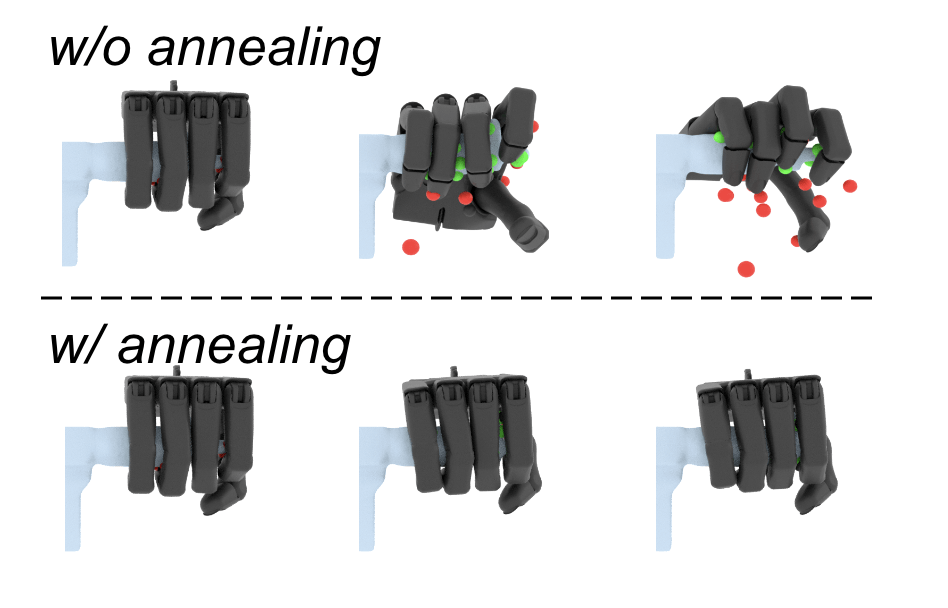
- Update the dual variable that tracks the residual gap between hand and target, with an annealing rule that resets it to zero if it grows past
2e-2to prevent divergence.
A penalty parameter rho balances the two forces. At rho=0 the algorithm ignores kinematics and picks unreachable targets; as rho goes to infinity it collapses back to Dexonomy's fixed-point behavior. The paper settles on rho=1e3 as the sweet spot.
The numbers
On the standard type-unaware benchmark of 5,697 assets from DexGraspNet, each scaled across 6 geometric sizes and grasped by an Allegro hand, GraspADMM lifts grasp success rate from Dexonomy's 60.5% to 74.6% while keeping penetration depth at zero. Other differentiable baselines like DexGraspNet, FRoGGeR, and SpringGrasp sit at 12.1%, 10.3%, and 7.8% respectively. BODex reaches 49.2% but only for fingertip-style grasps.

The type-aware setting is where the gap widens sharply. Across power, intermediate, and precision grasp categories, GraspADMM roughly doubles Dexonomy's success rate (62.8 vs 32.9 on power grasps, 54.6 vs 29.9 on intermediate, 59.2 vs 37.5 on precision), and consistently produces more contact links per grip. The advantage grows in low-friction stress tests: at mu=0.1, where Dexonomy struggles to find even one stable grasp out of 100 attempts on some objects, GraspADMM still produces diverse viable grips.
Cost, caveats, and code
The extra optimization is not free. GraspADMM runs at about 19 samples per second on a single AMD EPYC CPU versus Dexonomy's 24, though the higher success rate means the effective yield of usable grasps per second is comparable. The pipeline is also currently CPU-bound because MuJoCo is stepped serially with multiprocessing; the authors flag a port to GPU-native simulators like NVIDIA Newton as an obvious next step.
Other limitations worth flagging: the work still targets static grasps in uncluttered scenes, and no large-scale dataset has been released yet based on this pipeline. Dexonomy already shipped a corpus of 10.7k objects and 9.5M grasps covering 31 grasp types in the GRASP taxonomy, which is presumably the near-term successor target. The paper does not link a public code repository at this stage, but the method is described in enough detail (including a full pseudocode listing) that a reimplementation on top of the existing Dexonomy codebase is straightforward for anyone already working in this pipeline.