
Peking University's GDO Cuts Video AI Training Data by 14x and Still Wins
A new framework called GDO trims multimodal instruction tuning to under 55k samples while beating a 512k-sample baseline on four video benchmarks.
 Pro
Takeaways
- GDO cuts multimodal SFT data by 14-19x while beating a 512k-sample baseline on four video benchmarks.
- Six descriptors score each sample: optical flow, video-dependence, temporal necessity, self-consistency, difficulty, coverage.
- Four goal profiles (MinLoss, Diverse, Temp, Temp+) share one scorer but vary budget and composition constraints.
- Temp+ delivers +18.18 pp on VideoMME Temporal Perception and +3.08 pp on MLVU over uniform sampling.
- LVBench gains are smaller due to mismatch between ultra-long-video eval and short-video training pool.
- Code available at github.com/rujiewu/GDO, built on Qwen3-VL-8B-Instruct.
Multimodal instruction tuning has a dirty secret: teams throw hundreds of thousands of image and video samples at a fixed compute budget, but most of those samples barely move the needle. A team from Peking University, UIUC, and NUS just published Goal-Driven Data Optimization (GDO), a framework that shows you can cut training data by more than 14x and still beat the baseline on video understanding benchmarks, as long as you pick the right samples.
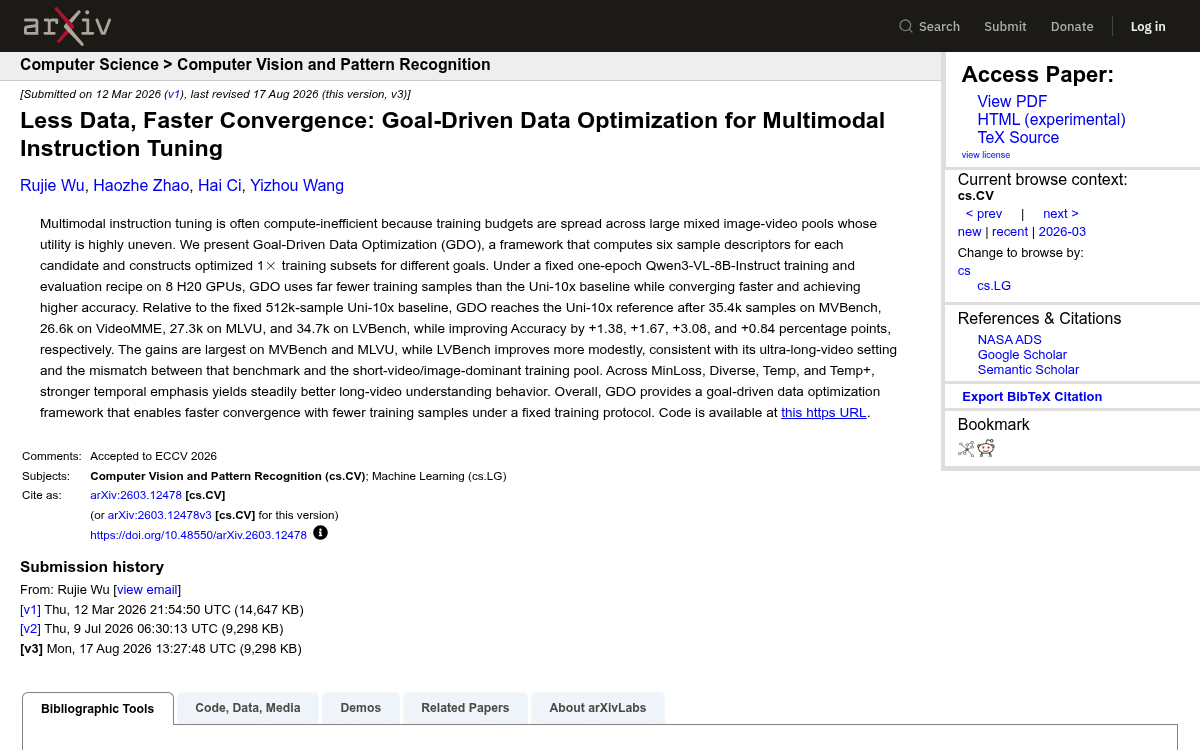
Relative to a fixed 512k-sample uniform baseline, GDO reaches the reference score after 35.4k samples on MVBench, 26.6k on VideoMME, 27.3k on MLVU, and 34.7k on LVBench, while improving accuracy by +1.38, +1.67, +3.08, and +0.84 percentage points respectively. That is the kind of efficiency gain that changes how you plan a fine-tuning run.
The allocation problem nobody was solving cleanly
The core observation is that mixed image-video instruction pools are large, redundant, and heterogeneous, and the value of one more training example is far from uniform. Some samples reinforce patterns the model already knows. Others carry the temporal evidence or ordering pressure that actually shifts downstream behavior. Existing tools like curriculum learning, sample reweighting, active selection, and data valuation all touch this problem, but what has been missing in multimodal instruction tuning is a reusable interface that separates data-optimization effects from changes in model, optimizer, or evaluation recipe.
GDO addresses that gap by holding everything else fixed. The model, training recipe, checkpoints, and evaluation stay constant, and only the training data changes. This makes any observed performance shift cleanly attributable to data allocation rather than confounded by other tweaks.
Six descriptors that score every candidate sample
For each candidate, GDO computes a six-dimensional descriptor vector. These descriptors capture different aspects of training value:
- Flow: average optical-flow magnitude across adjacent frames, measuring how much visible motion the clip actually contains.
- VDS (video-dependence score): the blind-vs-video loss gap, evaluating the same question-answer pair twice, once without visual input and once with the video frames. A larger VDS means the answer loss drops more when the video is available, so the sample is more genuinely video-dependent.
- Temporal necessity: a temporal-necessity judgment from the probe model, indicating whether the question requires ordering, change, duration, or cross-frame reasoning rather than a static visual lookup.
- Self-consistency: mean pairwise Jaccard similarity across repeated sampled answers to the same input, measuring how stable the supervision signal is.
- PPL-like difficulty: the exponentiated teacher-forced video-conditioned loss, serving as a raw optimization-difficulty signal.
- Coverage: a signal derived from text/vision clustering and source statistics, reflecting both semantic density and source repetition.

These feed into a shared scoring function that ranks candidates, and then goal-specific feasibility presets decide which ranked candidates actually make the cut. A pure global sort would over-select abundant, linguistically clean image QA and under-select rarer but more informative temporal video samples, so the feasibility layer enforces modality mix, temporal coverage, and source breadth.
Four goal profiles, one spectrum
GDO ships four preset profiles that share the same scoring backbone but differ in budget and composition constraints:
- MinLoss favors the easiest-to-fit supervision under the smallest budget (12.9k) and applies the lightest temporal and video pressure.
- Diverse uses a larger subset (42.9k) with stronger source floors, making it the most conservative profile against collapse onto only the easiest samples.
- Temp allocates 33.3k samples while raising the target video ratio and temporal-positive coverage.
- Temp+ increases both subset size and temporal pressure (53.3k, 58.7% selected video), making it the strongest temporal profile.
The training setup itself is deliberately vanilla: one fixed one-epoch Qwen3-VL-8B-Instruct SFT recipe on 32 H20 GPUs with batch size 1 per GPU and global batch size 32. The candidate pool is the full LLaVA-OneVision image-QA data plus the full LLaVA-Video short-video QA data.
Where the gains actually land
The benchmark pattern tells you where this approach shines and where it doesn't. MVBench and MLVU respond most strongly because they are organized around relatively focused subtasks, so a better allocation of motion-sensitive, order-sensitive, and temporally informative supervision translates more directly into score gains.
Some subtask deltas are striking. With Temp+, VideoMME Temporal Perception jumps by +18.18 pp, MLVU SportsQA by +11.11 pp, and MVBench Counterfactual Inference by +8.5 pp over the uniform baseline. These aren't scattered wins either. The gains cluster around the capabilities targeted by stronger temporal data optimization.
The honest limitations
LVBench is the clearest boundary case. Its improvement is smaller because it evaluates ultra-long videos, often much longer than the clips represented in LLaVA-Video, while the training pool also contains a large amount of image QA from LLaVA-OneVision. In other words, GDO cannot conjure supervision that doesn't exist in the pool.
The authors are explicit about this: GDO should not be read as a universal recipe whose gains are independent of the candidate pool. It is a fixed-contract allocator whose effect depends on whether the pool contains examples that can support the target capability. If your target task needs 30-minute videos and your pool is full of 30-second clips, no amount of clever scoring will fix that.
An ablation on Temp+ also revealed that no single descriptor is doing all the work. On VideoMME, removing VDS or the PPL-like term costs about one point. On MVBench and especially MLVU, removing self-consistency hurts more. The joint removal is more damaging on MVBench than any individual ablation. This is a combination effect, not a single silver bullet.
What is available
The code is open source at github.com/rujiewu/GDO. The pipeline is deterministic and staged, meaning descriptor extraction, scoring, and subset construction can be reproduced end to end. For anyone running video-heavy fine-tuning on Qwen3-VL or similar backbones, this is a concrete recipe for spending fewer GPU hours without giving up benchmark performance, provided your candidate pool actually contains the capability you want to teach.