
Peking University's EvolvR Beats GPT-o3 at Judging AI-Written Stories
A new framework teaches open-source models to judge stories through pairwise reasoning, then loops back to improve story generation itself.
 Pro
Takeaways
- EvolvR trains open-source story evaluators using pairwise comparison and self-synthesized Chain-of-Thought rationales.
- A four-stage agent pipeline filters 800K CoTs down to 536K high-quality, logically consistent examples.
- Achieves SOTA on StoryER, HANNA, and OpenMEVA, beating GPT-o3, Gemini-2.5-Pro, and Claude-4-opus.
- Used as a GRPO reward model, it lifts story generation to a 64% win rate over the base Qwen2.5-7B.
- Pairwise CoT training consistently beats pointwise CoT and direct GRPO across Qwen3 and LLaMA-3.1 base models.
- Code will be released at github.com/xindaaW/EvolvR.
Judging creative writing is one of the last places where LLM-as-a-judge still stumbles. A story has plot, character, surprise, and empathy woven together, and asking a model to slap a 1-to-5 score on all of that tends to produce inconsistent, poorly justified numbers. A team from Peking University, Alibaba, and Lanzhou University has proposed EvolvR, a self-evolving framework that trains open-source models to reason about stories pairwise and then reuses that evaluator as a reward model to make a generator write better fiction.
Why story scoring keeps breaking
Two roads have dominated automatic story evaluation, and both hit walls. Prompt engineering for proprietary models offers flexibility, but its results can be unstable and generalize poorly, while fine-tuning open-source evaluators tends to inherit paradigms built for generic NLG tasks that miss the fine-grained demands of narrative judgment. Even specialized story evaluators like Coke are trained on human judgments without a step-by-step reasoning process, thereby limiting their potential as a high-fidelity judge.
The authors' first design choice is to abandon absolute scoring in favor of pairwise comparison, i.e., asking the model which of two stories is better on a given axis. They back this with an inter-annotator study on the HANNA dataset showing pairwise agreement beats pointwise on five of six dimensions, with Coherence jumping 21.9% and Relevance 12.5%. Humans, it turns out, are more consistent when they compare than when they rate.
Growing chains of thought that actually match the scores
EvolvR builds a training corpus by having an LLM write its own Chain-of-Thought rationales for story pairs, then aggressively filtering them. The interesting part is how they force reasoning quality up.

The synthesis uses five distinct personas: Academic, Artist, Pragmatist, Sharp-Tongued Reader, and Casual Netizen, each with its own linguistic style and evaluation angle. For every seed pair with known ground-truth scores, each persona drafts a candidate rationale, producing a giant pool of noisy CoTs. To fight positional bias, every pair is also generated in swapped order.
Then comes the filtering pipeline, run as four agent operators in sequence:
- Self-Rulecheck: regex-parses the scores stated in the rationale and drops anything that does not exactly match ground truth.
- Self-Refinement: the model rewrites its own rationale for clarity without changing the verdict, then gets re-checked by the rule agent.
- Self-Attack: the scores in the rationale are flipped to contradict the reasoning, and the model must detect the contradiction. If it cannot, the reasoning was too generic to trust.
- Self-Confidence: the logits are inspected to confirm the model actually assigns highest probability to the ground-truth score token conditioned on the rationale.
The attrition is brutal and deliberate. Starting from 800,000 candidate CoTs, only about 536,000 survive, a 67% pass rate that the authors argue is the price of logical rigor.
The numbers
Trained on this refined data, a Qwen2.5-7B-Instruct evaluator hits state of the art on three benchmarks: StoryER, HANNA, and OpenMEVA. On HANNA the Pearson correlation with human ratings jumps from 0.187 (base model) to 0.616, beating GPT-o3 (0.484), Gemini-2.5-Pro (0.500), and Claude-4-opus (0.487). On StoryER, EvolvR reaches 0.677 Pearson versus 0.568 for GPT-o3.
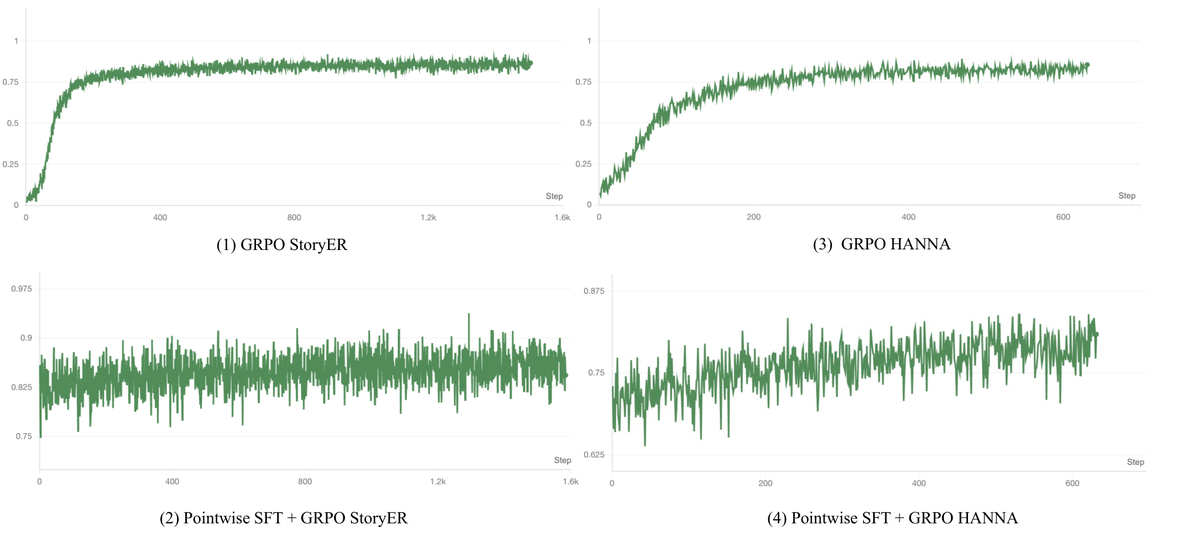
A revealing ablation across Qwen3-4B/8B/14B and LLaMA-3.1-8B shows pairwise CoT fine-tuning consistently beats pointwise CoT, and both crush direct GRPO on the base model. The authors note that applying GRPO directly to the base models yields limited performance gains, and in some cases, almost no improvement at all, blaming reward hacking where the model just predicts the most frequent scores in the dataset.
Closing the loop into generation
The evaluator is then plugged in as a reward model for GRPO fine-tuning of a Qwen2.5-7B story generator. The reward blends three signals: how much the candidate beats a reference story, its absolute quality across six dimensions, and a length term. Four professional screenwriters scored the outputs.
EvolvR-guided GRPO reaches a 64.4% win rate against the untuned base model and 31.6% against human-written HANNA stories, with the highest average score (3.59) across Relevance, Surprise, Engagement, and Complexity. A curious finding: pairing the rollout with another base-model story as reference works better than pairing with a human story, likely because the reward model compares style-similar drafts more precisely.
Where it helps, where it does not
The framework is genuinely useful if you need a reference-free story judge or a narrative reward model for RLHF-style creative writing pipelines. Unlike TIGERScore or InstructScore, it does not require a ground-truth reference text, which matters because in creative writing there is no single correct answer.
The caveats are real though. Coherence actually drops slightly under GRPO training with either reward model, suggesting the reward signal pushes toward surface novelty at the cost of tight structure. Inter-expert reliability on subjective axes like Surprise sits around 0.49 Pearson, so even the human ground truth is noisy. And the evaluator's own stability depends on aggregating multiple pairwise comparisons per story, which adds inference cost compared to a single pointwise call.
Getting it
The authors state code will be released at github.com/xindaaW/EvolvR. The full paper with prompts, ablations, and case studies is on arXiv. If you are building narrative generation systems, the recipe is portable: swap the persona prompts, keep the four-agent filter, and you have a template for training rigorous judges in any subjective domain where pairwise beats pointwise.