
Peking University's EfficientNav Beats GPT-4 Robot Navigation at 6.7x Lower Latency
A new framework runs zero-shot object-goal navigation on a Jetson Orin using smaller LLMs, beating GPT-4 planners on HM3D with 4.7x lower end-to-end latency.
 Pro
Takeaways
- EfficientNav runs zero-shot object-goal navigation on a Jetson Orin using LLaMA-3.2-11B or LLaVA-34B locally.
- Achieves 80.0% success rate on HM3D, an 11.1-point gain over GPT-4-based LFG baseline.
- Delivers 6.7x lower per-step latency and 4.7x lower end-to-end latency than GPT-4 planner.
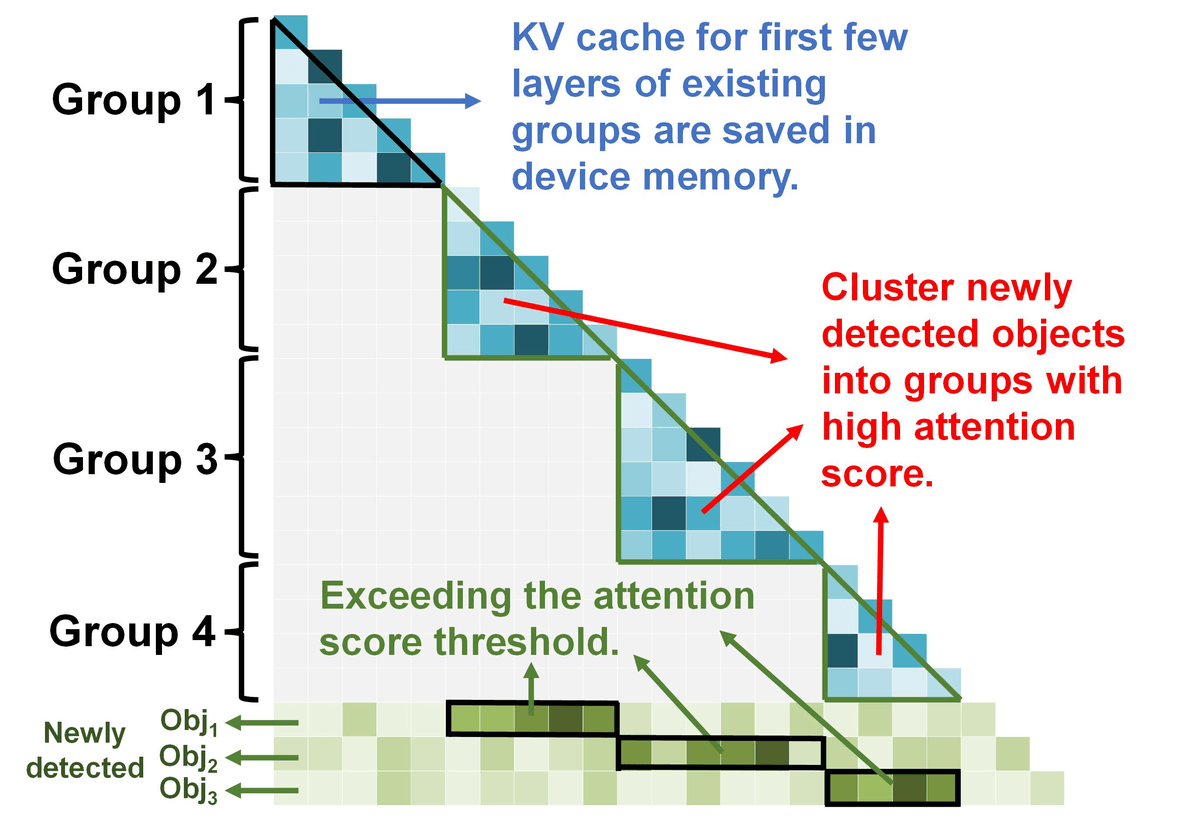
- Discrete memory caching splits KV cache into groups so it can be reused across planning steps without recomputation.
- CLIP-based semantics-aware retrieval selects relevant groups via a knapsack solver adapted to device memory budget.
- Code, install instructions, and pipeline available at PKU-SEC-Lab/EfficientNav on GitHub.
Object-goal navigation, where a robot has to find a specific item like a TV or a toilet in an unfamiliar house, has quietly become one of the more demanding testbeds for language models. The best zero-shot systems today lean on GPT-4 running in the cloud, which introduces network latency, privacy exposure, and running costs that make real deployment awkward. A team from Peking University, SCUT, and the Shenzhen Institute of AI and Robotics has published EfficientNav, a framework that pushes the whole planning stack onto a local device and, somewhat surprisingly, beats GPT-4 based baselines on the standard benchmark.
The headline numbers: an 11.1% absolute improvement in success rate on HM3D over a GPT-4 planner, 6.7x lower real-time latency per planning step, and 4.7x lower end-to-end latency to complete a task. All of it runs with LLaMA-3.2-11B or LLaVA-34B as the planner, targeted at hardware like the NVIDIA Jetson AGX Orin with 32GB of DRAM.
Why smaller LLMs choke on navigation maps
Modern zero-shot navigation agents build a graph-based semantic map as they explore. Detected objects and their positions get serialized into a text prompt, the LLM picks the next sub-goal, and the process repeats. The prompt grows linearly with exploration, quickly reaching thousands of tokens.

Two compounding problems then hit a device with tight memory. The KV cache for the map description balloons past what the Orin can hold once the model weights are loaded, forcing expensive recomputation on every planning call. A giant model will not fit in the first place, so you drop to something like LLaMA-3.2-11B, and smaller planners simply lose the plot when the map gets busy. The paper shows that as navigation progresses, attention on the ground-truth sub-goal object dilutes across the growing map, and the planner starts picking bad next steps.